Focus Keyword:China banks capital boost
Related Keywords:
- China banks
- China bank recapitalization
- China financial system
- Chinese state banks
- China insurers
- bank capital injection
- net interest margin
- China banking crisis
- China economic stimulus
- Chinese banks solvency
- ICBC
- Agricultural Bank of China
- China Life Insurance
Image ALT Text:China banks capital boost to strengthen state lenders and insurers
China Banks Get $54B Boost as Profit Risks Rise
China is moving to strengthen its financial system with a major China banks capital boost worth about 360 billion yuan, or roughly $53.6 billion. The package targets major state-owned banks and insurers as Beijing attempts to reinforce financial stability, support lending and improve the ability of large institutions to absorb economic shocks.
The move comes as Chinese financial institutions face a difficult combination of low interest rates, weak loan demand and pressure on profitability. Net interest margins, a key measure of banking profitability, remain close to historic lows, limiting the ability of lenders to build capital through retained earnings. SSouth China Morning Post+1
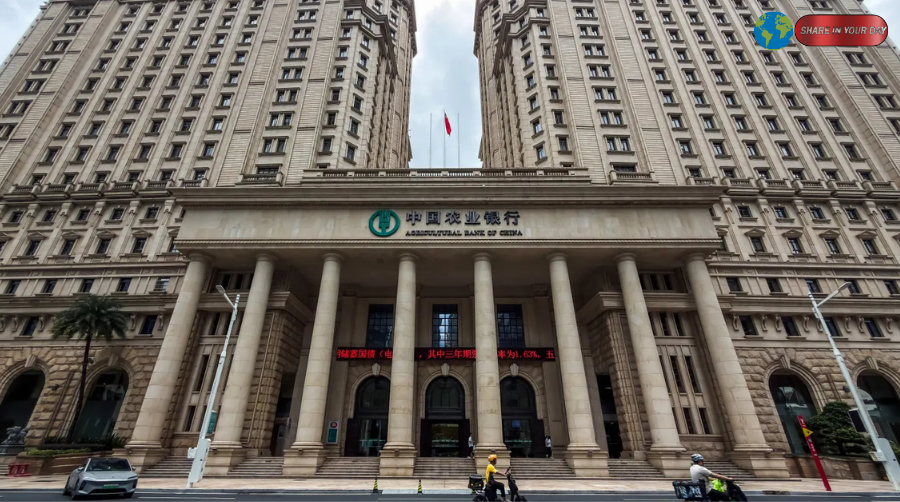
The scale of the latest intervention is significant. The Ministry of Finance is expected to provide 300 billion yuan through special bonds, while state-linked entities including China National Tobacco will contribute additional funds. The broader package involves eight major financial institutions. CChina Daily Asia+1
China Banks Capital Boost Targets Financial Stability
The immediate objective of the China banks capital boost is to strengthen the balance sheets of strategically important financial institutions.
Three major banks are included in the package, with Agricultural Bank of China and Industrial and Commercial Bank of China among the largest beneficiaries. The Export-Import Bank of China is also included.
The insurance sector is receiving attention as well.
China Life Insurance Group is set to receive 35 billion yuan, while China Taiping Insurance Group is expected to receive 7 billion yuan. People’s Insurance Company of China is also planning a capital raising. RReuters+1
The inclusion of insurers is particularly noteworthy because the government has historically focused more heavily on supporting the banking sector.
Analysts say the additional capital could reduce solvency pressure and give insurers greater flexibility to make long-term investments, including in equities. RReuters
Why China Is Injecting Capital Into Banks
China’s financial institutions remain large and systemically important, but they are operating in a challenging environment.
Banks depend heavily on the difference between what they earn from loans and what they pay on deposits. That difference is known as the net interest margin, or NIM.
When lending rates decline while banks still face funding costs, margins become compressed.
Recent data show just how difficult the environment has become. The average NIM for China’s commercial banks was about 1.41% in the second quarter of 2026, only slightly higher than 1.40% in the first quarter. SSouth China Morning Post
That tiny improvement does not eliminate the broader problem.
Weak demand for new loans also limits opportunities for banks to grow interest income. At the same time, policymakers want lenders to continue providing financing to businesses and other parts of the economy.
This creates a difficult balancing act.
Banks must remain profitable and adequately capitalized while simultaneously supporting economic activity through relatively inexpensive credit.
Low Margins Are Becoming a Structural Problem
The pressure on Chinese banks is not simply a short-term market fluctuation.
The country’s broader economic model has relied heavily on bank lending. State-owned lenders have historically played an important role in directing credit toward infrastructure, state-owned enterprises, manufacturing and other strategic sectors.
But weaker loan demand and lower interest rates can make that model increasingly difficult to sustain.
Average lending rates have fallen toward 3%, while the banking industry’s average NIM has remained around historically low levels. BBOFIT
For banks, this matters because capital can no longer be accumulated as easily through strong earnings growth.
That makes direct recapitalization more important.
The latest package therefore represents more than a simple liquidity measure. It is an attempt to strengthen the financial system’s capital foundation while allowing large lenders to continue performing their policy role.
Is China Facing a Banking Crisis?
The China banks capital boost should not automatically be interpreted as evidence that China’s largest banks are on the verge of collapse.
The country’s banking sector remains enormous, and official data indicate that banking institutions held around 480 trillion yuan in assets as of the latest available regulatory statistics. NNational Energy Administration
The purpose of recapitalization is to improve resilience before problems become more severe.
That distinction is important.
Governments frequently recapitalize strategically important financial institutions to increase their ability to withstand losses, expand lending or comply with changing capital requirements.
China’s approach is particularly influenced by the large role played by state-owned banks in the economy.
However, the need for repeated capital support does highlight underlying challenges.
The financial sector is being asked to maintain credit growth while operating with weaker margins. At the same time, China’s economy is dealing with slower domestic demand, property-sector problems and uneven private-sector investment.
Those pressures can eventually affect bank asset quality.
$54 Billion Package Includes Banks and Insurers
The overall package is valued at approximately 360 billion yuan, equivalent to about $53.6 billion.
The structure is important because the money is not going exclusively to commercial banks.
Five insurance groups and three banks are included, according to reports on the government’s recapitalization plans. RReuters+1
The Ministry of Finance is expected to contribute 300 billion yuan through special government bonds.
China National Tobacco and other state-linked entities are expected to provide another 60 billion yuan in connection with the bank capital raising. CCtol Digital+1
The funds are designed to strengthen core capital rather than simply provide temporary liquidity.
That distinction matters.
Liquidity support helps institutions meet short-term funding requirements. Capital injections, by contrast, strengthen their ability to absorb losses and expand their balance sheets.
Agricultural Bank and ICBC Are Key Beneficiaries
Agricultural Bank of China and ICBC are among the most important institutions involved in the latest move.
Agricultural Bank is seeking up to 160 billion yuan through a private placement, while ICBC is targeting up to 100 billion yuan. The Ministry of Finance is expected to subscribe to significant portions of both offerings. NNDTV Profit
The capital is intended to replenish core Tier 1 capital.
That is one of the most important forms of bank capital because it provides a fundamental buffer against losses.
For Beijing, strengthening these institutions has broader economic significance.
Large state-owned banks are not only commercial businesses. They are also major channels through which government policy reaches companies, households and strategic industries.
A stronger capital position gives them more room to provide credit without weakening regulatory capital ratios.
China Insurers Face Their Own Capital Pressure
The insurance component of the package deserves equal attention.
China’s large insurers have faced pressure from low interest rates and changing investment conditions. Lower yields can make it more difficult for insurers to generate investment returns while meeting long-term liabilities.
The government therefore has an additional reason to strengthen their balance sheets.
According to analysts cited by Reuters, the recapitalization could reduce short-term solvency pressure and increase insurers’ capacity for long-term equity investments. RReuters
That could have implications beyond the insurance sector.
Chinese insurers are large institutional investors. If stronger capital positions allow them to increase allocations to stocks, the policy could indirectly support China’s equity markets.
Analysts estimate the recapitalization could eventually enable a significant increase in insurers’ equity exposure. RReuters
Could the Capital Boost Help China’s Stock Market?
One potential consequence of the China banks capital boost is increased support for the domestic stock market.
The government has been encouraging long-term institutional investors to participate more actively in Chinese equities.
Insurers are particularly important because they have large pools of long-duration capital.
If recapitalization improves their solvency ratios and investment flexibility, insurers could have greater capacity to allocate funds to equities.
That does not mean the entire 360 billion yuan will flow directly into stocks.
Most of the money is designed to strengthen institutional balance sheets.
Nevertheless, healthier capital positions could create additional room for investment over time.
The policy therefore has a dual objective: strengthen financial stability while encouraging financial institutions to play a larger role in supporting capital markets.
Investors Initially See a Mixed Signal
The market reaction illustrates the complexity of the announcement.
Rather than immediately celebrating the recapitalization, investors also focused on the possibility of dilution and the underlying pressure that made the capital raising necessary.
Shares of major banks including ICBC and Agricultural Bank fell in Hong Kong following the announcement, according to the Financial Times. FFinancial Times
That reaction is understandable.
For shareholders, new equity issuance can dilute existing holdings.
At the same time, stronger capital positions can reduce long-term financial risk.
The market therefore has to weigh two opposing factors: short-term dilution versus improved resilience.
Beijing Is Moving From Monetary Support Toward Fiscal Support
The latest package also signals something important about China’s economic policy.
Instead of relying entirely on conventional monetary easing, Beijing is increasingly using fiscal resources to strengthen strategically important financial institutions.
The Ministry of Finance’s planned 300 billion yuan contribution through special bonds is a clear example.
The approach effectively transfers government financial resources into the capital base of major institutions.
That can help banks maintain lending capacity without requiring them to generate all additional capital internally.
It also reflects the government’s desire to keep credit flowing even when private-sector loan demand remains relatively subdued.
What the China Banks Capital Boost Means for the Economy
The immediate economic objective is straightforward: strengthen financial institutions so they can continue lending.
But the longer-term impact depends on what happens to China’s underlying economy.
If stronger banks can support productive private investment, infrastructure and consumer activity, the recapitalization could help generate broader growth.
If loan demand remains weak, however, stronger capital alone will not solve the problem.
Banks can have more capacity to lend without necessarily finding enough profitable borrowers.
That is why the recapitalization should be viewed as one component of a broader economic strategy.
China still faces challenges involving domestic consumption, property markets, business confidence and investment.
The Bigger Risk Is Prolonged Low Profitability
The most important issue for investors may not be whether Chinese banks have enough capital today.
It is whether they can generate sufficient returns over the next several years.
Persistently low NIMs can weaken profitability.
Weak profitability can slow organic capital accumulation.
That can eventually increase the need for external recapitalization.
The latest package helps address the capital side of the equation, but it does not automatically resolve the underlying earnings problem.
For that, China’s banks need a healthier combination of loan demand, pricing power and economic growth.
What Happens Next?
The success of the program will depend on how effectively the new capital is deployed.
For banks, investors will watch loan growth, asset quality, NIMs and capital ratios.
For insurers, attention will focus on solvency ratios, investment returns and equity-market exposure.
The broader question is whether the recapitalization can help China’s financial system transition from balance-sheet support toward stronger organic growth.
The government’s willingness to deploy tens of billions of dollars shows that financial stability remains a major policy priority.
But the size of the intervention also demonstrates how difficult the current environment has become for traditional financial institutions.
Bottom Line
China’s $54 billion financial-sector recapitalization represents one of Beijing’s most significant efforts in years to strengthen major state-owned banks and insurers.
The immediate goal is not simply to prevent a banking failure. Instead, the policy is designed to increase capital buffers, support lending, reduce solvency pressure and give financial institutions greater capacity to support economic growth. RReuters+1
The move comes at a critical time.
Chinese banks are operating with historically low net interest margins, while insurers are under pressure from low rates and investment challenges. At the same time, policymakers want financial institutions to provide more support to the economy and domestic capital markets.
The capital injection can strengthen the system’s defenses.
However, it cannot by itself eliminate the structural pressures facing China’s financial sector.
The next test will be whether stronger balance sheets translate into healthier lending, improved profitability and greater confidence across the broader economy.
Suggested Internal Links
Because no target domain was supplied, use your own relevant pages at these locations:
- China economy news — link from the section discussing economic growth.
- Global banking news — link from the section on bank capital and NIM.
- China stock market — link from the section discussing insurer equity investments.
- Asian markets — link from the section discussing investor reaction.
- China financial sector — link from the conclusion.
Recommended External Sources
- Reuters — China financial-sector recapitalization
- Reuters — China insurer capital injections
- China National Financial Regulatory Administration
- Financial Times — China banks and insurers recapitalization