Portsmouth Protest: Minister Issues Stark Warning After Riot
A Portsmouth protest over the arrival of about 120 migrants in the UK has triggered a strong government response after several police officers were injured and vehicles were damaged during disorder at a harbour in the city. Policing Minister Sarah Jones told MPs that threatening behaviour and serious disruption would not be tolerated.
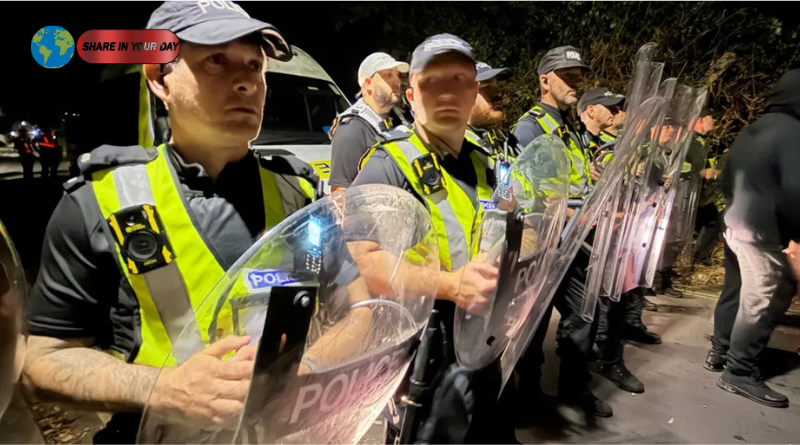
The confrontation happened on Sunday evening after a boat carrying approximately 120 people reached British waters near the Isle of Wight. The group was directed by the RNLI, under the direction of HM Coastguard, towards Eastney Marina in the Portsmouth area.
Later that evening, more than 200 protesters gathered at the harbour. According to the government, some protesters wore face coverings and attempted to prevent coaches from leaving with the migrants for processing.
Police used dispersal powers and, according to the policing minister, officers were forced to use batons and PAVA spray after some protesters became aggressive. The crowd began dispersing at about 4am, allowing the coaches to leave.
Portsmouth Protest Escalates After Migrant Boat Arrival
The Portsmouth protest followed the arrival of an unusually large boat carrying migrants across the English Channel.
The incident was notable because the boat reached the UK considerably farther west than the locations more commonly associated with small-boat crossings.
Government officials said the boat was carrying around 120 people and reached British waters near the Isle of Wight on Sunday afternoon. The RNLI subsequently assisted with the response and directed the vessel towards Eastney Marina.
The arrival quickly became a focus of local and national political debate.
By approximately 8pm, more than 200 protesters had gathered at the harbour. The government said their intention was to block three coaches that were due to transport the arrivals for processing.
The confrontation created a major public-order operation involving Hampshire and Isle of Wight Constabulary and neighbouring police forces.
Police officers formed lines to prevent protesters from reaching the coaches. Officers subsequently used batons and PAVA spray as tensions escalated.
Several officers were injured during the unrest, while official vehicles were also damaged. Police are now investigating the incident and attempting to identify those suspected of committing offences.
Sarah Jones Condemns Portsmouth Protest Disorder
Policing Minister Sarah Jones delivered a statement to the House of Commons on Monday, condemning what she described as intimidating and thuggish behaviour.
She stressed that peaceful protest remains an important democratic right. However, she said that right does not extend to threatening behaviour or serious disruption.
Jones warned that anyone crossing the line from peaceful protest into illegality would face the consequences of the law.
The minister also confirmed that investigations into the Portsmouth incident remain ongoing.
No arrests were made during the night of the protest, but authorities are continuing to examine what happened and identify people who may have committed offences.
The government has also begun reviewing the police response to the weekend’s events.
Jones said lessons were being established and that intelligence needed to be shared more quickly across the law-enforcement system.
Portsmouth Protest Follows Disorder in Dover
The events in Portsmouth were not isolated.
A day earlier, a separate demonstration took place around the Port of Dover in Kent.
The government said approximately 150 people arrived at the port early on Saturday morning, with many wearing face coverings. Kent Police responded rapidly to what was described as a “no-notice” protest.
The Dover demonstration caused disruption to local residents, workers, motorists and ferry passengers.
Although no arrests were made, the crowd remained at the port for several hours before dispersing.
The timing of the Dover protest and the subsequent Portsmouth protest has raised questions about whether groups opposed to small-boat crossings are coordinating demonstrations across southern England.
The government has said it is examining the connection between the events and reviewing how intelligence was shared between police forces.
Why the Portsmouth Protest Has Raised Security Concerns
The incident has attracted particular attention because Portsmouth is not normally one of the principal points associated with Channel migrant arrivals.
The arrival of a boat carrying more than 100 people at a location farther west along the southern English coast has prompted concern among authorities about whether people-smuggling routes are changing.
In her Commons statement, Jones described the use of larger boats carrying more than 100 people as a clear concern.
She also warned that authorities remained alert to crossings using less frequently targeted sections of Britain’s coastline.
The concern is not limited to immigration policy.
A new arrival location can create additional demands for police, emergency services, local authorities and immigration officials. The response can also require officers from neighbouring forces to be deployed at short notice.
Hampshire Police and Crime Commissioner Donna Jones said the Portsmouth incident placed pressure on police resources, with hundreds of officers involved in managing the situation.
She said police had done an excellent job maintaining control but argued that Portsmouth should not become a destination for people traffickers.
Police Face Questions After Portsmouth Protest
The police response has also become part of the wider political debate.
The government has promised to examine what happened during the weekend and determine whether intelligence was shared quickly enough.
The issue is particularly important because the Dover demonstration occurred only a day before the unrest in Portsmouth.
The Home Office has said law-enforcement agencies are working to ensure relevant intelligence is shared rapidly.
The government has also backed the police response and praised officers who worked through the night.
The challenge for police is complicated by the distinction between lawful protest and criminal behaviour.
People have a legal right to demonstrate peacefully. However, police can intervene when demonstrations involve violence, serious disruption, criminal damage or threats to public safety.
Jones emphasized that balance in her parliamentary statement, saying peaceful protest must be defended while citizens must also be able to go about their lives without undue interference.
Portsmouth Protest Fuels Wider Immigration Debate
The confrontation has also intensified Britain’s already heated debate over immigration.
Small-boat crossings have become one of the most politically sensitive issues in the UK.
Supporters of tougher immigration controls argue that continued Channel crossings undermine border security and encourage organised smuggling networks.
Others warn that political frustration should not turn into hostility towards migrants or emergency responders.
The government has attempted to address both issues by combining stronger enforcement against people-smuggling gangs with measures intended to reduce irregular migration.
In Parliament, Jones said the government had doubled the number of National Crime Agency officers working against organised immigration crime.
She also said system-wide arrests were up by 70%, while more than 1,100 boats and engines had been seized. According to the minister, cooperation with French authorities had helped prevent more than 48,000 attempted crossings.
The figures are part of the government’s broader argument that enforcement measures are beginning to reduce crossings.
However, the Portsmouth incident demonstrates how quickly local tensions can escalate when a large migrant arrival occurs outside the areas normally associated with Channel crossings.
Government Says Small-Boat Arrivals Are Falling
Despite the latest confrontation, the government says overall small-boat arrivals have fallen compared with previous years.
Jones told MPs that this summer recorded the lowest number of small-boat arrivals since 2020.
She also said crossings so far in 2026 were down by more than 43% compared with the previous year.
The government has attributed the decline partly to increased enforcement and cooperation with France.
It says more than 6,000 small-boat returns have taken place since the election, while more than 80,000 illegal migrants and foreign criminals have been removed from the UK.
The government also says its new cooperation arrangements with France include increased personnel, surveillance technology and specialist units.
However, ministers acknowledge that people-smuggling groups are adapting.
The appearance of a large boat farther west along the English Channel could therefore become an important test of the government’s ability to respond to changing tactics.
What Happens Next After the Portsmouth Protest?
The immediate focus is now on the police investigation.
Authorities are working to identify protesters suspected of assault, criminal damage or other offences.
Police are expected to examine footage from the scene as part of the investigation. Officers will also assess whether additional criminal offences took place during the confrontation.
The government is simultaneously reviewing the wider public-order response.
One key question will be whether police forces received sufficient warning about the demonstrations.
Another will be whether intelligence about planned protests can be shared more effectively between forces in different parts of southern England.
The government will also need to consider whether changing migrant routes require additional contingency planning.
The arrival of 120 people in a single boat near the Isle of Wight represented an unusual challenge for local authorities. The subsequent Portsmouth protest added another layer of pressure.
Portsmouth Protest Highlights a Growing Challenge
The events in Portsmouth highlight the difficult intersection between immigration, policing, public protest and local community tensions.
The arrival of migrants created immediate operational demands for emergency services and immigration authorities. The protest that followed then required a significant police presence to maintain order.
For the government, the challenge is twofold.
It must demonstrate that Britain’s borders are being controlled and that people-smuggling networks are being disrupted. At the same time, it must ensure that public frustration does not result in violence, intimidation or attacks on police officers and emergency workers.
The Portsmouth events also underline the unpredictable nature of Channel migration.
If larger boats begin using different departure points and arrival routes, authorities could face similar situations in other coastal communities.
The government says it is prepared to adapt.
Jones told MPs that people-smuggling gangs would continue changing their tactics and that enforcement agencies must respond accordingly.
For residents, meanwhile, the priority is likely to remain public safety and the ability to go about daily life without disruption.
Conclusion: Portsmouth Protest Puts Pressure on Government
The Portsmouth protest has become the latest flashpoint in Britain’s continuing debate over Channel crossings and immigration.
More than 200 protesters gathered after approximately 120 migrants reached the UK in a single boat. The demonstration later descended into disorder, with police officers injured and vehicles damaged.
Policing Minister Sarah Jones has condemned the behaviour and promised that people responsible for criminal activity will face the consequences.
At the same time, authorities are investigating whether intelligence-sharing and police planning could have been improved.
The incident also raises broader questions about the future of Channel crossings.
If people-smuggling networks increasingly use larger boats and less familiar routes, towns such as Portsmouth could find themselves dealing with arrivals that have previously been concentrated elsewhere.
For now, police investigations remain underway and the government is reviewing the weekend’s events.
What happens next could influence not only the response to future migrant arrivals, but also how authorities manage increasingly tense demonstrations over Britain’s immigration system.