Bitcoin Defies Tech Selloff as AI Fears Shake Stocks

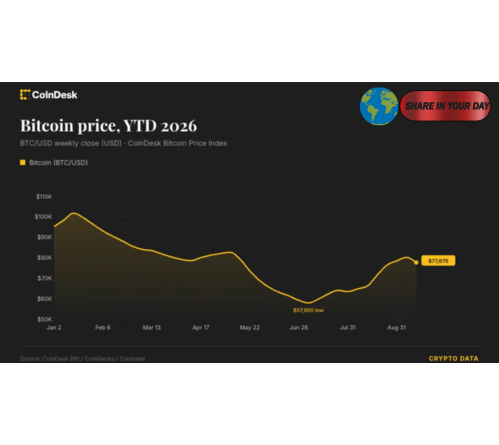
Bitcoin rose above $77,000 on Monday as technology stocks came under renewed pressure from growing concerns about the safety and pace of artificial intelligence development. The move marked a notable divergence between the cryptocurrency and risk-sensitive technology shares, as investors reassessed the outlook for the booming AI industry. CCoinDesk+1
The cryptocurrency was trading around the $77,000-$78,000 area during Monday’s session, according to market data, while investors continued to monitor a difficult backdrop for global markets. Bitcoin’s resilience came as Nasdaq 100 futures fell sharply and AI-linked equities faced selling pressure following calls from prominent technology executives to slow the development of increasingly powerful AI systems. CCoinDesk+1
The contrast is significant because Bitcoin and technology stocks have frequently traded in the same direction in recent years. Both assets can attract investors seeking exposure to higher-growth opportunities, but Monday’s action suggested that traders were beginning to distinguish between risks affecting the AI sector and the broader digital-asset market.
Bitcoin Holds Above $77,000 as Stocks Retreat
Bitcoin’s ability to remain above $77,000 stood out against a broader deterioration in technology sentiment.
CoinDesk reported that Bitcoin climbed above $77,000 while calls for a slower approach to AI development weighed on technology shares. At the same time, rising oil prices added another source of pressure to global markets. CCoinDesk
Other market data showed Bitcoin around $77,590 during Monday trading, representing a modest gain and a partial recovery from recent weakness. The cryptocurrency nevertheless remained below the psychologically important $80,000 level. BBarron’s
That distinction matters. Bitcoin’s rise was not necessarily evidence of a new breakout. Instead, it showed that sellers were not able to push the asset lower despite several unfavorable macroeconomic and market developments.
Bitcoin had also been struggling to regain momentum after a period of volatility. CryptoQuant recently identified $81,700 as an important resistance level that Bitcoin would need to overcome to confirm a stronger bullish trend. The research firm also identified potential support around $70,000 and a deeper support zone between $62,000 and $65,000. TThe Block
As a result, traders may continue to treat the $77,000 area as an important battleground rather than assuming Monday’s move represents the beginning of another major rally.
AI Safety Concerns Trigger Technology Selloff
The immediate catalyst for the weakness in technology stocks was a growing debate about whether the AI industry is moving too quickly.
Executives and prominent figures across the AI industry have recently warned that the development of increasingly capable systems needs stronger safety controls. Anthropic CEO Dario Amodei called for a slower approach, while OpenAI CEO Sam Altman and other major AI figures also expressed concerns about the risks associated with rapid AI advancement. TThe Guardian+1
Investors responded by reassessing companies that have benefited from enormous expectations surrounding AI.
Nasdaq 100 futures fell about 1.72% early Monday, according to Reuters, while several AI-linked companies faced significant declines. Semiconductor companies were particularly vulnerable because their valuations and growth expectations are closely tied to continued investment in AI data centers and computing infrastructure. Reuters
The concern is straightforward.
If AI development slows, companies may delay or reduce spending on data centers, advanced chips, networking equipment and related infrastructure. That could affect the revenue expectations supporting some of the technology industry’s highest valuations.
However, a slowdown in AI development does not necessarily mean that artificial intelligence itself is disappearing.
The technology is already being integrated into search, software, cloud computing, cybersecurity, enterprise applications and consumer products. The debate is increasingly about the speed of investment and development rather than whether AI has commercial value.
Why Bitcoin Is Behaving Differently
Bitcoin’s relative strength raises an important question: Why is the cryptocurrency holding up while technology stocks are selling off?
One explanation is portfolio diversification.
Investors have become heavily exposed to a relatively small number of large technology companies because of the enormous gains associated with AI. Bitcoin can provide a different source of exposure to technological and digital transformation without being directly dependent on corporate spending on AI infrastructure.
That distinction could become more important if concerns about AI valuations continue.
Bitcoin also has its own market structure. Unlike technology stocks, it does not depend on quarterly corporate earnings, data-center spending or semiconductor demand. Its valuation is influenced by factors such as liquidity, institutional demand, ETF flows, monetary policy, market positioning and expectations about the future role of digital assets.
This does not make Bitcoin immune to risk.
In fact, Bitcoin remains highly sensitive to changes in global liquidity and interest rates. But its risk drivers are not identical to those of the companies currently at the center of the AI selloff.
That difference may explain why Bitcoin was able to rise even as investors reduced exposure to some of the most crowded technology trades.
Rising Oil Prices Add Another Layer of Risk
The AI debate was not the only issue confronting investors on Monday.
Oil prices also moved sharply higher, creating additional concerns about inflation and monetary policy. Reuters reported that Brent crude rose to around $108.31 per barrel, while U.S. crude climbed to approximately $103.35. RReuters
Higher oil prices can complicate the outlook for central banks because energy costs can feed into broader inflation.
For investors, that creates a difficult combination.
Technology stocks generally benefit from expectations of strong economic growth and favorable financing conditions. Bitcoin can also benefit from abundant liquidity and lower real interest rates. If inflation remains elevated, however, central banks may have less flexibility to ease monetary policy.
The result is a market where investors are forced to balance several competing narratives at once.
AI spending remains enormous.
Inflation remains a concern.
Oil prices are rising.
Interest-rate expectations are shifting.
And investors are questioning whether some technology valuations have moved too far ahead of underlying fundamentals.
Federal Reserve Decision Remains Crucial
The Federal Reserve is another major factor for Bitcoin and global markets this week.
Investors have been increasing their expectations for another U.S. interest-rate hike after recent inflation data and other economic indicators remained firm. Reuters reported that markets were pricing in a high probability of a rate increase at the upcoming Federal Reserve meeting. RReuters
Higher interest rates can create headwinds for Bitcoin because they increase the relative attractiveness of cash and yield-bearing assets.
The U.S. dollar can also benefit from tighter monetary policy. A stronger dollar can place additional pressure on assets priced in dollars, including Bitcoin.
Yet Bitcoin’s performance on Monday suggested that investors were not treating the cryptocurrency simply as another technology trade.
That could be an important development if the market continues to rotate away from highly concentrated AI positions.
Bitcoin Still Faces a Critical Resistance Zone
Despite Monday’s strength, Bitcoin remains at a technically important point.
The cryptocurrency has been unable to sustain a move above $80,000, while CryptoQuant has identified $81,700 as a major resistance level. A decisive move above that area could strengthen the bullish case, while failure to break higher could leave Bitcoin vulnerable to another period of consolidation. TThe Block
The $70,000 region is also important.
A sustained move below that level could change the short-term market structure and increase the risk of a deeper correction. Conversely, continued trading above $77,000 could give bulls another opportunity to challenge resistance.
For now, neither scenario has been confirmed.
Bitcoin’s current behavior therefore looks more like a test of market strength than a confirmed breakout.
Could AI Fears Actually Benefit Bitcoin?
The relationship between Bitcoin and the AI trade could become increasingly interesting if investor concerns about technology concentration continue.
For years, major technology stocks have dominated market performance. The enormous capital expenditure associated with AI has also created a powerful investment cycle involving chipmakers, cloud providers, data-center operators and software companies.
If investors begin to reduce that exposure, they will need to decide where capital should go.
Bitcoin could become one potential destination.
That does not mean Bitcoin automatically benefits whenever technology stocks decline. During severe market-wide risk-off events, investors often sell cryptocurrencies alongside equities.
The difference this time is that the current technology weakness is partly linked to concerns specific to AI development. If those concerns remain concentrated within the technology sector, Bitcoin could continue to trade independently.
That would strengthen the argument that digital assets are developing into a distinct asset class rather than simply functioning as another high-beta technology trade.
ETF Flows Remain Important for Bitcoin
Investors should also watch Bitcoin exchange-traded fund flows.
Recent reports have pointed to outflows from Bitcoin ETFs, suggesting that institutional demand has not been strong enough to provide unlimited support near current prices. TThe Economic Times
ETF flows matter because they provide a useful indication of how traditional investors are positioning toward Bitcoin.
Strong inflows could help Bitcoin challenge the $80,000-$82,000 region. Persistent outflows, on the other hand, could make it harder for bulls to maintain upward momentum.
This means Bitcoin’s ability to withstand the current stock-market weakness may ultimately depend on whether fresh capital continues entering the cryptocurrency market.
What Investors Are Watching Next
Several factors could determine Bitcoin’s next major move.
First, traders will watch whether Bitcoin can reclaim and hold $80,000. A sustained move above that psychological level would likely improve sentiment.
Second, investors will monitor the Federal Reserve. Any unexpected shift in interest-rate expectations could quickly affect the dollar, bond yields and risk assets.
Third, oil prices remain critical. Continued gains could increase inflation concerns and make monetary policy more restrictive.
Finally, the market will watch the AI industry itself.
If concerns about AI safety lead to a genuine slowdown in infrastructure spending, technology valuations could face additional pressure. If investors conclude that the warnings represent a temporary adjustment rather than a fundamental change to the AI growth story, technology stocks could stabilize.
Bitcoin may continue to trade according to a different set of drivers.
Bitcoin’s Resilience Sends an Important Market Signal
Monday’s market action does not prove that Bitcoin has permanently decoupled from technology stocks. Correlations between major risk assets can change quickly, particularly during periods of financial stress.
Still, Bitcoin’s ability to rise while AI-related stocks fell sharply is notable.
The cryptocurrency is now operating in a market where investors are increasingly separating exposure to digital assets from exposure to traditional technology companies. That distinction could become more meaningful if concerns about AI valuations, infrastructure spending and safety continue to dominate financial markets.
For now, Bitcoin remains below $80,000 and faces significant resistance around $81,700. At the same time, the asset has shown enough resilience above $77,000 to keep the bullish case alive. TThe Block+1
The next few sessions could therefore be decisive.
If Bitcoin continues to hold firm while technology stocks remain under pressure, investors may begin to view the cryptocurrency as an increasingly independent portfolio asset. But if broader risk aversion spreads across markets, Bitcoin could still face renewed selling.
The immediate message from Monday is clear: Bitcoin is holding its ground even as one of the market’s biggest investment themes — artificial intelligence — comes under pressure.