Ukraine Drone Attacks: Oil Crisis Revealed
Ukraine drone attacks on Russian energy infrastructure have intensified sharply in 2026, putting growing pressure on the country’s oil-refining system and contributing to fuel shortages at home.
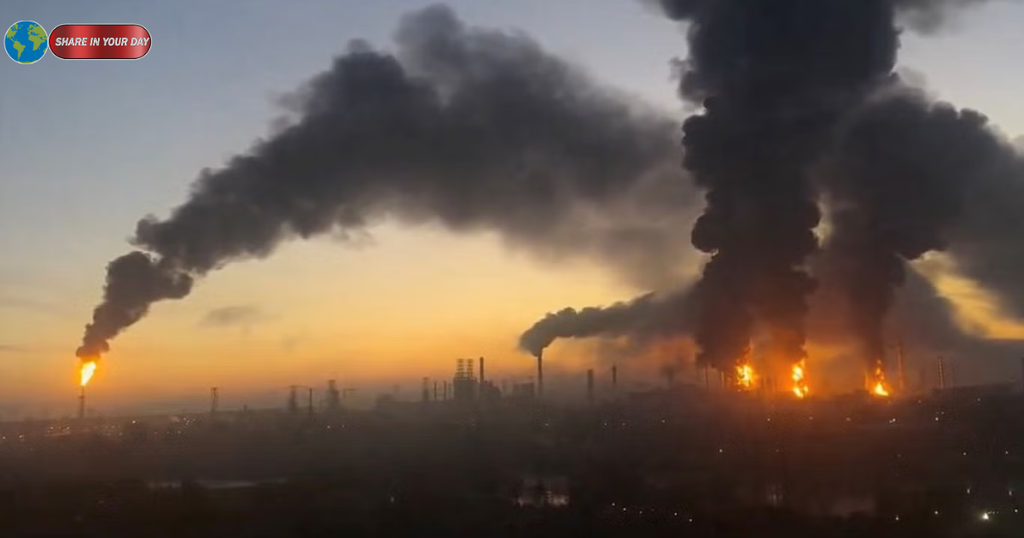
The campaign reached another significant point on September 20, when a large Ukrainian drone assault struck targets around Moscow. Russian authorities said more than 1,600 drones had been intercepted since the previous day, including about 450 aimed at the capital. The attack damaged a facility at the Moscow oil refinery, while Russian officials reported deaths and damage to residential buildings in the wider Moscow region. RReuters+1
The Moscow strike was not an isolated incident.
Ukraine has repeatedly targeted Russian refineries and related energy infrastructure during the war. According to the International Energy Agency, the campaign has expanded considerably over the past 18 months, with Russian refineries being hit at an average rate of roughly once every three days during the first eight months of 2026. IIEA
The consequences are increasingly visible in Russia’s domestic fuel market and are also being felt in international diesel markets.
Ukraine Drone Attacks Target Russia’s Refining Network
Russia operates 32 major oil refineries with combined installed refining capacity of approximately 6.5 million barrels per day. The country has historically been one of the world’s largest producers of refined petroleum products. IIEA
That refining network has become a major target of Ukraine’s long-range drone campaign.
The IEA reported in September that only five of Russia’s major refineries had remained untouched by Ukrainian drones as of late August. Those facilities are located in eastern Siberia or Russia’s Far East, between roughly 3,500 and 6,500 kilometers from Ukraine and therefore remain beyond the reach of Ukraine’s most advanced long-range systems, according to the agency. IIEA
Some facilities closer to Ukraine have reportedly been attacked repeatedly.
The objective is not necessarily to destroy an entire refinery. Instead, attacks can focus on specific pieces of equipment that are important to converting crude oil into gasoline, diesel, jet fuel and other products.
That distinction matters because damage to one processing unit can reduce output even when the rest of a refinery remains physically intact.
Moscow Refinery Hit Again
The Moscow refinery has become one of the most prominent targets.
On September 20, drones reached the facility during the large-scale attack on Moscow. Russian authorities acknowledged damage at the refinery, while industry sources later told Reuters that fires broke out in two primary crude-distillation units. RReuters+1
Reuters reported that the refinery subsequently halted crude processing.
The facility’s AVT-6 unit accounts for about 53 percent of its total crude-processing capacity, according to industry sources cited by Reuters. The EURO+ facility accounts for the remaining 47 percent. Repairs were expected to take several weeks, the sources said. RReuters
The refinery processed approximately 11.6 million metric tons of crude in 2024, producing about 2.9 million tons of gasoline and 3.2 million tons of diesel, according to Reuters. RReuters+1
The disruption therefore affects a facility that plays an important role in supplying fuel to one of Russia’s largest metropolitan areas.
Russia’s Fuel Problems Are Growing
The effect of the attacks has extended beyond individual refinery shutdowns.
The IEA said Russian refinery throughput fell to 3.8 million barrels per day in June 2026. That was the lowest level in more than two decades and approximately 30 percent below the level recorded a year earlier. IIEA
Production of gasoline was down about 20 percent compared with 2025 levels, while diesel production had fallen by nearly 30 percent, according to the IEA. IIEA
Those declines have forced Moscow to take extraordinary measures to protect domestic supplies.
Russia banned gasoline exports in April and subsequently introduced restrictions on jet-fuel and diesel exports. The diesel export ban was extended through September as attacks continued to affect refinery operations. IIEA
Fuel shortages were reported across a large portion of Russia during the summer.
The IEA said shortages had been reported in 92 percent of Russia’s regions by the end of June, while around two-thirds of regions had introduced some form of fuel rationing. Some motorists reportedly waited as long as 40 hours at filling stations. IIEA
The government has also taken steps that illustrate the seriousness of the supply problem.
Russia temporarily lowered certain fuel-quality requirements, allowing older fuel specifications to be produced and distributed. It has also imported gasoline from countries including Belarus, Kazakhstan, Morocco, South Korea, India and Türkiye, according to the IEA. IIEA
Why Ukrainian Drones Are Focusing on Refinery Equipment
Modern refineries are complex industrial systems.
Crude oil first passes through primary distillation units. The resulting products then move through secondary processing units that increase the production of higher-value fuels and improve their quality.
The IEA said Ukrainian attacks have increasingly focused on these secondary units, including fluid catalytic crackers, hydrocrackers, reformers and hydrotreaters. IIEA
Damage to these facilities can take considerably longer to repair than damage to some simpler equipment.
According to the IEA, minor damage to a crude-distillation unit can sometimes be repaired within one or two weeks. Serious damage to complex secondary processing units can require six to eight months. IIEA
This creates a cumulative problem.
A refinery can repair one damaged unit, only to face another attack before its operations have fully recovered. Repeated damage can also place additional pressure on maintenance schedules and equipment availability.
Western sanctions add another complication because some replacement equipment is more difficult for Russian companies to obtain, the IEA noted. IIEA
The September Attacks Came During Russia’s Election
The timing of the September 20 Moscow attack was also significant.
The drone assault took place on the final day of Russia’s parliamentary elections. Moscow Mayor Sergei Sobyanin said the attack was intended to disrupt the vote, an allegation that describes the Russian government’s interpretation of the operation. Reuters reported that the attack did not prevent the election from proceeding. RReuters+1
Ukraine has not publicly accepted responsibility for the specific Moscow attack, and both sides have repeatedly denied intentionally targeting civilians. RReuters
The attack nevertheless demonstrated the geographic reach of Ukraine’s long-range strike campaign.
The Moscow refinery lies hundreds of kilometers inside Russia. Ukraine has also demonstrated an ability to reach much farther into Russian territory.
In July, for example, the IEA reported that a Ukrainian strike reached the Omsk refinery, Russia’s largest, approximately 2,500 kilometers from the Ukrainian border. IIEA
That growing range has expanded the number of Russian energy facilities potentially exposed to attack.
The Economic Impact Extends Beyond Russia
The consequences of Ukraine drone attacks are not confined to Russia.
Russia has traditionally been a major exporter of refined petroleum products, particularly diesel. When domestic refinery output falls, Russia has less product available for export and must redirect supplies toward its own market.
The IEA said the reduction in Russian exports is contributing to already tight global diesel markets.
International markets are facing additional disruption from the conflict in the Middle East and constraints on oil and refined-product shipments through major trading routes. The result is a market in which the loss of Russian refined products can have an amplified effect. IIEA+1
The IEA reported that combined Gulf and Russian diesel/gasoil exports in August were 1.6 million barrels per day below February levels. Those regions previously represented almost 45 percent of global seaborne diesel and gasoil trade. IIEA
Other refiners are attempting to compensate.
However, the IEA said refining systems outside the affected regions are already operating under considerable pressure, limiting their ability to replace lost Russian and Middle Eastern supplies quickly. IIEA
That makes diesel particularly sensitive to further disruptions.
Russia Is Trying to Keep Refineries Operating
Russian energy companies have responded in several ways.
The IEA said refiners have delayed scheduled maintenance, accelerated repairs and attempted to bring previously inactive equipment back online. These measures can help maintain production temporarily, but they have limits. IIEA
Repeated attacks create another problem: reliability.
Even when a damaged refinery resumes operations, repeated strikes can leave equipment in a weaker condition and increase the risk of additional interruptions.
The Russian government has also increased its involvement in refinery security.
In August, President Vladimir Putin signed a decree allowing the government to temporarily take control of privately owned businesses or infrastructure considered critical if owners fail to implement adequate security measures or delay restoration. The measure includes energy facilities, according to the IEA. IIEA
The steps demonstrate how refinery security has become both an economic and national-security concern for Moscow.
Ukraine’s Long-Range Capability Has Expanded
The refinery campaign also illustrates the evolution of Ukraine’s long-range strike capability.
The IEA said Ukraine has expanded both the range and effectiveness of its drone operations, particularly during the first half of 2026. Multiple waves of drones have increasingly been used against individual refineries, potentially overwhelming passive defenses such as protective netting. IIEA
The September attack on Moscow further highlighted the scale of that capability.
Russian officials said more than 1,600 Ukrainian drones had been intercepted across the country during the attack period, including approximately 450 headed toward Moscow. Some drones nevertheless reached their targets, including the refinery and residential areas, according to Russian authorities. RReuters
The figures are claims by Russian officials and cannot independently establish the total number of drones launched or intercepted.
What is clear from multiple sources is that the attacks have become a recurring feature of the war rather than isolated incidents. The IEA’s refinery data and Reuters reporting on individual facilities show measurable effects on Russian refining operations. IIEA+1
A New Pressure Point in the War
The refinery campaign has created a difficult challenge for Russia.
The country still has extensive crude-oil production capacity. But crude oil is not the same thing as finished fuel.
A refinery converts crude into products that can be used by cars, trucks, aircraft, agricultural machinery and industrial facilities. Damage to refining capacity can therefore create domestic shortages even when crude remains available.
That distinction has become increasingly important in 2026.
The IEA expects Russian refinery throughput to average around 4 million barrels per day for the remainder of 2026 and in 2027, reflecting the continuing impact of damaged facilities and limited recovery prospects. IIEA
At the same time, Russia faces pressure on its government finances. Reuters reported that Russia’s 2026 budget deficit was expected to reach about 3 percent of GDP, above the government’s original target, with higher military spending and measures to address fuel shortages contributing to the pressure. RReuters
The refinery attacks are therefore affecting multiple parts of the Russian economy at once: fuel production, domestic prices, exports, refinery maintenance and government spending.
What Comes Next for Russia’s Oil Industry?
The trajectory will depend partly on whether the attacks continue at their current frequency and whether Moscow and Kyiv reach an agreement restricting strikes on energy infrastructure.
There have already been diplomatic efforts to establish an energy truce.
U.S. President Donald Trump called for an end to attacks on energy facilities in September, while Ukrainian President Volodymyr Zelensky has linked a potential halt in Ukrainian strikes to Russia stopping attacks on Ukraine’s energy infrastructure. Reuters reported that attacks continued despite those discussions. RReuters+1
For Russia’s refining industry, the immediate challenge is repairing damaged facilities while maintaining enough fuel for domestic consumers.
For international markets, the concern is whether additional losses from Russian refineries will coincide with existing disruptions elsewhere.
The IEA has warned that global diesel markets are already under significant pressure. Further refinery outages could therefore have consequences well beyond the facilities directly hit by drones. IIEA+1
Conclusion
The latest Ukraine drone attacks against Russia’s energy infrastructure show how the war is increasingly being fought through long-range strikes far from the front lines.
The September 20 attack on the Moscow refinery was particularly significant because the facility subsequently halted crude processing, according to industry sources cited by Reuters. RReuters
But the broader story is larger than one refinery.
The IEA’s data indicate that repeated Ukrainian attacks have reduced Russian refining output, contributed to domestic fuel shortages and forced Moscow to restrict exports and seek additional supplies. At the same time, lower Russian diesel exports are adding pressure to an already constrained international market. IIEA+1
The campaign has consequently become an important part of the economic dimension of the Russia-Ukraine war.
Whether it ultimately changes Russia’s wider war strategy remains uncertain. What can already be measured is its effect on refinery operations, fuel availability and petroleum markets.