Trump Praises Roman Space Telescope After Launch
President Donald Trump unexpectedly called into a NASA press conference Sunday to congratulate officials following the successful launch of the Roman Space Telescope, a mission his administration had previously sought to cut or potentially cancel.
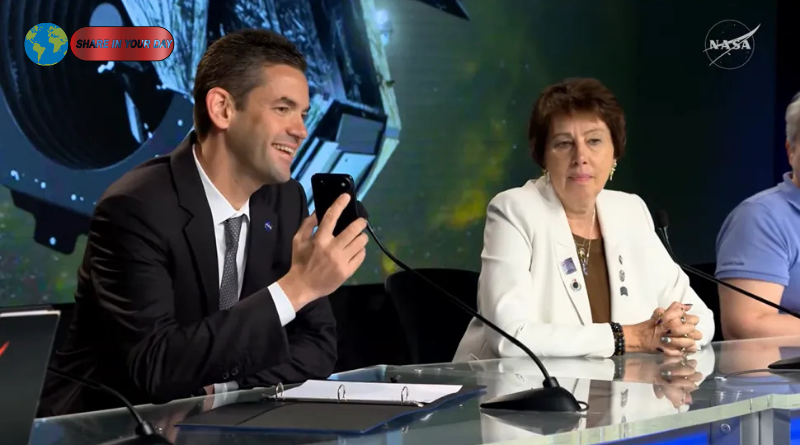
The surprise phone call came only hours after a SpaceX Falcon Heavy rocket carried NASA’s Nancy Grace Roman Space Telescope into orbit from Kennedy Space Center in Florida. The launch marked a major milestone for a nearly two-decade project designed to investigate dark energy, dark matter and distant planets.
NASA Administrator Jared Isaacman was speaking during a post-launch news conference when his cellphone rang. Isaacman briefly stepped away from the stage before returning and placing Trump on speakerphone. Trump congratulated the team and said the launch looked beautiful on television.
The moment was notable because the Roman Space Telescope had faced a very different future during Trump’s administration.
Roman Space Telescope Gets a Surprise Presidential Call
The unusual exchange happened during NASA’s post-launch briefing on Aug. 30, shortly after the telescope successfully separated from its Falcon Heavy rocket.
According to Space.com’s live coverage, Isaacman’s phone rang in the middle of the press conference. He told the audience that the president was excited about Roman before leaving the stage to answer the call.
Isaacman later returned and put Trump on speakerphone.
Trump congratulated NASA and the mission team, saying the launch had looked beautiful on television. Reuters also reported that Trump praised the NASA team and referred to the agency’s approximately $24 billion 2026 budget while discussing federal support for the space program.
The brief call quickly became one of the most striking moments surrounding the mission.
It also highlighted an unusual political turnaround.
The administration had previously proposed deep reductions to NASA’s science programs, putting the future of Roman in doubt. Congress ultimately preserved funding, allowing engineers to complete the spacecraft and prepare it for launch.
Roman Space Telescope Survives Threat of Cancellation
The story behind the Roman Space Telescope began long before its dramatic launch.
The observatory represents nearly two decades of development and roughly $4 billion in investment. But in 2025, its future became uncertain after leaked budget documents from the Trump administration proposed significant reductions to NASA funding.
Space.com’s reporting said an initial proposal called for a 24% overall reduction in NASA funding and a 50% reduction in science programs. The documents did not provide funding for several telescopes beyond major existing missions, raising concerns that Roman could be abandoned close to completion.
The possibility was particularly painful for members of the Roman team.
By that stage, the spacecraft was already deep into assembly, testing and qualification. Engineers had spent years preparing the observatory for launch, and cancellation would have meant losing a major scientific project just before it reached the finish line.
The situation eventually changed when Congress rejected the steep proposed cuts and restored NASA funding to earlier levels.
Instead of slowing down, the Roman team accelerated its schedule.
Project managers pushed the launch date earlier, partly to reduce the risk of another budget fight delaying the mission. Engineers worked extended shifts and weekends to complete the spacecraft. NASA ultimately announced that Roman had been completed eight months ahead of schedule and under budget.
That effort made Sunday’s successful launch especially significant.
Roman Space Telescope Launches on Falcon Heavy
The Roman Space Telescope lifted off at 7:26 a.m. EDT on Aug. 30 aboard a SpaceX Falcon Heavy rocket from Launch Complex 39A at NASA’s Kennedy Space Center.
The launch vehicle’s three-core configuration provided the heavy-lift capability needed to send the observatory toward its destination beyond Earth’s immediate neighborhood.
The Falcon Heavy performed successfully during the flight. Its two reusable side boosters returned to Earth and landed as planned, while the upper stage continued carrying Roman toward its intended trajectory.
Roman separated from the rocket roughly 31 minutes after liftoff.
The spacecraft is now beginning the next phase of its journey toward Sun-Earth Lagrange Point 2, or L2, located approximately 1 million miles from Earth.
Reaching that destination will take months of travel and commissioning.
NASA expects the observatory to spend its early period in space checking systems, adjusting its trajectory and preparing its instruments for scientific operations. The first images are expected after the commissioning process is completed.
Why the Roman Space Telescope Matters
The Roman Space Telescope is not simply another successor to Hubble or the James Webb Space Telescope.
Instead, NASA designed Roman to provide a much wider view of the universe.
Its wide-field infrared instrument will allow astronomers to survey enormous sections of the sky far more quickly than earlier observatories. Reuters reported that Roman could survey the Milky Way in about a month, a task that would take Hubble roughly a century according to Roman senior project scientist Julie McEnery.
That speed is one of Roman’s biggest scientific advantages.
Hubble is famous for detailed observations of individual astronomical targets. Webb is capable of extremely sensitive observations of distant and ancient objects. Roman adds another capability: surveying huge areas of the sky efficiently.
NASA compares the difference to photography.
Webb works more like a powerful zoom lens, allowing scientists to study distant objects in extraordinary detail. Roman works more like a wide-angle lens, capturing a much broader portion of the cosmos in each observation.
Together, the observatories can provide complementary views of the universe.
Roman Will Investigate Dark Matter and Dark Energy
One of the biggest scientific goals of the Roman Space Telescope is understanding the mysterious components that dominate the universe.
Ordinary matter — including stars, planets, gas and dust — represents only a small fraction of the universe’s total contents.
Dark matter and dark energy make up most of the remainder, yet neither can be directly observed in the same way as ordinary matter.
Dark matter is inferred largely through its gravitational effects. It helps explain how galaxies behave and how large-scale structures form.
Dark energy is associated with the accelerating expansion of the universe.
Roman will survey huge numbers of galaxies and help scientists measure how cosmic structures have changed over time. Those observations could provide new clues about why the expansion of the universe is accelerating and what dark energy actually represents.
NASA expects the telescope’s main surveys to cover billions of galaxies.
That enormous dataset could transform cosmology.
Rather than studying a handful of carefully selected objects, astronomers will have an opportunity to analyze large statistical samples across vast portions of the sky.
Roman Space Telescope Could Find Thousands of Exoplanets
The mission also has an ambitious planetary science component.
The Roman Space Telescope is expected to discover thousands of exoplanets — worlds orbiting stars beyond our solar system.
Its enormous survey capability will allow astronomers to search for planets using techniques that complement the methods used by other observatories.
Roman will also carry a coronagraph designed to block the overwhelming glare of stars. This technology could eventually help astronomers directly image planets around other stars.
The instrument is experimental, meaning its performance in space will be closely watched.
Although Roman is not specifically designed to determine whether extraterrestrial life exists, its discoveries could help identify planetary systems worthy of deeper investigation by future observatories.
This makes Roman an important bridge between today’s exoplanet discoveries and future efforts to study potentially habitable worlds.
A Telescope With a Surprising Spy-Satellite Connection
One of the most unusual aspects of the Roman Space Telescope is the history of its main mirror.
The observatory was not originally designed as a NASA science telescope.
Its primary mirror came from technology developed for a U.S. intelligence satellite program.
The National Reconnaissance Office, which manages America’s reconnaissance satellite systems, donated surplus mirror hardware to NASA in 2012. NASA then adapted the technology for astronomical research.
The mirror is approximately the same size as Hubble’s primary mirror.
But Roman’s design is optimized for a dramatically wider field of view.
The result is a remarkable example of technology originally developed for national security being repurposed to investigate the universe.
Roman Will Join Hubble and Webb
The successful launch does not mean NASA’s older space telescopes are becoming obsolete.
Instead, Roman is expected to work alongside Hubble and Webb.
Hubble has spent more than three decades producing some of the most recognizable images in astronomy. Webb has expanded humanity’s view of the early universe with its powerful infrared capabilities.
Roman will add a different strength: speed and scale.
The three observatories can potentially identify targets and then study them at different levels of detail.
For example, Roman may survey a huge region of the sky and identify an interesting planetary system or distant galaxy. Webb could then conduct a much deeper observation of a specific target.
This combination could dramatically improve scientists’ ability to understand both individual objects and the larger cosmic structures in which they exist.
The Mission Is Now Focused on Science
After years of political uncertainty, engineering challenges and schedule pressure, the Roman team can finally focus on the scientific mission itself.
The spacecraft must still complete a demanding commissioning process.
It will travel toward L2, deploy and test its systems, conduct trajectory adjustments and prepare its instruments for observations.
NASA says the observatory will spend its early months being carefully checked before entering full science operations. The spacecraft’s planned mission is approximately five years, although available fuel could potentially support an extension.
That means the most important part of Roman’s story is only beginning.
The launch was the dramatic moment, but the scientific discoveries could continue for years.
Trump’s Roman Praise Highlights a Remarkable Turnaround
Trump’s unexpected call added a political twist to an already historic launch.
The president’s praise came after his administration had proposed NASA budget reductions that threatened the mission’s future. Congress ultimately protected Roman, while the mission team responded to the uncertainty by accelerating development and preparing the telescope for launch.
Now the telescope is safely on its way to space.
For NASA scientists and engineers, that may be the most important development of all.
The Roman Space Telescope has moved beyond political debates over budgets and schedules and entered the operational phase of its mission.
Its destination is nearly a million miles away.
Its targets are billions of galaxies, thousands of potential new worlds and some of the deepest mysteries in modern physics.
And after surviving years of uncertainty, Roman has finally begun its journey.
What Comes Next for the Roman Space Telescope?
The next major stage will be commissioning.
NASA will verify the spacecraft’s systems, adjust its trajectory and prepare its scientific instruments for observations. The observatory will then begin its surveys of the universe from L2.
Scientists are particularly interested in what Roman can reveal about dark energy, dark matter, galaxy formation and exoplanets.
The mission could also produce discoveries that were not part of its original headline goals.
Large astronomical surveys routinely uncover unexpected objects and phenomena. Roman’s combination of a wide field of view, infrared sensitivity and rapid surveying makes it particularly well suited to finding unusual cosmic targets.
For NASA, that creates an exciting possibility: the telescope may answer some existing questions while simultaneously raising entirely new ones.
The launch therefore represents more than the completion of a troubled government-funded project.
It marks the beginning of a new astronomical era.
And for the Roman Space Telescope, the biggest headlines may still be years away.
Conclusion
The successful launch of NASA’s Roman Space Telescope ended one chapter and opened another.
President Donald Trump’s surprise call during the NASA post-launch briefing provided an unexpected political moment, especially given the administration’s earlier efforts to reduce funding for the mission. But the spacecraft’s successful launch ultimately belongs to the scientists, engineers, technicians and lawmakers who kept the project moving.
Roman now has a chance to transform astronomy.
Its wide-field surveys could reveal enormous numbers of galaxies, stars and exoplanets while providing new evidence about the mysterious forces shaping the universe.
It will not replace Hubble or Webb.
Instead, it will complement them.
As Roman travels toward its new home near L2, the focus is finally shifting away from whether the telescope would launch and toward what it will discover.
After nearly two decades of development, that may be the most exciting development of all.