Ugreen HomeAgent: 5 Big Local AI Features
The Ugreen HomeAgent is putting a new spin on the smart home by moving artificial intelligence processing away from the cloud and directly into the home. UGREEN has unveiled a new ecosystem built around local AI hubs that combine smart home control, security monitoring, storage and AI-powered automation in a single system.
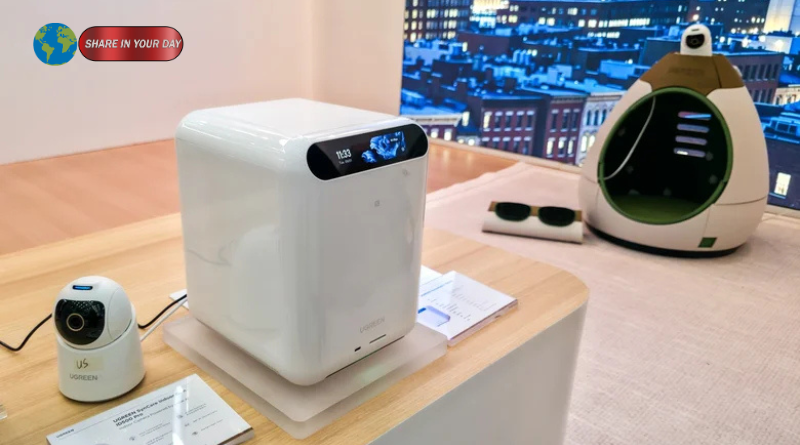
The move marks a major expansion for UGREEN, a company better known for chargers, USB accessories and network-attached storage products. With HomeAgent, the company is entering a market dominated by ecosystems from Amazon, Google and other established smart home platforms.
However, UGREEN is taking a different approach.
Instead of depending heavily on remote cloud servers to process information, the Ugreen HomeAgent platform is designed to keep much of that intelligence inside the home. The company says the system can store data locally, run AI models locally and control compatible devices without sending sensitive information to the cloud.
That could make HomeAgent particularly interesting for consumers who want smarter automation without giving up as much control over their personal data.
1. Ugreen HomeAgent Brings AI Directly Into the Home
The biggest feature of the Ugreen HomeAgent is its local AI architecture.
Traditional smart home products often rely on cloud infrastructure. A camera records footage, sends information to a remote server, processes the data and then sends a result back to the user. This approach can offer powerful AI capabilities, but it also creates privacy concerns and potentially adds recurring cloud-storage or AI-service costs.
HomeAgent takes a different route.
UGREEN describes the system as an “Agentic AI Local Hub” that combines local computing, storage and smart home control. The company says its system can connect cameras, speakers, storage and compatible smart home devices into a coordinated ecosystem.
This local-first design means the HomeAgent can potentially analyze information inside the home instead of constantly sending it elsewhere.
For users, that could mean faster responses, greater privacy and less dependence on cloud subscriptions.
UGREEN is also positioning the system as more than a conventional smart home hub. Rather than simply passing commands between devices, the company wants its AI system to understand what is happening and respond accordingly.
That is an important distinction as smart home technology moves from basic automation toward AI agents.
2. Three HomeAgent Hubs Target Different Users
UGREEN is launching three primary local AI hubs: the HomeAgent HA100, HomeAgent HA100 Pro and MasterAgent MA100.
They share the same broad concept but have dramatically different hardware capabilities and prices.
The standard HA100 is the entry point. It uses a Rockchip RK3588 platform, 16GB of LPDDR5 memory and provides a claimed 26 TOPS of AI performance. UGREEN lists an MSRP of $1,799, although its current Super Early Bird price is $899.
The HA100 Pro steps things up considerably.
It uses a CIX-CP8180 platform, doubles memory to 32GB and offers a claimed 205 TOPS of AI performance. It also adds faster connectivity, including 10GbE networking. The official MSRP is $5,999, while the current Super Early Bird price is $2,999.
Then there is the MasterAgent MA100.
This is where the concept becomes considerably more ambitious.
The flagship model uses NVIDIA’s Jetson Thor T5000 platform and 128GB of unified memory. UGREEN claims up to 2,070 FP4 TFLOPS of AI performance, placing it closer to a compact edge-AI workstation than an ordinary consumer smart home hub.
The MSRP is an eye-catching $19,999, although UGREEN currently advertises a $9,999 Super Early Bird price.
That price immediately raises questions about who the MasterAgent is actually designed for.
For an average homeowner, the HA100 is likely to make considerably more sense. The MA100 appears better suited to developers, enthusiasts and users who specifically want substantial local AI computing power.
3. Privacy Is at the Center of the Ugreen HomeAgent
Privacy is arguably the strongest argument for the Ugreen HomeAgent ecosystem.
UGREEN says HomeAgent stores data at home and runs AI locally. Its marketing also emphasizes the absence of cloud storage fees for locally stored footage, photos and home data.
That approach could be especially important for smart security cameras.
A camera installed inside a home can capture highly sensitive information. Footage may include family members, children, visitors, deliveries and daily routines. Sending that data continuously to a cloud platform introduces another layer of privacy and security considerations.
UGREEN’s SynCare cameras are designed to work with HomeAgent and provide AI-based features such as human and pet detection, facial recognition and event analysis.
The company says remote access uses end-to-end encryption, while locally stored data is protected using AES-256 encryption, according to Engadget’s report from UGREEN’s launch event.
That does not mean every aspect of the system operates completely offline.
Remote access and some notification features can still require an internet connection. Therefore, “local AI” should not be interpreted as meaning the entire ecosystem never communicates with external services.
Still, keeping core AI processing and storage inside the home represents a meaningful shift from cloud-first smart home products.
4. HomeAgent Can Connect With Matter Devices
Another important part of the Ugreen HomeAgent strategy is compatibility.
The three hubs support ONVIF and Matter-compatible devices out of the box, while UGREEN has indicated that Zigbee and Thread support are also planned.
Matter is particularly important because the smart home industry has increasingly embraced the standard as a way to make devices from different manufacturers work together.
In theory, that means homeowners won’t necessarily have to replace every existing smart device to use HomeAgent.
A Matter-compatible light, switch or other device could potentially become part of the HomeAgent-controlled environment.
However, there is an important limitation.
Engadget reports that HomeAgent does not currently offer official Home Assistant support.
That could be a drawback for advanced smart home users who already rely on Home Assistant to connect devices from different manufacturers.
Compatibility will therefore be one of the biggest factors determining whether HomeAgent can become a genuine open smart home platform or remains primarily a UGREEN-centered ecosystem.
Internal Link Suggestion:
[Internal Link: Best Smart Home Devices for 2026]
5. Uliya Turns HomeAgent Into an AI Assistant
The hardware would be much less interesting without a way to interact with it.
UGREEN’s answer is Uliya, the company’s AI-powered voice assistant.
The accompanying UGREEN Smart Speaker for Uliya is designed to provide a voice interface for HomeAgent. Users can communicate with the system using natural language rather than relying exclusively on rigid commands.
This becomes particularly interesting with the HA100 Pro and higher-end models.
UGREEN says the Pro model can understand motion and infer behavioral intent. It also allows users to create automation rules using natural-language voice input.
In other words, instead of manually configuring a complicated series of rules, users could potentially describe what they want the home to do.
That is the direction much of the smart home industry is moving toward.
Google has also been pushing conversational AI into the home with Gemini for Home, while other companies are experimenting with AI agents capable of understanding context rather than simply executing isolated commands.
UGREEN’s differentiation is that it wants much of this intelligence to happen locally.
According to UGREEN, Uliya is integrated with Qwen3 for its local large-language-model approach, while cloud models such as ChatGPT can also be supported. Users can switch between local and cloud modes depending on their needs.
That hybrid strategy could give users more flexibility.
Ugreen SynCare Expands the Ecosystem Beyond a Hub
The Ugreen HomeAgent launch is not just about three boxes.
UGREEN has also introduced the SynCare family of security cameras, including indoor, outdoor and battery-powered models.
The SynCare Indoor Cam ID500 Pro is designed for indoor monitoring, while the PoE Cam OD600 Pro targets outdoor installations. The Battery Cam OD800 Pro provides a wireless outdoor option.
According to UGREEN, the cameras can use AI to recognize people, pets and important events. The company’s broader SynCare platform is intended to combine cameras with local storage and AI analysis.
Pricing varies by model.
The official UGREEN information lists Super Early Bird pricing of $89 for the ID500 Pro, $159 for the OD600 Pro and $199 for the OD800 Pro. Regular listed prices are higher.
This camera ecosystem could ultimately be one of HomeAgent’s strongest selling points.
A smart home hub that merely controls lights is easy to replace. A platform that combines cameras, security alerts, local video storage, AI analysis and home automation becomes much more deeply integrated into a household.
The $20,000 Question: Is Local AI Worth It?
The biggest controversy surrounding the Ugreen HomeAgent lineup is undoubtedly its pricing.
The standard HA100 already has a $1,799 MSRP.
The HA100 Pro jumps to $5,999.
And the MasterAgent MA100 reaches $19,999.
Those prices are far beyond what most consumers would expect to pay for a smart home hub.
UGREEN argues that local AI can reduce the need for cloud inference and cloud storage costs over time. The company also emphasizes the performance and privacy benefits of running AI models inside the home.
There is a reasonable argument behind that strategy.
Running powerful AI locally requires expensive hardware. Unlike a cloud service, however, users are purchasing the computing hardware upfront rather than continuously paying a provider to process their data.
Whether that equation makes financial sense will depend heavily on how much AI processing a homeowner actually needs.
For most households, paying thousands of dollars for local AI hardware may be difficult to justify.
For developers, professionals, AI enthusiasts and users handling sensitive data, however, the calculation could be different.
HomeAgent Still Has Something to Prove
Despite the ambitious specifications, there are reasons to remain cautious.
Engadget reported that only a single working HomeAgent model was available for demonstration at the launch event. Basic controls for smart curtains and lights worked, but more advanced features such as voice-based automation-rule creation were not demonstrated.
That distinction matters.
Specifications can tell us how powerful a device should be. They do not tell us how well the software will actually work.
Smart home platforms live or die by reliability.
Voice recognition needs to be accurate. Automation needs to behave predictably. Cameras need to identify events correctly. Devices from different manufacturers need to communicate without constant troubleshooting.
UGREEN will also need to build a strong software ecosystem around its hardware.
The company has already positioned HomeAgent as a platform that can connect third-party devices, but compatibility details will be crucial as the system expands.
Internal Link Suggestion:
[Internal Link: Best AI Smart Home Gadgets to Watch]
When Will Ugreen HomeAgent Be Available?
UGREEN’s current campaign information indicates that reservations are open, with a Kickstarter campaign scheduled to begin later in October. The company says reservations can start with a $50 deposit for the HA100 and HA100 Pro, while the MasterAgent requires a $200 deposit for its Super Early Bird access.
Shipping is planned in stages during 2027.
UGREEN currently lists late January 2027 shipping for the HA100, along with certain SynCare cameras. The HA100 Pro and additional accessories are scheduled for later in 2027, while the MasterAgent MA100 is currently listed for late July 2027 shipping.
Because these products are being introduced through crowdfunding, final availability and delivery schedules could change.
Consumers considering a reservation should therefore evaluate the specifications, compatibility and crowdfunding terms carefully rather than treating early pricing as the same thing as an established retail product.
Ugreen HomeAgent Could Change the Smart Home Conversation
The Ugreen HomeAgent is an ambitious attempt to redefine what a smart home hub can be.
Instead of serving simply as a bridge between devices, UGREEN wants HomeAgent to become the local intelligence layer for an entire household.
It can combine AI processing, storage, security cameras, voice control and smart home automation in one ecosystem. More importantly, it is designed around the idea that sensitive information should remain inside the home whenever possible.
That is an increasingly important proposition.
Consumers are becoming more aware of how much information smart devices can collect. At the same time, AI is making those devices dramatically more capable.
The tension between smarter AI and greater privacy is likely to become one of the defining issues in the next generation of connected homes.
UGREEN’s answer is to put more computing power at home.
The question is whether consumers will be willing to pay for it.
The HA100 and HA100 Pro could find an audience among privacy-conscious smart home enthusiasts, NAS users and technology professionals. The $19,999 MasterAgent MA100, meanwhile, is a much more specialized proposition that appears aimed at developers and serious local-AI users rather than ordinary homeowners.
For now, HomeAgent remains a promising but unproven platform.
If UGREEN can deliver reliable AI automation, broad device compatibility and genuinely useful local intelligence, it could become an intriguing alternative to cloud-heavy smart home ecosystems.
If the software experience fails to match the hardware, however, even impressive AI specifications may not be enough.
Either way, Ugreen HomeAgent signals that the smart home is entering another phase: one where the most important computer in the house may no longer be a speaker or phone, but a dedicated AI system quietly processing everything locally.