Missouri Supreme Court Map: 5 Big Election Shifts
The Missouri Supreme Court map ruling has created a major new twist in the 2026 midterm elections. In a unanimous decision, Missouri’s highest court blocked a Republican-backed congressional map from being used in the November general election unless voters first approve it in a statewide referendum.
The decision immediately changes the political landscape in Missouri. It also creates an unusual situation because the state’s August primary elections were conducted under the newer congressional boundaries.
The court ruled Thursday that a referendum challenging the 2025 redistricting law was legally valid. As a result, Missouri must return to its previous congressional district boundaries for the November election unless voters approve the new map.
The ruling is a significant setback for Missouri Republicans, who had hoped the new districts would improve their chances of capturing another U.S. House seat. It also represents an important test of how far voter referendum powers extend when state lawmakers redraw congressional districts.
Here are five major developments to understand.
1. Missouri Supreme Court Map Ruling Blocks the New Districts
The central issue is straightforward but politically explosive.
Missouri lawmakers approved a new congressional map in 2025. The legislation, known as House Bill 1, replaced the congressional districts created following the 2020 census.
The Missouri General Assembly’s official description said the bill established boundaries for the state’s eight congressional districts beginning with the election of the 120th Congress. Supporters argued that the new map was more compact, split fewer municipalities and satisfied federal and state legal requirements.
But opponents challenged the map through Missouri’s referendum process.
The Missouri Supreme Court ultimately ruled that voters have the constitutional right to decide whether the redistricting legislation should take effect.
The court therefore prohibited the new congressional map from being used in the November 2026 general election unless Missouri voters approve it.
The ruling means the older 2022 congressional map will govern the November election for now.
That distinction is critical.
The new map has not been permanently erased. Instead, its implementation has been placed on hold while voters decide its fate.
2. Missouri Voters Will Get the Final Say
One of the biggest consequences of the Missouri Supreme Court map decision is that the redistricting fight is moving directly to voters.
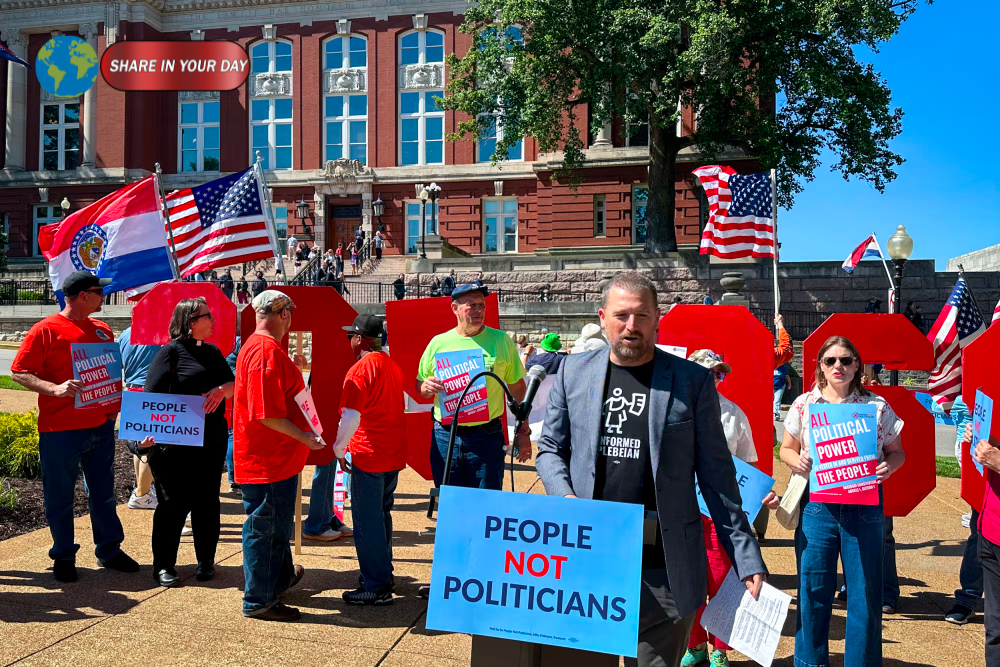
A citizen group called People Not Politicians gathered more than 300,000 signatures to challenge the congressional redistricting legislation through a referendum.
Missouri’s Secretary of State records identify the challenge as referendum petition 2026-R004, submitted by Richard von Glahn and associated with People Not Politicians. The petition challenges House Bill 1 and asks voters whether they approve the legislation replacing Missouri’s existing congressional plan with new boundaries.
The Supreme Court ruled that the referendum petition was legally sufficient and timely.
That means Missouri voters will have a direct role in determining whether the new congressional boundaries become permanent.
According to the court’s ruling as reported by Missouri news organizations, the 2022 congressional districts remain in place for the November election unless the voters approve the newer plan. If voters approve it, the legislation can take effect after the required waiting period.
This makes the November election about more than individual candidates.
Missouri voters will also be deciding the political boundaries that determine where those candidates compete.
3. The Decision Could Help Democrats Hold a Key House Seat
The political stakes are particularly high in Missouri’s 5th Congressional District.
The Republican-backed redistricting plan was designed to change several congressional districts, including the Kansas City-area district represented by Democratic Rep. Emanuel Cleaver.
The new boundaries were intended to make the district more favorable to Republicans and improve the GOP’s opportunity to gain a seventh seat in Missouri’s eight-member U.S. House delegation.
Returning to the previous map therefore gives Democrats a much different political environment.
For Cleaver and other Democratic candidates, the court decision could preserve districts that are more favorable to their campaigns than the boundaries approved by Republican lawmakers.
For Republicans, the ruling creates a significant strategic problem.
The party spent months preparing candidates and campaigns around the new boundaries. Those candidates participated in a primary election conducted under the newer map.
Now, however, the November general election will use the older boundaries unless voters approve the new plan.
That creates an unusual mismatch between the primary and general elections.
4. Missouri Already Held Its Primary Under the New Map
Perhaps the most unusual part of the situation is the timing.
Missouri conducted its congressional primary elections on Aug. 4 using the Republican-backed map. The Supreme Court decision came afterward.
The ruling does not simply erase the results of that primary.
Instead, the candidates who won their nominations must now determine how they will proceed under the different district boundaries.
That creates difficult questions for campaigns.
A candidate who won a primary under one district configuration could find that the voters included in the general-election district are substantially different.
Campaign strategies may therefore need to change quickly.
Candidates could have to adjust their advertising, voter outreach, fundraising priorities and campaign messages based on the restored boundaries.
The situation also raises logistical challenges for election officials.
Ballots, candidate information, precinct assignments and election administration must reflect the boundaries that are legally in effect for the November election.
The Missouri Secretary of State’s office had previously instructed local election authorities to prepare for the 2026 election using House Bill 1’s map after earlier court rulings upheld the legislation.
Thursday’s Supreme Court decision dramatically changed that situation.
5. The Fight Could Move to the U.S. Supreme Court
The Missouri ruling may not be the final word.
Missouri Attorney General Catherine Hanaway said the state plans to seek relief from the U.S. Supreme Court.
Republican officials argue that the Missouri Supreme Court’s interpretation conflicts with federal constitutional rules concerning congressional elections and redistricting.
The dispute therefore has implications beyond Missouri.
At its core is a major constitutional question: Can voters use a state referendum to overturn or delay a congressional redistricting plan adopted by a state legislature?
Missouri’s Supreme Court answered yes under the state’s Constitution.
The court focused heavily on the language authorizing referendums on acts of the General Assembly. The court found no explicit exception excluding congressional redistricting legislation from that process.
Opponents of the ruling argue that congressional redistricting is governed by the U.S. Constitution’s Elections Clause and that state legislatures have special authority over the process.
That disagreement could make the case important well beyond the 2026 election.
Why the Missouri Redistricting Fight Matters Nationally
The Missouri Supreme Court map dispute comes during a period of intense national attention on congressional redistricting.
Both political parties are increasingly treating congressional maps as major tools in the battle for control of the U.S. House.
Republicans in Missouri supported a mid-decade redistricting effort that could have improved their chances of winning an additional House seat.
The Missouri Supreme Court’s decision now prevents those boundaries from being used in November unless voters approve them.
Reuters described the decision as a blow to Republican efforts to maintain their narrow House majority.
That makes Missouri one of several states where congressional redistricting has become intertwined with national control of Congress.
The outcome of the November referendum could therefore influence both Missouri politics and the broader national debate over partisan redistricting.
What Happens to the 2026 Missouri Congressional Election?
For voters, the immediate takeaway is relatively simple.
The 2022 congressional map is back in effect for the November general election, unless the new map is approved by voters.
At the same time, the new map will appear before voters as a referendum question.
The Missouri Secretary of State’s official petition records identify the referendum as the challenge to House Bill 1.
This means voters are facing two connected decisions:
- Who should represent their congressional district?
- Should Missouri approve the new congressional district boundaries?
The first decision determines the representatives elected in November.
The second could determine which congressional boundaries Missouri uses going forward.
That makes the 2026 Missouri election especially consequential.
The Emanuel Cleaver District Becomes a Major Battleground
The 5th Congressional District in the Kansas City area is one of the most closely watched parts of the dispute.
Under the Republican-backed map, the district was substantially changed in an effort to make it more competitive for Republicans.
The strategy was part of a broader effort to increase the GOP’s representation in Missouri’s congressional delegation.
The Missouri Independent reported that the changes would affect Districts 1 through 6, with the most dramatic change involving the 5th District.
The court’s decision effectively restores the previous boundaries for the general election unless voters approve the new map.
For Democrats, that could make holding the Kansas City-area seat easier.
For Republicans, it means a potentially important opportunity to gain a seat has been put on hold.
What the Referendum Could Mean for Missouri Republicans
Republicans remain in a strong position across much of Missouri, but the new map was designed to strengthen that advantage.
The state currently has eight congressional districts, with Republicans holding six seats and Democrats holding two, according to reporting on the redistricting fight.
The proposed map sought to make a seventh Republican seat more attainable.
If voters approve the map, Republicans could regain the structural advantage lawmakers sought when they passed House Bill 1.
If voters reject it, the existing district boundaries will remain.
That makes the referendum a potentially decisive political event.
Republican campaigns will likely have to explain why voters should approve the new boundaries, while Democratic campaigns and voting-rights advocates are likely to argue that the existing map should remain.
What the Court Decision Means for Voters
The ruling does not cancel the November election.
Instead, it changes the congressional boundaries that will be used.
Voters should therefore pay attention to their updated district information before casting a ballot.
Election officials will need to communicate which congressional district each voter belongs to and which candidates will appear on the ballot.
Because the primary was conducted under different boundaries, voters may also see candidate names or district assignments that differ from what they encountered earlier in the election cycle.
That makes official election information especially important.
For official Missouri election and referendum information, voters can consult the Missouri Secretary of State’s election resources and its 2026 referendum petition information.
The Bigger Constitutional Question
Beyond the immediate political consequences, the case raises a broader question about democracy and redistricting.
State legislatures traditionally play a central role in drawing congressional districts.
But Missouri’s Constitution also provides citizens with referendum powers.
The dispute arose because the two principles came into conflict.
Republican lawmakers argued that the congressional map should be implemented after being passed by the Legislature.
Opponents argued that Missouri voters retained the constitutional authority to challenge the legislation through a referendum.
The state’s Supreme Court ultimately sided with the referendum argument.
The court emphasized that Missouri’s Constitution broadly allows referendums on acts of the General Assembly and does not specifically exclude congressional redistricting.
That interpretation could become an important precedent if similar disputes emerge elsewhere.
What to Watch Before November
Several developments could shape the final outcome.
U.S. Supreme Court action
Missouri officials have indicated they will seek intervention from the nation’s highest court. Whether federal judges agree to intervene could determine which map is ultimately used.
The November referendum
Even if the current map governs the November congressional election, voters will still decide whether the new map should be approved.
Candidate strategies
Candidates who won primaries under the newer districts may have to adapt to the restored boundaries.
Election administration
Missouri election officials will have to make sure ballots and voter information reflect the legally operative districts.
Control of Congress
The result could matter nationally because even one additional House seat can become important when congressional control is closely contested.
Bottom Line: Missouri’s Map Fight Is Far From Over
The Missouri Supreme Court map ruling has transformed the state’s 2026 congressional election.
The Republican-backed map cannot be used for the November general election unless voters first approve it. For now, the 2022 congressional boundaries are back in effect.
The decision also gives Missouri voters an unusually direct role in deciding the future of congressional redistricting.
For Republicans, the ruling threatens a strategy designed to create a seventh favorable House district.
For Democrats, it offers a potentially important opportunity to defend seats that would have become more difficult under the new boundaries.
For voters, the most important point is that the congressional map is now part of the election itself.
The legal battle may continue in federal court, while the political battle will move to the ballot box.
And with control of the U.S. House at stake in November, Missouri’s congressional map could have consequences far beyond the state’s borders.