Ceuta Migrant Crisis: Spain Seeks Urgent EU Help
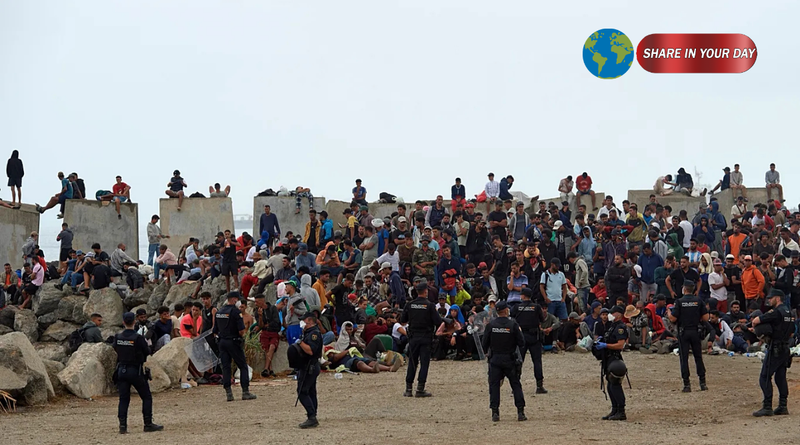
The Ceuta migrant crisis has reached a critical point, with Spain asking the European Union for additional support from Frontex, Europol and the European Union Agency for Asylum as authorities struggle to process thousands of migrants who remain in the Spanish enclave in North Africa.
The request came after an unprecedented influx from neighbouring Morocco in late July, when at least 72,000 people entered Ceuta over several days. Although the overwhelming majority subsequently returned to Morocco, thousands are still in the territory, placing significant pressure on local authorities, accommodation facilities and public services.
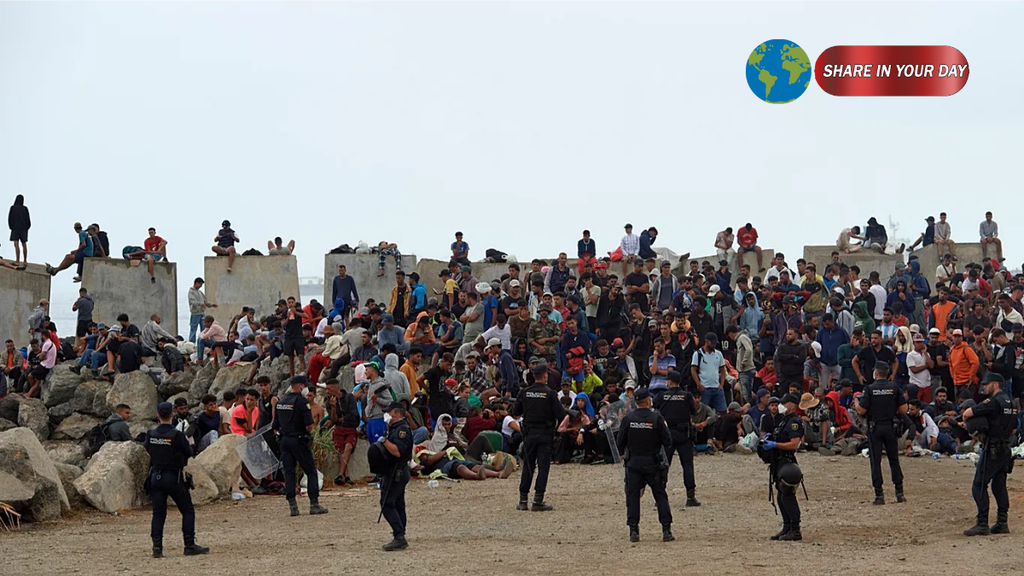
Ceuta’s local assembly has now described the situation as extreme and warned that the city is “on the brink of collapse.” At the same time, tensions between residents, migrants and police have intensified, with demonstrations and violent incidents adding another layer to an already complex humanitarian and political crisis.
Spain’s government is attempting to respond by strengthening the border, accelerating migrant screening and seeking greater assistance from European agencies.
Ceuta Migrant Crisis Pushes Spain to Seek EU Support
Spain’s Interior Minister Fernando Grande-Marlaska has formally asked the European Commission for additional assistance to deal with migrants who remain irregularly in Ceuta.
The request includes support from Frontex, the European Border and Coast Guard Agency, Europol, the EU agency responsible for law-enforcement cooperation, and the European Union Agency for Asylum, or EUAA.
Madrid wants these agencies to reinforce the system used to identify, screen and process migrants still in Ceuta. The aim is to determine the legal status of individuals and establish whether they qualify for asylum or are subject to return procedures.
Spain has also requested an extension of Frontex’s Operation Minerva.
The operation currently covers several Spanish ports, including Ceuta, as part of border-control efforts during the busy summer crossing period. Madrid wants the operation extended beyond its planned September 2 end date for as long as necessary to deal with the continuing crisis.
Spain has additionally requested 10 extra Frontex officers to accelerate the screening process.
More Than 72,000 Migrants Entered Ceuta
The scale of the Ceuta migrant crisis is closely connected to the extraordinary events of late July.
At least 72,000 people crossed into Ceuta from Morocco during a mass influx over July 30 and 31. Many crossed by swimming or on foot, creating chaotic scenes along the territory’s coastline and border areas.
The influx was large enough to trigger a wider European migration alert.
Most of those who entered returned to Morocco relatively quickly. However, thousands remained in Ceuta, creating a continuing challenge for Spanish authorities.
Estimates of the number still present have varied.
Euronews reported that Spain’s government estimated between 3,500 and 7,000 migrants remained, while local authorities put the figure considerably higher. Many people have been sleeping outdoors or in makeshift camps, including along beaches.
The continuing presence of thousands of people has placed extraordinary pressure on a territory with a population of roughly 80,000 and an area of only about 18.5 square kilometres.
That geographic limitation is one of the most important factors behind local concerns.
Ceuta Warns It Is Near the Brink of Collapse
Ceuta’s political authorities have become increasingly vocal about the pressure facing the territory.
On Friday, the Ceuta Assembly unanimously called on Spain’s central government to act immediately, describing the situation as extreme and warning that the city was approaching collapse.
Ceuta President Juan Vivas said the territory had lost its normal way of life and calm and warned that authorities had limited time to prevent a more serious deterioration.
The local declaration also called for migrants who entered during the mass influx to be returned to their countries of origin where legally possible.
However, local officials simultaneously emphasized that demonstrations must remain peaceful and orderly.
That distinction has become increasingly important as public frustration has grown.
Authorities are facing pressure from residents demanding stronger border controls while also attempting to prevent confrontations from escalating into wider violence.
Protests Turn Violent in Ceuta
Tensions increased sharply during the week as residents protested against the continued presence of migrants.
On Thursday, police intervened after demonstrators moved toward a beach where migrants had been sleeping. Some migrant belongings were reportedly burned during the disturbances.
The protests followed a separate incident involving migrants and Spanish military personnel.
According to police, about 70 migrants attacked a military vehicle with stones and other objects. One soldier suffered minor injuries, while Spanish authorities detained 12 Moroccan migrants.
Additional arrests were reported after a police officer was allegedly attacked.
The incidents have raised concerns that the migration crisis could develop into a broader security and social problem.
Spain’s Interior Minister has repeatedly urged people to remain calm.
“Violence is not the answer,” Fernando Grande-Marlaska told parliament, arguing that the complexity of the situation required legal and institutional solutions rather than confrontation.
Spain Strengthens the Ceuta Border
Madrid has responded with a package of what it calls extraordinary measures to reinforce Ceuta’s border.
The measures include extending the breakwaters at Tarajal and Benzú, establishing a permanent maritime containment buoy system and increasing aerial surveillance using drones.
Spain also plans to use light intervention vessels and remotely operated underwater equipment.
The objective is to strengthen monitoring along the coastline and reduce the possibility of another large-scale crossing from Morocco.
The Spanish government is also seeking longer-term surveillance capabilities.
Its request to the EU includes maintaining the EUROSUR services operated by Frontex, which provide surveillance information including satellite imagery covering maritime areas, coastlines, ports and areas close to the border with Morocco.
These measures demonstrate that Madrid is treating the situation as more than a temporary humanitarian emergency.
The government is also preparing for the possibility of additional migration pressure in the future.
Frontex Could Play a Larger Role
The request for expanded Frontex involvement marks an important development in Spain’s response.
The European border agency already cooperates with Spanish authorities, but Madrid is now asking for additional personnel and a longer operational presence.
The immediate priority is migrant screening.
Officials need to identify individuals, establish their circumstances and determine what legal procedures apply to each case.
That process is particularly complicated because migrants do not all have the same legal status.
Some may seek asylum. Others may have entered without authorization and could eventually be subject to return procedures.
There are also unaccompanied migrant children, who receive special protections under Spanish and European law.
As a result, authorities cannot simply treat everyone who entered Ceuta as a single group.
Each case must be assessed individually.
EU Asylum Agency Asked to Provide Interviews and Interpreters
Spain has also requested assistance from the European Union Agency for Asylum.
The agency could help conduct interviews and provide interpreters as authorities work through the large number of cases.
Space is a major challenge.
Because Ceuta has limited facilities, Spain expects some of this work to be conducted electronically or remotely.
The use of interpreters is particularly important because migrants arriving in large groups can come from different countries and speak different languages.
Accurate communication is essential when authorities are determining whether someone intends to request asylum or is eligible for another form of protection.
The process must also comply with Spanish and European legal requirements.
That makes the screening operation both logistically demanding and legally sensitive.
Europol Focuses on Migrant Smuggling Networks
While Frontex and the EU asylum agency would have roles related to border management and migrant processing, Spain wants Europol to strengthen cooperation against organized migrant-smuggling networks.
Grande-Marlaska has requested continued and deeper operational cooperation between Europol and Spanish law-enforcement agencies.
The goal is to investigate trafficking and smuggling networks and improve strategic analysis of the organizations facilitating irregular migration.
This reflects a broader European approach to irregular migration.
Authorities increasingly focus not only on people crossing borders but also on the networks that organize transportation, communication and other aspects of illegal migration.
If investigators can identify the organizations behind major movements, governments hope they can disrupt future crossings before they reach the border.
Spain Requests More Emergency Funding
The financial burden of the Ceuta migrant crisis has also become a major concern.
Spain said it had requested more than €32 million in emergency funding from EU migration and border-management funds.
The money would help authorities deal with the costs associated with migration management, border control and support services.
Ceuta faces particular financial pressure because of its small size.
Unlike larger mainland regions, it has limited physical capacity to accommodate sudden population increases.
The situation becomes even more difficult when migrants require shelter, food, medical attention, interpretation and legal assistance.
Unaccompanied minors create an additional challenge because Spanish authorities are legally required to provide them with special protection.
The Spanish government has already approved additional funding for the care of unaccompanied minors as part of its broader response.
Political Pressure Mounts on Pedro Sánchez
The Ceuta migrant crisis has also become a major political issue in Spain.
Prime Minister Pedro Sánchez’s government has faced criticism from opposition parties and local leaders who argue that Madrid did not respond quickly enough to the mass influx.
Conservative and far-right parties have demanded tougher measures, including the return of migrants who entered during the July crisis.
The government, however, has emphasized that returns must follow legal procedures.
Every individual must first be identified and assessed.
That position has created a political divide.
Opposition parties argue that Spain needs stronger enforcement and faster returns, while the government says migration management must respect asylum law and protections for vulnerable people.
The dispute is taking place against the backdrop of a national political environment already heavily focused on immigration.
Morocco Remains Central to the Crisis
Ceuta’s geographical position makes Morocco central to almost every aspect of the current crisis.
The Spanish territory sits on the North African coast and shares a land border with Morocco.
Ceuta and nearby Melilla are unique because they represent the European Union’s only land borders with Africa.
That makes them particularly sensitive points in Europe’s wider migration system.
The relationship between Spain and Morocco has therefore become critical.
Spain needs cooperation with Moroccan authorities to prevent future mass crossings and facilitate returns where legally possible.
The July events demonstrated how quickly pressure at the border can escalate.
Madrid has said that most people who crossed on July 30 and 31 were returned to Morocco within hours, while a later attempted crossing on August 14 was also prevented.
Maintaining that cooperation will be essential as Spain attempts to stabilize the situation.
A Humanitarian Crisis as Well as a Border Crisis
While political debate often focuses on border security, the situation also has a significant humanitarian dimension.
Thousands of migrants have been left without stable accommodation.
Some have been sleeping on beaches or in temporary camps.
The situation has become particularly sensitive because some migrants are children and other vulnerable people.
At the same time, local residents have legitimate concerns about pressure on public services and the effects of a sudden population increase in a territory with very limited space.
Balancing those competing pressures is one of the greatest challenges facing Spanish authorities.
The government must maintain border security while ensuring that people are treated according to Spanish and European law.
Why the Ceuta Migrant Crisis Matters to Europe
The crisis extends far beyond Ceuta.
The territory sits on one of Europe’s most sensitive external borders and serves as a potential indicator of wider migration pressures along the Mediterranean.
The EU has spent years trying to strengthen cooperation with countries bordering the bloc while expanding Frontex’s role.
The latest request from Spain demonstrates that even established national border systems can become overwhelmed by sudden, large-scale movements of people.
It also highlights the importance of European coordination.
Spain is now asking multiple EU agencies to assist with different parts of the response.
Frontex can contribute to border management.
Europol can help investigate criminal networks.
The EU asylum agency can assist with interviews, interpretation and asylum-related procedures.
Together, those agencies could provide Spain with a more coordinated response.
What Happens Next in Ceuta?
The immediate priority for Spain is to process the migrants who remain in the territory.
Authorities must identify them, determine their legal status and decide what happens next.
Some may qualify for asylum or other forms of protection.
Others could be returned to Morocco or another country if legal conditions are met.
The government must also continue providing protection for unaccompanied minors.
At the same time, Madrid will strengthen the physical border and increase surveillance to prevent another mass crossing.
The requested European assistance could significantly increase Spain’s capacity to manage these tasks.
However, the political and social tensions may prove harder to resolve.
Local residents are demanding rapid action, while human-rights considerations require authorities to follow established legal procedures.
Ceuta Faces a Critical Test
The Ceuta migrant crisis has become one of Spain’s most serious migration challenges in years.
A mass influx of more than 72,000 people in late July has left thousands still in the territory, while public frustration has increasingly turned into protests and clashes.
Spain is now seeking broader European support, including assistance from Frontex, Europol and the EU Agency for Asylum.
At the same time, Madrid is strengthening the physical border with drones, maritime barriers, new vessels and additional surveillance technology.
For Ceuta’s residents, the coming weeks will be crucial.
For Spain, the challenge is to restore order without abandoning legal obligations toward asylum seekers and vulnerable migrants.
And for the European Union, the crisis is another reminder that managing migration requires cooperation across borders rather than relying on individual countries alone.
The situation remains fluid.
As Spain works to process those who remain and prevent another mass crossing, the future of Ceuta will depend on whether Madrid, Brussels and Rabat can maintain cooperation while easing tensions inside the enclave.
For now, however, the warning from Ceuta’s authorities is unmistakable: after an extraordinary influx and weeks of mounting pressure, the territory believes it has reached a critical point.