Full Article
The Kennedy Center Blue sculpture has been removed from the grounds of Washington’s John F. Kennedy Center for the Performing Arts, marking another highly visible change at the cultural institution during President Donald Trump’s second term.
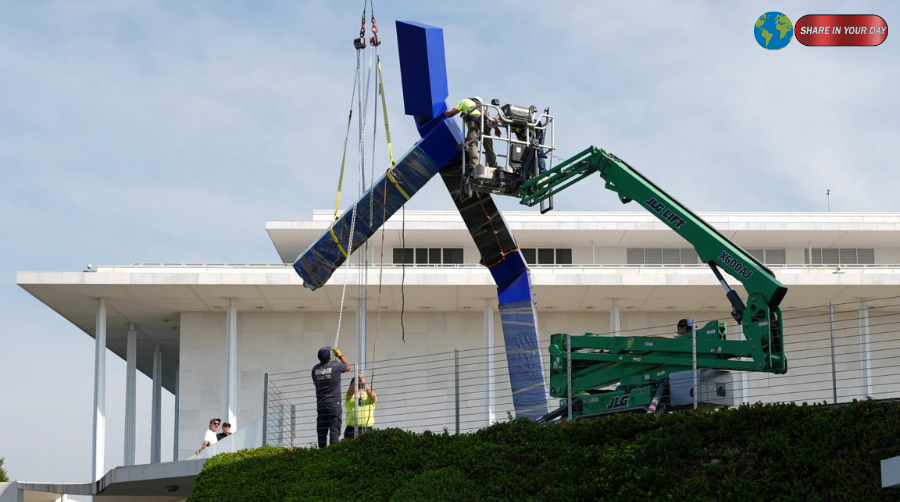
Workers dismantled the towering blue sculpture on Wednesday, Sept. 2, carefully removing its arms and legs before taking the artwork away from the campus. Created by acclaimed American sculptor Joel Shapiro, the piece had stood at the Kennedy Center since 2019 and had become a recognizable part of the complex.
The removal comes as the Kennedy Center undergoes a major transformation under a board aligned with Trump. The institution has already faced disputes over leadership, programming, renovations and efforts to associate the president’s name with the historic performing arts center.
Kennedy Center Blue sculpture removed after seven years
The Kennedy Center Blue sculpture was installed in 2019 as part of the Kennedy Center’s expanding campus.
The artwork was a tall, minimalist representation of a human figure. Its bright blue structure and unusual pose made it easy to recognize from a distance.
Shapiro was known for creating simplified human forms that appear to move, balance or interact with their surroundings. In the case of “Blue,” the figure appears to be in motion, almost as if it has just kicked a ball.
Shapiro described the work as being connected to action, risk, performance and energy. He also characterized it as a celebration of possibility, according to the Associated Press.
That interpretation helped make the sculpture particularly fitting for a performing arts center.
Rather than depicting a specific person or historical event, “Blue” represented movement and imagination. Over the years, it became part of the visual identity of the Kennedy Center campus.
Shapiro died in 2025 at the age of 83.
Why was the Kennedy Center Blue sculpture removed?
The Kennedy Center said the artwork was being removed at the request of the Joel Shapiro and Ellen Phelan Foundation.
The institution did not say that the sculpture was being destroyed or permanently discarded. Instead, the foundation is expected to determine where the artwork will be installed next.
The Kennedy Center said it was grateful for the years that “Blue” spent on its campus and praised Shapiro’s contribution.
That explanation has not ended controversy surrounding the removal, however.
The timing is significant because the Kennedy Center has been undergoing a series of major changes since Trump took control of its board.
The president became chairman of the Kennedy Center board after replacing members of the institution’s previous leadership structure. Since then, the center has pursued changes to its programming, leadership and physical appearance.
Reports have also indicated that internal Kennedy Center documents showed plans to remove “Blue” after Trump’s takeover, although those documents did not establish a specific reason for targeting the sculpture.
That has fueled speculation about whether the artwork’s removal is connected to the broader effort to reshape the institution.
There is currently no confirmed evidence that Shapiro’s personal political views were the reason the sculpture was removed.
A beloved landmark for Kennedy Center visitors
For many visitors, the Kennedy Center Blue sculpture was more than an ordinary piece of outdoor art.
The sculpture stood near The REACH, the Kennedy Center’s newer campus addition. Its location made it visible to visitors attending performances, educational programs and community events.
The artwork also became associated with National Dance Day celebrations.
Michael Sebastiani, a member of the advocacy group Hands Off the Arts, told AP that “Blue” had been a welcoming fixture for people coming into the city. He also described the sculpture as a mascot for National Dance Day events.
Its connection to dance was particularly appropriate because the sculpture itself appeared frozen in a moment of movement.
For supporters of the artwork, removing it means losing an important part of the campus atmosphere.
The criticism is not necessarily focused only on the sculpture itself. Instead, some observers see its removal as another example of how the Kennedy Center’s identity is changing.
Workers carefully dismantle Blue
Images from the removal showed workers using a crane to dismantle the sculpture.
The artwork’s individual appendages were wrapped for protection as crews worked around the structure. The process highlighted the fact that “Blue” was being carefully deinstalled rather than simply demolished.
That distinction matters because the artwork may eventually appear somewhere else.
The Joel Shapiro and Ellen Phelan Foundation is expected to determine its next location.
As a result, the sculpture’s story may be moving to a new chapter rather than ending altogether.
Still, its absence from the Kennedy Center represents a major visual change for visitors who have become familiar with the bright blue figure since its installation in 2019.
Joel Shapiro’s legacy lives on
Joel Shapiro was one of America’s best-known contemporary sculptors.
His work frequently explored the human figure using simple geometric shapes and seemingly unstable arrangements. Instead of producing highly detailed representations of people, Shapiro used basic forms to create a strong sense of movement.
That approach made his sculptures immediately recognizable.
“Blue” reflected those characteristics. The simplified figure avoided facial details and other realistic features while suggesting a human body caught in motion.
The result was a sculpture that could be interpreted in different ways depending on the viewer’s position.
From one angle, the figure could appear to be kicking something. From another, it could look as though it were taking a large step or balancing in the middle of an energetic movement.
Shapiro’s death in 2025 means that the current removal is taking place without the artist being able to comment on the decision himself.
His foundation and representatives therefore play an important role in determining the artwork’s future.
Kennedy Center faces broader controversy
The Kennedy Center Blue sculpture removal is happening against the backdrop of a much larger dispute over the future of the institution.
Trump and his allies have pushed for significant changes to the Kennedy Center since taking control of its leadership.
One of the most controversial issues has involved the president’s name.
The Kennedy Center’s official name is tied to President John F. Kennedy and was established by Congress as a living memorial. A Trump-aligned board previously moved to place Trump’s name alongside Kennedy’s on the building.
That action triggered a legal battle.
A federal judge previously ruled that the center’s official name could not simply be changed by the board because Congress had established the institution’s name. More recently, the administration has continued fighting over signage and references to Trump at the complex.
The dispute has made the Kennedy Center a national political flashpoint.
Supporters of Trump’s changes argue that the president is modernizing and restoring an institution they believe needs significant improvements.
Critics argue that the changes threaten the Kennedy Center’s traditional role as a national, nonpartisan cultural institution.
The sculpture removal adds to the debate
The removal of “Blue” has become part of that larger debate because art is closely tied to the identity of cultural institutions.
A performing arts center is not simply a collection of theaters. Its architecture, public spaces, sculptures and exhibitions also contribute to the experience visitors have when they arrive.
That is why the departure of one outdoor sculpture can attract attention well beyond the art world.
Critics of the decision have questioned why a recognizable public artwork needed to leave the campus.
The Kennedy Center, meanwhile, has emphasized its stewardship of Shapiro’s work and said it is honored to have hosted the sculpture.
The two perspectives highlight the central question surrounding the Kennedy Center’s transformation: how much should an institution change while preserving the cultural identity that made it important in the first place?
Trump-era changes are reshaping the institution
The Kennedy Center Blue sculpture is only one visible element of the changes taking place at the institution.
Trump has promoted a broader vision for reshaping Washington, including major renovation projects and changes to prominent landmarks.
At the Kennedy Center, the administration has discussed substantial renovations and has pursued changes that would make the complex more closely associated with Trump’s leadership.
Those moves have generated resistance from artists, former officials and advocacy groups.
Some performers and arts organizations have also distanced themselves from the Kennedy Center since Trump’s takeover.
The resulting debate is about more than one building. It touches on questions of artistic independence, government influence and the role of public cultural institutions.
Could Blue return somewhere else?
There is still a possibility that “Blue” will remain part of Washington’s cultural landscape or find a new home elsewhere.
The Joel Shapiro and Ellen Phelan Foundation is expected to decide where the sculpture goes next.
That means the removal from the Kennedy Center does not necessarily represent the permanent disappearance of the artwork.
A new location could also give “Blue” a fresh public life.
Because the sculpture has already developed a recognizable identity, another museum, arts organization or public space could potentially become its next home.
The possibility of relocation also explains why the Kennedy Center described the process as a deinstallation rather than destruction.
What the removal means for Kennedy Center visitors
Visitors returning to the Kennedy Center will notice a different campus without the familiar blue figure.
For people who attended performances or National Dance Day events near The REACH, the empty space may be particularly noticeable.
Public art often becomes part of people’s memories without them consciously realizing it.
A sculpture can become a meeting point, a backdrop for photographs or simply something visitors recognize when they return years later.
“Blue” appears to have filled that role for many Kennedy Center visitors.
Its removal therefore changes not only the physical appearance of the campus but also a small part of the institution’s recent history.
A symbolic moment in a changing Kennedy Center
The Kennedy Center Blue sculpture may eventually find a new home, but its removal has already become symbolic of the changes underway at America’s national performing arts center.
The sculpture arrived during a period when the Kennedy Center was expanding its public spaces and developing The REACH into a major part of the campus.
Seven years later, it has been carefully dismantled as the institution enters a very different era.
The Kennedy Center says it is grateful to have been the steward of Shapiro’s work.
Critics, however, worry that the removal represents a broader loss of the institution’s previous identity.
Whether “Blue” eventually returns to another prominent public space remains to be seen.
For now, the bright blue figure that once greeted visitors at the Kennedy Center is gone.
Its removal is another reminder that the Kennedy Center is undergoing one of the most significant transformations in its modern history — and that the debate over what the institution should represent is far from finished.
Image ALT Text
Kennedy Center Blue sculpture being removed from the Kennedy Center grounds
Suggested Image Caption
Workers dismantle Joel Shapiro’s “Blue” sculpture at the Kennedy Center in Washington, D.C., on Sept. 2, 2026.