Moon city ambitions meet a critical water question
The idea of a Moon city is moving from science fiction toward a serious subject of discussion in the space industry. Elon Musk has said SpaceX is now focused on developing a “self-growing city” on the Moon that could become possible within less than a decade.
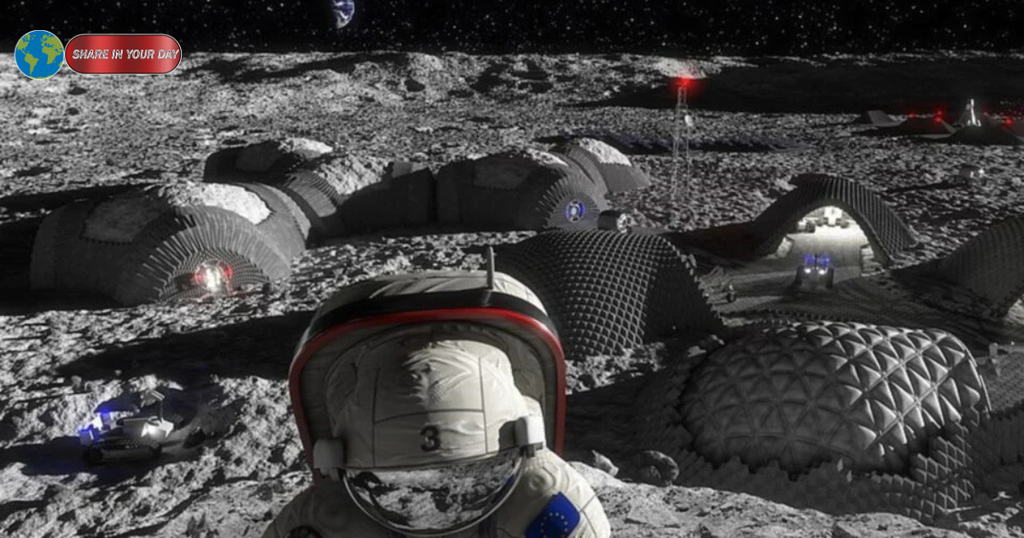
But a major question remains: How long could such a settlement survive using the Moon’s available water?
New research has raised concerns about whether lunar water reserves are sufficient to support a large, permanent human population. Researchers Martin Elvis and Jonathan McDowell estimate that even a substantial lunar settlement could face severe water constraints, particularly if its population eventually reaches the scale envisioned by Musk. GGizmodo+1
The problem is not simply whether water exists on the Moon. Scientists already have evidence of lunar water, particularly in permanently shadowed polar regions. The bigger challenge is determining how much usable water exists, where it is located, how difficult it would be to extract, and how efficiently a future settlement could recycle it.
Those questions could become decisive for any future Moon city.
Musk wants a self-growing Moon city
Musk’s latest lunar ambitions represent a significant change in SpaceX’s long-running focus on Mars.
In February 2026, Musk said SpaceX had shifted its attention toward building a self-growing city on the Moon, with the possibility of achieving it in less than 10 years. Contemporary reports described the move as a major change from SpaceX’s previous emphasis on establishing a human settlement on Mars. TThe Independent+1
The concept of a self-growing settlement is particularly ambitious.
Rather than relying indefinitely on supplies launched from Earth, a mature lunar settlement would need to manufacture or obtain many of its essential resources locally. That could include construction materials, oxygen, fuel, food and water.
This approach is often discussed through the concept of using local resources, sometimes called in-situ resource utilization.
For a lunar settlement to grow continuously, however, local resources would need to be available at a scale large enough to support increasing numbers of residents.
Water is arguably the most important of those resources.
Why water matters so much on the Moon
Water would have several uses in a lunar settlement.
Humans need it for drinking and hygiene. Agriculture would require water as well. Industrial processes could consume additional quantities, while water can also be separated into hydrogen and oxygen.
That last use is especially important for space exploration.
Hydrogen and oxygen can serve as rocket propellants. A lunar settlement capable of extracting water and processing it into propellant could potentially support transportation between the lunar surface and orbit.
Water therefore represents much more than a basic human necessity.
It could become an important part of the infrastructure supporting a lunar economy.
The difficulty is that the Moon does not have rivers, lakes or easily accessible underground aquifers comparable to those found on Earth.
Instead, much of the water of interest is believed to exist as ice or other forms of hydrogen-bearing material, especially in extremely cold permanently shadowed areas near the lunar poles.
Lunar ice may be harder to access than expected
The Moon’s polar regions have attracted enormous interest because some crater interiors never receive direct sunlight.
Temperatures in these permanently shadowed regions can become extraordinarily cold, creating conditions where water ice can remain stable for long periods.
But finding ice does not automatically make it available for human consumption or industrial use.
A future lunar mining system would need to locate deposits, excavate or otherwise collect the material, process it and purify the resulting water.
That requires machinery, energy and infrastructure.
Recent research has also complicated earlier assumptions about the amount of accessible lunar water. Gizmodo reported in March that a study had raised questions about previous estimates after a search for surface ice in permanently shadowed regions failed to find the expected abundance. GGizmodo
The uncertainty matters because lunar settlements cannot be designed around a resource estimate that later turns out to be overly optimistic.
How long could a Moon city survive?
The answer depends heavily on population and recycling efficiency.
The researchers discussed in the recent reporting estimate that a lunar settlement with one million people could potentially exhaust available polar ice on a timescale of roughly a century, even assuming extremely high recycling efficiency. EEarth.com+1
That does not mean a million-person lunar city would literally run out of every molecule of water after 100 years.
The calculation is instead an illustration of how finite resources could constrain a large settlement.
The situation could become considerably more difficult if the actual amount of accessible ice is lower than optimistic estimates suggest.
Conversely, future discoveries could change the picture.
Scientists may identify additional deposits, improve extraction methods or develop technologies capable of recycling water more efficiently than current systems.
The uncertainty is therefore significant.
A smaller Moon city could be more realistic
One implication of the research is that the scale of a settlement may matter more than the simple existence of lunar water.
A relatively small scientific or industrial outpost would consume far less water than a city housing hundreds of thousands or millions of people.
Researchers have suggested that settlements of roughly 1,000 people could represent a much more manageable scenario under some assumptions. TThe Times
Such a settlement would still face extraordinary engineering challenges.
Residents would need protection from radiation, extreme temperature changes and the Moon’s lack of a breathable atmosphere. Habitats would also need reliable power, communications, food production and waste-management systems.
However, a small settlement could potentially operate within a much tighter resource budget.
That creates an important distinction between establishing a permanent Moon base and building a self-sustaining lunar metropolis.
The Moon could have abundant energy
Water may be a limiting resource, but energy is a different story.
Certain locations near the lunar poles receive sunlight for exceptionally long periods because of the Moon’s geography.
Solar power could therefore provide a potentially valuable energy source for future infrastructure.
Researchers have suggested that lunar solar power could support energy-intensive activities, including resource extraction and industrial operations. Space
Nuclear power could provide another option.
The combination of abundant energy and limited water creates an unusual engineering problem.
A future lunar settlement might have enough energy to operate powerful machines but still struggle to obtain one of the basic resources those machines need to process.
Water recycling would become essential
A large Moon city could not operate like a typical Earth city.
On Earth, water moves through enormous natural cycles involving oceans, rivers, groundwater, clouds and precipitation. A lunar settlement would have no comparable natural water cycle.
Instead, engineers would need to create a largely artificial cycle.
Wastewater would have to be collected and processed. Moisture from human breathing and perspiration could potentially be recovered. Water used in agriculture would need to be captured and reused wherever possible.
The International Space Station already demonstrates that advanced water-recycling systems can dramatically reduce the amount of fresh water that astronauts require.
But a city would create different challenges.
Millions of people would produce vastly more waste and require much larger agricultural, industrial and sanitation systems.
The higher the recycling rate, the longer a finite lunar water supply could potentially last.
Yet achieving near-perfect recycling is extremely difficult.
Small losses accumulated over decades could eventually become significant.
Food production could add another challenge
A growing lunar settlement would eventually need to produce at least part of its own food.
That creates another major demand for water.
Plants require water to grow, and agriculture also involves evaporation and other losses. Closed-loop farming systems can recover some of that water, but they cannot eliminate every loss.
A lunar settlement might therefore need highly controlled agriculture designed around minimal water consumption.
Advanced hydroponic or aeroponic systems could potentially reduce some requirements compared with conventional soil-based farming.
Even so, food production on the Moon would remain an engineering problem closely tied to water availability.
What happens if lunar water runs short?
A water shortage would not necessarily mean the end of lunar civilization.
Several alternatives could theoretically extend the lifetime of a settlement.
One option would be importing water from Earth.
That would be expensive and would undermine the goal of creating a genuinely self-sustaining lunar settlement.
Another possibility would be importing water or water-rich material from asteroids.
Some asteroids contain substantial amounts of hydrated minerals or ice. If future space infrastructure makes asteroid mining practical, lunar settlements could potentially obtain additional water from outside the Moon.
That technology, however, remains far from being an established commercial supply chain.
A third possibility is discovering that the Moon contains more accessible water than current surveys indicate.
That would fundamentally change the resource calculation.
The biggest uncertainty is what scientists haven’t found yet
The debate over lunar water remains highly dependent on incomplete information.
Scientists know that water exists on the Moon. What remains uncertain is its exact distribution, concentration and accessibility at the scale needed for industrial operations.
Remote sensing provides important information, but future missions will need to directly investigate promising areas.
That could involve drilling, sampling and testing lunar materials.
Only then can engineers determine how much water can realistically be extracted.
This distinction between water existing and water being economically recoverable is critical.
A deposit containing a huge quantity of ice is not necessarily useful if extracting it requires enormous amounts of energy or machinery.
Musk’s timeline adds another layer of uncertainty
Musk’s proposed timeline is extremely ambitious.
A self-growing lunar city in less than 10 years would require several major technological and logistical advances to happen in parallel.
SpaceX would need reliable heavy-lift transportation, lunar landing capabilities, surface infrastructure, power generation, life-support systems, construction equipment and resource-processing technology.
The company would also need a way to transport enough equipment to establish the initial settlement.
The announcement therefore represents a long-term vision rather than evidence that a self-sustaining lunar city is already technically demonstrated.
The distinction is important.
SpaceX has made major advances in reusable launch technology, but building a permanent civilization on another world involves challenges far beyond transportation.
A Moon city may begin as something much smaller
The most plausible development path may involve gradual expansion.
Instead of immediately creating a metropolis, early lunar missions could establish small research stations.
Those facilities could test water extraction, construction methods, power systems and closed-loop life support.
If those systems work reliably, additional infrastructure could be added.
Robotic equipment could potentially arrive before large numbers of humans. Machines could prepare landing areas, move material and construct basic infrastructure.
Over time, a small scientific outpost could theoretically evolve into an industrial settlement.
That is where the concept of a “self-growing” city becomes important.
The settlement would need to use its existing infrastructure to build additional infrastructure.
The Moon’s water question could determine the future
The biggest lesson from the new research is not necessarily that a Moon city is impossible.
Instead, it highlights the importance of resource limits.
A settlement with a few dozen people is fundamentally different from one with thousands. A settlement with thousands is different again from a city with one million residents.
Each increase in population would multiply demand for water, food, housing, power and industrial production.
The Moon may eventually support a permanent human presence.
But whether it can support a huge self-sustaining metropolis is a much larger question.
Researchers currently have significant uncertainty about the amount of usable water available, while recent studies have challenged some earlier assumptions about lunar ice. GGizmodo+1
For Musk’s vision to become reality, advances in water extraction and recycling may be just as important as advances in rockets.
The future of lunar settlement may depend on efficiency
A successful lunar civilization would likely need to treat water as an extremely valuable resource.
Every kilogram lost would matter.
Every recycling improvement could extend the settlement’s operating lifetime.
Every new water deposit discovered could change the economics of expansion.
That makes lunar water research one of the most consequential areas of future Moon exploration.
Musk’s vision of a self-growing lunar city is therefore facing a deceptively simple question: How much water can the Moon actually provide?
The answer is still being investigated.
Until scientists know how much accessible water exists and engineers demonstrate that it can be extracted economically, the scale of any future lunar city remains uncertain.
For now, the Moon may have enough resources to support human outposts. Whether those outposts can grow into millions of residents is a much harder question—and water could ultimately determine the answer.