Ceuta Migrant Crisis: 5 Revealing New Claims
The Ceuta migrant crisis has taken a new diplomatic turn after Spanish Prime Minister Pedro Sánchez accused networks linked to Russia and Israel of spreading disinformation following the mass migrant crossings from Morocco into the Spanish territory.
The accusations add an international dimension to a crisis that has already placed enormous pressure on Spain’s border authorities, local government and European migration policy.
More than 72,000 migrants rushed into Ceuta between July 30 and July 31, according to Spanish reporting cited by CBS News and other international outlets. At least 70 people died during the attempted crossings, according to Spain’s national EFE news agency, although other estimates from local authorities have been higher.
Most of those who crossed have since returned to Morocco. However, thousands remained in Ceuta at the end of August, creating an increasingly difficult humanitarian and political situation in the small Spanish territory.
Sánchez now says the crisis was amplified by false information circulating online. He also argues that Russian- and Israeli-linked networks exploited the situation to attack Spain over its positions on Russia’s war in Ukraine and Israel’s conduct in Gaza.
Both Russia and Israel have rejected the accusations.
Ceuta Migrant Crisis Began With a Massive Border Surge
The scale of the Ceuta migrant crisis was unprecedented.
Ceuta is a small Spanish territory on the North African coast, surrounded by Morocco. Its strategic position makes it one of the European Union’s most sensitive migration pressure points.
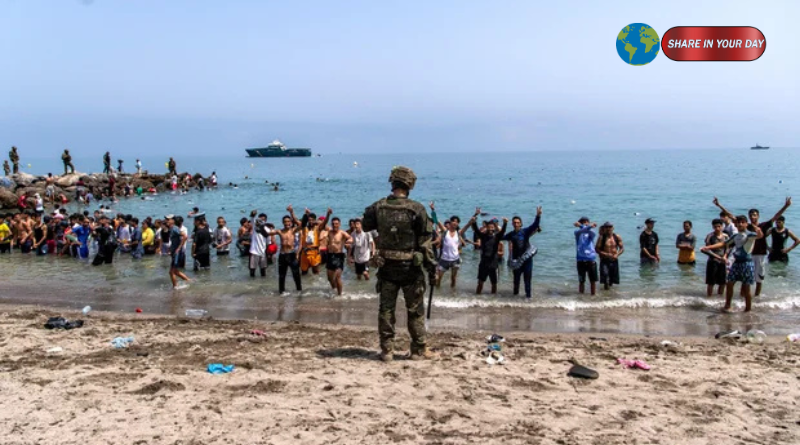
During the late-July crisis, tens of thousands of people moved toward the territory. Many attempted to reach Ceuta by swimming or using coastal routes around the border.
Spanish authorities were quickly overwhelmed.
CBS News reported that more than 72,000 migrants rushed across the border during July 30 and 31. The figure was extraordinary compared with Ceuta’s normal population and created an immediate emergency for police, military personnel, shelters and local authorities.
Earlier reports also described a rapidly developing humanitarian emergency, with migrants gathering along beaches and border areas while Spanish security forces attempted to regain control.
The Spanish government eventually deployed additional resources and began returning large numbers of migrants to Morocco.
However, the crisis did not end when the majority left.
Thousands remained in Ceuta, including many minors, leaving local authorities struggling to provide adequate accommodation and services.
Social Media Played a Major Role
One of the most important elements of the crisis was the role played by social media.
Before and during the mass crossings, false claims circulated online suggesting that Spain’s border was effectively open or that migrants entering Ceuta would be able to remain in Spain.
Other online posts reportedly offered information about routes, patrol movements and ways to reach the territory.
A Washington Post report based on Associated Press reporting described how Instagram posts, Facebook discussions and TikTok videos helped create the impression that Spain had opened its border. The rumors encouraged thousands of people to travel toward the Moroccan city of Fnideq, close to Ceuta.
The Spanish government subsequently tried to correct those claims.
Spain’s Foreign Ministry specifically stated that entering Ceuta or Melilla irregularly does not give migrants the right to remain in Spain, travel to mainland Spain or move freely through Europe. It also emphasized that a Spanish Supreme Court ruling had not created a new legal route into the country.
That distinction became central to understanding the crisis.
A court ruling concerning the procedures applicable to certain arrivals by sea was reportedly misrepresented online as an opening of Spain’s borders. The false interpretation then spread rapidly through social media.
The result was a dangerous combination of misinformation, desperation and mass movement.
Spain Accuses Russia and Israel of Amplifying Disinformation
The latest development has moved the story beyond migration policy.
Sánchez said that after the July 30 and 31 crossings, social media networks linked to Russia and Israel, along with international far-right groups, amplified rumors and disinformation.
He said the activity was not simply about migration.
According to Sánchez, the alleged campaigns were intended to attack Spain and deepen divisions within Europe.
The Spanish prime minister connected the accusations to Madrid’s foreign policy. Spain has strongly supported Ukraine since Russia’s full-scale invasion and has also been among the European governments most outspoken in criticizing Israel’s actions in Gaza.
Sánchez said those political positions provided a possible motive for foreign actors to exploit the migration crisis.
However, an important distinction must be made.
Spain’s allegation is not the same as an independently established finding that Russia or Israel caused the mass migration.
Sánchez referred to research by the European External Action Service, the EU’s diplomatic service, but did not publicly provide detailed evidence during his interview.
That has become a major point of controversy.
What Does the EU Evidence Actually Show?
The question of what European investigators found remains central to the dispute.
Sánchez said EEAS research indicated links involving Russian and Israeli networks.
Spanish government officials later defended the prime minister’s comments by pointing to European analysis of online activity surrounding the crisis.
But reports from Spain have raised questions about how far the available evidence actually goes.
One Spanish report said EU analysis identified Russian influence activity following the crisis but did not establish that Russia or Israel had caused the original migrant surge. It also reported that alleged Israeli activity was more limited and was not clearly connected to the Israeli government.
That distinction matters.
There is considerable evidence that misinformation circulated around the crisis. There is also evidence that online networks attempted to exploit the situation after the border surge.
But establishing that a particular government directed or organized such activity requires a much higher evidentiary threshold.
The controversy therefore centers on whether foreign-linked networks merely amplified existing misinformation or whether they deliberately orchestrated a broader campaign.
So far, the public evidence described in available reports does not conclusively establish that Russia or Israel organized the mass crossing itself.
Israel Rejects Spain’s Allegations
Israel reacted strongly to Sánchez’s accusations.
Israeli Foreign Minister Gideon Saar publicly rejected the claim and accused the Spanish prime minister of lying.
Saar said the allegation that Israel had disseminated misleading information about the Ceuta events was false. The Israeli government has also previously criticized Spain over its policies toward Israel and the Gaza war.
The dispute is therefore taking place against an already strained political relationship.
Spain has been one of Europe’s strongest critics of Israel’s conduct in Gaza, while Israeli officials have repeatedly criticized Madrid’s position.
The Ceuta allegations add another issue to that diplomatic confrontation.
Israel’s response also highlights the difficulty of distinguishing between activity by individuals, online communities and groups based in a country and activity that can legitimately be attributed to that country’s government.
That distinction is particularly important in modern disinformation investigations.
Russia Also Demands Evidence
Moscow has similarly rejected Sánchez’s allegations.
Russian officials have demanded evidence supporting the Spanish prime minister’s claims.
The Kremlin’s response means the Ceuta migrant crisis has now become part of a wider political argument involving Russia, Spain and the European Union.
Russia has repeatedly faced accusations from European governments of using online influence operations to exploit political divisions.
Migration is particularly vulnerable to such campaigns because it can quickly become politically polarizing.
Images of large groups crossing borders can spread rapidly online. False claims can generate fear among local residents while simultaneously encouraging people in neighboring countries to attempt dangerous journeys.
That makes migration an especially powerful subject for disinformation campaigns.
But it also creates a challenge for governments.
Officials must identify genuine foreign interference without automatically treating every false social media post as evidence of a state-directed operation.
Spain Rejects Blame on Morocco
Another major controversy surrounding the Ceuta migrant crisis involves Morocco.
Some Spanish politicians and local officials have questioned whether Moroccan authorities deliberately allowed or encouraged the mass movement toward Ceuta.
Sánchez has rejected that theory.
He said Spanish intelligence services had not provided evidence that Morocco was responsible for the surge. Instead, he defended continued cooperation between Madrid and Rabat.
The prime minister argued that the crisis could only be resolved through cooperation with Morocco rather than confrontation.
This is politically significant.
Morocco is one of Spain’s most important partners in managing migration toward Europe. Cooperation between the two countries has helped Spain control migration routes and coordinate border security.
A breakdown in that relationship could create additional pressure on the western Mediterranean migration system.
For Sánchez, maintaining cooperation with Rabat may therefore be as important as addressing the political criticism coming from inside Spain.
Thousands of Migrants Still Remain in Ceuta
The Ceuta migrant crisis has not disappeared simply because the initial border surge ended.
Sánchez said around 5,000 migrants remained in the territory at the end of August, including about 1,200 minors. Other estimates have varied depending on the source and the definition of who remains in Ceuta.
The continuing presence of migrants has created pressure on accommodation, public services and local infrastructure.
Ceuta is only around 18 square kilometers in area and has a population of approximately 80,000.
That makes the sudden arrival of tens of thousands of people an extraordinary logistical challenge.
The situation has also generated protests among residents.
Local concerns include public safety, sanitation, accommodation and the availability of services.
At the same time, humanitarian organizations and government officials face the challenge of protecting vulnerable people, particularly children who arrived without parents or guardians.
The result is a highly polarized environment.
Spain Turns to the European Union
Madrid has increasingly sought European support as the crisis continues.
Spain requested assistance from Frontex, the EU’s border and coast guard agency, to help process migrants remaining in Ceuta. The request reflects the fact that the crisis has implications beyond Spain’s national borders.
Ceuta is part of Spain and the EU, making its border strategically important to the wider European migration system.
European governments have also expressed concern about the security of the bloc’s external borders.
A briefing from the UK House of Commons Library noted that more than 70,000 migrants crossed into Ceuta in July and that the incident raised questions about the integrity of Europe’s external borders and the operation of the Schengen system.
The crisis therefore has the potential to influence future European migration policy.
Governments may seek stronger border controls, faster responses to misinformation and closer cooperation with countries such as Morocco.
The Bigger Lesson From the Ceuta Crisis
Perhaps the most important lesson from the Ceuta migrant crisis is the speed at which online misinformation can translate into real-world events.
A false social media claim can reach thousands of people within hours.
When those claims concern migration, border policy or asylum rules, the consequences can be especially serious.
In Ceuta, misinformation reportedly helped create the belief that entering Spain would provide migrants with a new legal opportunity to remain in Europe.
Spain’s government later attempted to correct those claims.
But by then, thousands of people were already moving toward the border.
The episode demonstrates that governments face two challenges at once.
The first is controlling physical borders.
The second is controlling the information environment surrounding those borders.
The second problem can be much harder.
What Happens Next?
The diplomatic dispute over the Ceuta migrant crisis is likely to continue.
Spain will face pressure to explain the evidence behind Sánchez’s claims concerning Russian and Israeli-linked networks.
Russia and Israel will continue demanding proof.
Meanwhile, Spanish opposition parties are expected to keep challenging the government’s handling of the migration surge and its decision to rule out Moroccan involvement.
For Ceuta itself, the immediate priority remains managing the thousands of migrants who are still there while preventing another mass crossing.
The European Union also faces a broader question: how should it respond when migration crises are accelerated by viral misinformation?
The answer could shape future European border policy.
For now, the Ceuta crisis remains a warning about the intersection of migration, geopolitics and social media.
What began as a chaotic border surge has developed into a much wider political confrontation involving Spain, Morocco, Russia, Israel and the European Union.
And the most controversial question remains unresolved: who was responsible for amplifying the information that helped turn a regional migration problem into one of Europe’s most dramatic border crises of 2026?