Ceuta Migrant Crisis: Spain Blames Russia and Israel
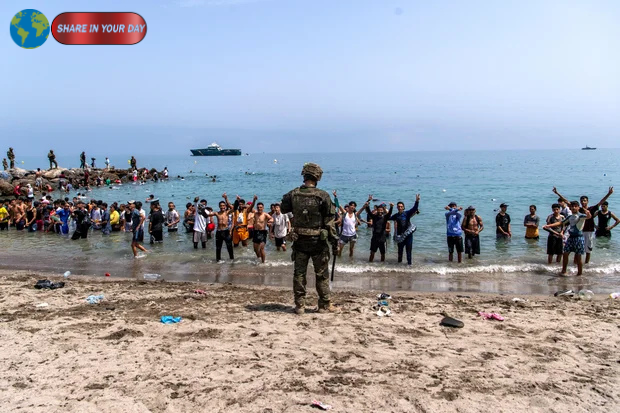
Spain’s Ceuta migrant crisis has taken a new geopolitical turn after Prime Minister Pedro Sánchez accused networks linked to Russia and Israel of spreading disinformation following the massive and deadly migration surge into the Spanish territory.
Sánchez said misleading narratives circulating online were exploited to attack Spain and deepen political divisions in Europe. His comments have drawn strong denials from both Israel and Russia, adding a diplomatic dimension to a crisis that has already raised serious questions about migration, border security and the power of online disinformation.
The events in Ceuta represent one of the most significant migration emergencies Spain has faced in years. More than 72,000 migrants crossed from Morocco into the Spanish territory during the mass crossings at the end of July, while dozens of people died during attempts to reach the enclave. Thousands remained in Ceuta at the end of August, including a significant number of minors.
Pedro Sánchez Links Disinformation to Russia and Israel
The Ceuta migrant crisis became the focus of an intense political dispute after Sánchez said social media networks linked to Russia and Israel had helped spread rumors and misleading information surrounding the migration emergency.
Speaking to Spanish radio network Cadena SER, Sánchez said the disinformation was part of a broader effort to exploit migration as a political weapon.
According to Sánchez, the activity was not simply about Spain’s immigration policies. He argued that foreign-linked networks and elements of the international far right were using the crisis to attack Spain and contribute to wider divisions across Europe.
Sánchez pointed to information associated with the European External Action Service, the European Union’s diplomatic service, as part of the basis for his concerns. However, detailed public evidence linking specific online networks directly to the events has not been fully disclosed.
The Spanish prime minister suggested that Spain’s positions on Russia’s war against Ukraine and Israel’s military actions in Gaza may have contributed to the country’s becoming a target of hostile online narratives.
Spain has been a strong supporter of Ukraine since Russia launched its full-scale invasion in 2022. At the same time, Sánchez has become one of Europe’s most outspoken critics of Israel’s actions in Gaza and the occupied West Bank.
What Happened During the Ceuta Migrant Crisis?
Ceuta is a small Spanish-controlled territory on the North African coast that shares a land border with Morocco. Along with Melilla, it represents one of the European Union’s only land borders with Africa.
The latest Ceuta migrant crisis began with an extraordinary mass movement of people toward the territory between July 30 and July 31. More than 72,000 migrants crossed or attempted to cross into Ceuta, overwhelming local authorities and forcing Spain to deploy major security resources.
The crisis also carried a devastating human cost. CBS News reported that at least 70 people died during the attempted mass crossings, according to Spain’s EFE news agency.
Although the majority of migrants were later returned to Morocco, approximately 5,000 people remained in Ceuta by the end of August. Sánchez said that figure included around 1,200 minors.
The scale of the event immediately transformed the local emergency into a national and European political issue.
Social Media and the Spread of False Information
Online misinformation has been identified as an important part of the wider story surrounding the Ceuta migrant crisis.
Earlier reporting indicated that Spanish and Moroccan authorities were examining how misleading claims circulated through social media platforms before and after the mass crossings. Some posts allegedly promoted false or distorted interpretations of Spanish immigration rules and legal decisions.
One important narrative involved a ruling by Spain’s Supreme Court. According to Spanish authorities, some smuggling networks and online accounts presented the decision in a misleading way, creating the impression that migrants who reached Ceuta would automatically be able to remain in Spain or continue to mainland Europe.
That interpretation was incorrect, according to Spanish officials. However, the false belief may have encouraged people to make the dangerous journey toward Ceuta.
The episode illustrates how quickly inaccurate information can produce real-world consequences. A misleading legal interpretation shared online can spread through social networks, messaging groups and informal communities before authorities have an opportunity to respond.
Spain Rejects Claims That Morocco Orchestrated the Crisis
Another major controversy surrounding the Ceuta migrant crisis concerns Morocco’s possible role.
Some Spanish politicians and officials questioned whether Moroccan authorities had encouraged or permitted the mass crossings. Ceuta’s regional leader, Juan Jesús Vivas, suggested that the events may have been at least tolerated or facilitated.
Sánchez, however, rejected that assessment.
The Spanish prime minister said he had no evidence that the Moroccan government was directly involved and described Spain’s cooperation with Morocco on migration issues as positive. He argued that managing the crisis requires continued cooperation between Madrid and Rabat.
Moroccan officials had also previously blamed the crisis partly on the malicious exploitation of digital platforms and the spread of misleading information.
The disagreement over Morocco’s role has complicated Spain’s political response. Opposition figures and some members of Sánchez’s broader political camp have questioned whether the government is too willing to dismiss concerns about Morocco’s potential responsibility.
Israel Strongly Rejects Sánchez’s Allegations
Israel responded forcefully to Sánchez’s claims.
Israeli Foreign Minister Gideon Saar accused the Spanish prime minister of making false allegations and described Sánchez’s statements as defamatory.
The dispute reflects broader tensions between the governments of Spain and Israel.
Spanish officials have repeatedly criticized Israel’s military campaign in Gaza, while Israeli officials have accused Sánchez’s government of hostility and political bias. The Ceuta migrant crisis has now become another source of confrontation between the two countries.
Sánchez has argued that the alleged disinformation should be viewed within the wider context of international political disputes. Israeli officials, however, have firmly denied any involvement in spreading misleading information connected to the Ceuta crisis.
Russia Also Denies Any Role
Russia has similarly rejected allegations that networks connected to Moscow played a role in spreading disinformation around the Ceuta migrant crisis.
Russian officials have demanded evidence to support Sánchez’s claims and dismissed the suggestion that Moscow was involved in causing or directing the migration emergency.
The available information has created an important distinction between exploiting a crisis and causing it.
European officials and media reports have indicated that Russia-linked actors may have attempted to exploit the situation through online disinformation and polarizing narratives. However, there is no confirmed public evidence that foreign actors directly caused the initial mass migration event.
That distinction could become increasingly important as Spanish authorities and European institutions continue to investigate what happened.
The Ceuta Migrant Crisis Raises Questions About European Security
The events in Ceuta have also reignited a wider European debate over illegal migration and border security.
The scale of the crossings alarmed governments across the continent. In early August, leaders from 22 of the European Union’s 27 member states signed a joint letter emphasizing the need for stronger action against illegal migration and more effective protection of Europe’s external borders.
The letter also referred to policies that could potentially act as migration “pull factors,” including large-scale regularization programs for undocumented migrants.
Spain recently introduced a program that allows certain undocumented migrants to apply for legal status if they meet specific eligibility requirements.
More than 1.1 million applications were submitted under the scheme, far exceeding initial expectations. Sánchez has defended the policy, arguing that legal status allows migrants to work formally, contribute to society and integrate more effectively.
Critics, however, have argued that such programs could encourage further irregular migration.
The Ceuta migrant crisis has intensified this political debate and placed Spain’s immigration policies under greater international scrutiny.
Why Disinformation Is Now a Major Security Concern
One of the most significant lessons from the Ceuta migrant crisis may involve the growing relationship between digital misinformation and real-world security threats.
Migration networks increasingly rely on smartphones, social media platforms and encrypted messaging services to share information about travel routes, border conditions and immigration laws.
This digital environment can also be exploited by smugglers, political activists and foreign influence networks.
False information does not necessarily need to convince everyone to be dangerous. It may only need to reach a relatively small group of people who are willing to act on it.
In the case of Ceuta, misleading claims about Spanish law and potential opportunities in Europe may have contributed to dangerous decisions by migrants who believed they would be able to remain in Spain.
Authorities are therefore increasingly treating online misinformation as more than a communications problem. It can become a border security, humanitarian and public safety issue.
What Happens Next for Spain and Ceuta?
The immediate emergency may have eased, but the consequences of the Ceuta migrant crisis continue to affect Spain.
Thousands of migrants remain in the territory, local infrastructure is under pressure and the national government faces criticism over its handling of the crisis.
Spain must also manage difficult diplomatic relationships with Morocco, Israel and Russia while responding to domestic concerns about border security and migration.
Meanwhile, the political battle over what caused the crisis is unlikely to end soon.
Sánchez’s claims have focused international attention on alleged foreign disinformation campaigns, while his critics continue to question Spain’s immigration policies and the government’s relationship with Morocco.
European institutions may also face pressure to provide greater transparency about evidence concerning online influence operations connected to the crisis.
Conclusion: A Migration Crisis With Global Consequences
The Ceuta migrant crisis is no longer simply a border emergency involving Spain and Morocco.
It has developed into a broader international dispute involving allegations of foreign disinformation, diplomatic tensions and competing views about how Europe should manage migration.
Pedro Sánchez’s accusations against networks linked to Russia and Israel have been firmly rejected by both countries. At the same time, evidence from European and Spanish reporting suggests that online disinformation played a significant role in amplifying narratives surrounding the crisis, even if the precise origins of the mass crossing remain disputed.