Germany drone threat triggers warning from Friedrich Merz
The Germany drone threat has become a growing national security concern after an explosive-carrying drone was discovered near Leipzig/Halle Airport, prompting Chancellor Friedrich Merz to warn that those responsible for such attacks will “pay a price.”
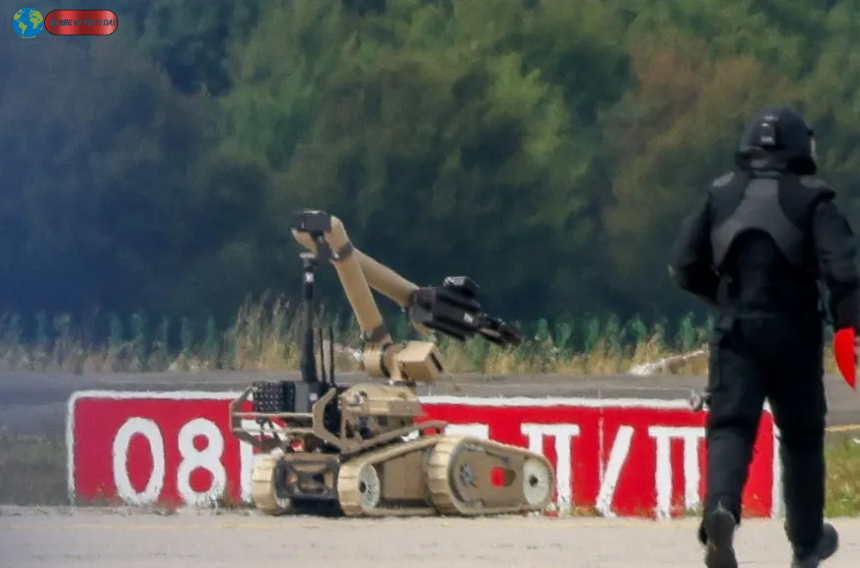
The incident has raised fresh questions about Germany’s ability to protect airports, military facilities and other critical infrastructure from increasingly sophisticated drone activity.
The discovery came as Germany was already dealing with a series of unauthorized drone flights over sensitive locations. Officials and security experts have warned that the incidents could represent a deliberate effort to test the country’s defenses.
For Berlin, the challenge is particularly serious because Germany remains one of Ukraine’s strongest supporters in its war against Russia.
Germany drone threat grows after explosive device discovery
The most serious incident occurred on 4 August, when authorities discovered a drone carrying an explosive device at Leipzig/Halle Airport in eastern Germany.
According to reporting linked to the BBC story, the explosive device failed to detonate because of a faulty detonator. Police were able to secure and neutralize the device before it caused casualties or significant damage.
Investigators also believe another drone may have collided with a nearby cargo aircraft.
The discovery was significant because Leipzig/Halle is not simply a civilian airport. It is an important logistics hub and has connections to military and international cargo operations.
The airport is also associated with Antonov Airlines, which operates cargo aircraft from the site.
That combination makes the location particularly sensitive from a security perspective.
Merz warns attackers will pay a price
German Chancellor Friedrich Merz has responded forcefully to the growing concern.
Merz said those responsible for attacks involving drones should expect consequences, warning that Germany would not simply ignore attempts to target sensitive locations.
The chancellor has also emphasized that Germany is working with security authorities to determine how the country can better defend itself.
The warning comes as Berlin considers additional measures to strengthen protection against drones.
German authorities are examining ways to improve air defenses and give security services additional capabilities to respond to hostile unmanned aircraft.
The government has also discussed measures that could allow authorities to take more aggressive action against those controlling drones.
Why the Leipzig airport incident matters
The Leipzig/Halle incident is important because it demonstrates how drones can be used to threaten infrastructure without requiring traditional military aircraft.
Small unmanned aircraft can be relatively inexpensive, difficult to detect and capable of reaching locations that would otherwise be heavily protected.
An explosive device carried by a drone could potentially disrupt airport operations, damage aircraft or create serious risks for passengers and workers.
The fact that the device discovered near Leipzig did not detonate was therefore crucial.
Had the detonator worked, the consequences could have been significantly more serious.
The incident has consequently become a warning for German authorities as they assess the country’s vulnerability to drone-based attacks.
Germany has seen more suspicious drone activity
The explosive drone discovery did not happen in isolation.
German authorities have reported a series of unauthorized drone flights in recent months.
The aircraft have reportedly been seen over locations including military bases, airports, energy facilities, ports and logistics companies.
These locations are particularly attractive to anyone seeking information about Germany’s infrastructure or military capabilities.
Security officials have raised concerns that some of the activity could be connected to foreign intelligence operations.
Russia has been mentioned in speculation surrounding some incidents, although German authorities have not publicly established Russian responsibility for the Leipzig device.
Moscow has denied involvement in such activity.
That distinction remains important.
Suspicion and intelligence assessments should not automatically be treated as proof of responsibility.
Russia remains a major concern for German security officials
The wider security environment has changed dramatically since Russia’s full-scale invasion of Ukraine.
Germany has become one of Kyiv’s most important European supporters, providing military equipment, financial assistance and political backing.
That has made Germany an increasingly important player in the wider European response to Russia.
At the same time, European governments have become more concerned about hybrid threats.
These can include cyberattacks, sabotage, disinformation campaigns, espionage and unauthorized drone activity.
The drone incidents therefore come at a time when European countries are already examining how hostile states could attempt to undermine critical infrastructure without launching conventional military attacks.
Germany’s geographic position and economic importance make the country particularly significant.
It has major airports, ports, rail networks, military facilities and industrial sites that are essential to both Germany and the wider European economy.
Explosive drone raises questions about airport security
The discovery at Leipzig/Halle has also raised questions about the security of major airports.
Airports already use multiple layers of protection, including surveillance systems, restricted areas and security personnel.
However, drones create a different kind of challenge.
Traditional airport security is primarily designed to control people and vehicles entering protected areas. A drone can approach from above, potentially bypassing many of those conventional barriers.
That means airports need increasingly sophisticated detection and response systems.
Authorities must be able to identify unauthorized aircraft, determine whether they represent a genuine threat and respond quickly enough to prevent an incident.
The Leipzig case demonstrates why that challenge is becoming increasingly important.
Germany plans stronger drone defenses
Berlin is now considering additional measures to improve its ability to deal with hostile drones.
One priority is strengthening Germany’s air-defense capabilities.
Another is improving coordination between civilian authorities, police, intelligence services and military organizations.
The government is also examining whether security agencies should have additional powers to respond to drone operators.
That could involve technological measures designed to disrupt or disable drones.
The debate is complicated by legal and operational questions.
Authorities need to distinguish between legitimate drone activity and potential hostile operations. They also need to determine who has the authority to intervene when a drone enters restricted airspace.
The more widespread drone technology becomes, the more important those rules will become.
Germany’s support for Ukraine adds another dimension
Merz has linked Germany’s security concerns with the country’s continued support for Ukraine.
The chancellor has emphasized that Germany’s backing for Ukraine is intended not to prolong the war indefinitely but to help create conditions for negotiations.
Germany’s position places it firmly among Ukraine’s most important European supporters.
That makes the country an important target for Russian criticism and, according to Western security officials, a potential target for hybrid pressure.
However, there is currently no publicly established evidence proving that Russia was responsible for the Leipzig drone incident.
The distinction matters because assigning responsibility for a security incident can have significant diplomatic consequences.
Germany therefore faces a difficult balance between responding firmly to potential threats and avoiding premature conclusions.
Military and civilian infrastructure increasingly overlap
The Leipzig incident also highlights how difficult it can be to separate civilian and military infrastructure.
Airports, ports and logistics companies can serve both commercial and strategic purposes.
Leipzig/Halle is an important example.
The airport handles major cargo operations and is connected to international logistics networks. At the same time, it has been used for military-related transportation.
That dual role makes the facility valuable for legitimate commerce but also potentially attractive to anyone attempting to disrupt Germany’s logistics infrastructure.
The same challenge applies to railways, energy terminals and industrial facilities.
Modern European security therefore requires authorities to protect infrastructure that may appear civilian but has broader strategic importance.
The wider European drone problem
Germany is not alone in facing concerns about suspicious drone activity.
Across Europe, governments have increasingly focused on the potential use of unmanned aircraft for surveillance, sabotage and other hostile purposes.
The technology itself is not inherently dangerous.
Drones are widely used for photography, agriculture, surveying, emergency services and commercial deliveries.
The problem arises when the same technology is adapted for hostile purposes.
That makes regulation and detection increasingly difficult.
Authorities cannot simply treat every drone as a threat. They must instead identify unusual behavior and determine whether a specific flight presents a genuine security risk.
This requires advanced technology as well as trained personnel.
What happens next?
The immediate focus will be on the investigation into the Leipzig incident and the broader series of suspicious drone flights.
German authorities will likely continue examining recovered equipment, flight paths and other evidence to determine who was responsible.
The government is also expected to continue strengthening its ability to detect and respond to unauthorized drones.
For Merz, the political challenge is equally significant.
He must reassure the public that Germany is capable of protecting critical infrastructure while avoiding unnecessary escalation with Russia or other potential adversaries.
The warning that attackers will “pay a price” signals that Berlin intends to take the threat seriously.
But determining exactly what that price would be depends on identifying those responsible and establishing sufficient evidence.
Germany drone threat becomes a major security test
The Germany drone threat represents a new type of security challenge for Europe’s largest economy.
The discovery of an explosive-carrying drone near Leipzig/Halle Airport showed that the danger is not simply theoretical. A device capable of causing significant disruption was found close to an important transportation hub.
The fact that it failed to detonate prevented a potentially serious incident.
Nevertheless, the episode has forced German authorities to confront a difficult question: how can a modern state protect critical infrastructure from small, inexpensive and potentially difficult-to-detect aircraft?
Merz’s warning demonstrates that Berlin intends to respond.
Germany is strengthening its defenses, reviewing security procedures and examining new ways to counter unauthorized drones.
At the same time, investigators still need to establish who was behind the Leipzig incident.
Until that question is answered, speculation about foreign involvement must remain separate from confirmed facts.
What is clear is that drones are becoming an increasingly important part of Europe’s security environment.
For Germany, the Leipzig incident is a powerful reminder that the country’s airports, military sites, energy infrastructure and logistics networks can face threats from the sky — and that traditional security measures may no longer be enough.
Source: BBC News
External sources to cite: BBC News, German government statements, Reuters and other established European security reporting.
Internal link suggestions: Link to existing articles about Germany, Ukraine, Russia, European security, NATO and drone warfare.
Featured image suggestion: A licensed editorial image of Friedrich Merz, a German airport, or a German military drone-defense system.