Macron Gaza Diplomacy Takes Center Stage at the UN
Macron Gaza diplomacy became a major focus of the United Nations General Assembly on September 22, as French President Emmanuel Macron publicly challenged US President Donald Trump over his description of the situation in Gaza.
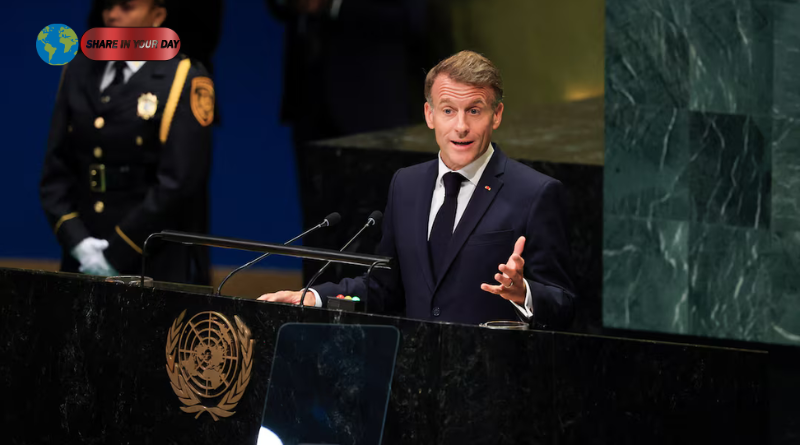
Speaking during his final appearance at the United Nations General Assembly before leaving office next year, Macron questioned Trump’s assertion that his administration had secured peace in Gaza. Macron said that despite the declaration of peace, humanitarian access had not been restored in the enclave.
The exchange came only hours after Trump addressed the same General Assembly and presented his Gaza peace plan as a diplomatic achievement.
The contrasting speeches highlighted a broader disagreement over how governments should measure progress in Gaza: through political declarations and an end to major fighting, or through tangible changes in humanitarian conditions and access.
Reuters reported that the White House did not immediately respond to a request for comment on Macron’s remarks.
Macron Gaza Diplomacy Challenges Trump’s Gaza Claims
The central issue in the Macron Gaza diplomacy debate was the meaning of peace.
Trump told world leaders that the war in Gaza had ended and said his administration had helped save large numbers of lives. Macron, however, argued that a declaration of peace was not sufficient if humanitarian access remained restricted.
Macron asked what credibility governments would have if they remained inactive while conditions in Gaza continued to deteriorate. He also questioned whether countries should simply watch what he described as a spectacle surrounding claims of peace.
The disagreement is significant because both leaders were speaking from the same international platform but emphasizing different indicators of progress.
Trump’s position, as reported by Reuters, focused on the conclusion of the war and the lives he said had been saved. Macron placed greater emphasis on humanitarian access and the continuing political and security consequences of the conflict.
The United Nations’ own opening debate also placed humanitarian access at the center of discussions.
UN Secretary-General António Guterres called for fighting to stop and humanitarian aid to flow. He also said the situation in the occupied Palestinian territory remained devastating and warned that violence, displacement and settlement expansion in the West Bank were undermining prospects for a two-state solution.
Why Humanitarian Access Matters in the Gaza Debate
Humanitarian access has become one of the clearest measures used by international organizations to assess conditions on the ground.
In his September 22 address, Guterres said that peace involves more than the absence of fighting. He linked peace to restraint, international law and the ability of humanitarian organizations to operate.
That context helps explain why Macron focused so strongly on humanitarian corridors.
Macron’s argument was not simply about whether a political agreement had been announced. Instead, he questioned whether such an agreement was producing concrete changes for civilians.
This distinction is important when assessing the competing diplomatic narratives surrounding Gaza.
A government may describe an agreement as a peace breakthrough, while humanitarian agencies and other governments may assess the situation through different criteria, including aid delivery, civilian protection and access for relief organizations.
The UN’s opening debate underscored those concerns. Guterres called for humanitarian aid to flow and urged governments to comply with international law and relevant court orders.
Macron Raises New Concerns About the West Bank
The Macron Gaza diplomacy story also extends beyond Gaza.
During his UN address, Macron turned attention toward the occupied West Bank, where he said continuing violations were undermining the possibility of a future Palestinian state.
He argued that developments in the West Bank were making a political project based on the rights of Palestinians increasingly difficult to achieve.
Reuters reported that France has strengthened its position on settler violence in the West Bank, including national sanctions and a process concerning products from Israeli settlements in the occupied territory.
The West Bank has become an increasingly important part of the wider debate over a two-state solution because developments there can affect the geographic and political viability of a future Palestinian state.
The UN has similarly warned about settlement expansion and violence in the territory. Guterres said such developments were undermining the path toward peace and called for preserving the possibility of a two-state solution.
France’s Position on Palestinian Statehood
Macron’s remarks also reflect a diplomatic position France adopted publicly at the UN in 2025.
At the previous year’s General Assembly, Macron announced France’s recognition of the State of Palestine while also stating that recognition of Palestinian rights did not remove the rights of Israelis.
The French president presented recognition as part of a broader effort to preserve the possibility of two states living alongside one another in peace and security.
That earlier decision provides important context for Macron’s latest remarks.
His September 2026 speech therefore did not represent an isolated intervention. It followed a broader French diplomatic approach that has increasingly emphasized Palestinian statehood, humanitarian concerns and the two-state framework.
At the same time, Macron has faced criticism inside France from politicians and activists who argue that recognition of Palestine has not been matched by sufficient action. Reuters reported those criticisms while also noting measures France has taken concerning violence and settlement-related products.
Macron and Trump Present Different Diplomatic Messages
The contrast between Macron and Trump was particularly visible because their speeches occurred on the same day and at the same venue.
Trump presented his administration’s actions as evidence of American diplomatic influence. Reuters reported that his UN speech also addressed Iran, Ukraine and the broader role of US power in international affairs.
Macron instead used his final UN appearance to defend multilateralism and the role of international institutions.
The difference reflects two approaches to international diplomacy.
One emphasizes national power and negotiated outcomes driven by major states. The other places greater emphasis on international institutions, legal frameworks and collective action among governments.
Neither description eliminates the complexity of the policies involved, but the speeches made the distinction particularly visible at this year’s General Assembly.
The official French presidency said Macron’s September 22 agenda focused on developing an effective multilateral response to major international crises, including Ukraine and the Middle East.
Macron Defends the United Nations
Another major element of Macron’s speech was his defense of the United Nations itself.
Macron warned against what he described as a return to a global “law of the jungle” and argued that countries faced a choice between a system governed by power and coercion and what he called a civilized international society.
He ended his speech by expressing support for the United Nations.
That message was significant because the General Assembly has increasingly become a forum for debates over whether existing international institutions remain capable of addressing major conflicts.
The president of the 81st General Assembly, Khalilur Rahman, also raised questions about the effectiveness and credibility of the United Nations during the opening of the session.
Rahman said that people outside the UN were asking whether the organization still worked and called on member states to take greater responsibility for reforming the institution.
Guterres likewise used his opening address to call for international cooperation, warning that geopolitical divisions and weakened trust were placing pressure on the international system.
Together, the speeches showed that the Gaza conflict is being discussed within a much larger argument about the future of global governance.
Macron’s Final UN Appearance Carries Added Significance
The September 22 speech was also notable because it was Macron’s final appearance before the UN General Assembly as France’s president.
Reuters reported that Macron first addressed the General Assembly from its podium in 2017 and is due to leave office in May 2027.
That gave his remarks an additional element of political and diplomatic significance.
Over nearly a decade, Macron has repeatedly promoted European strategic autonomy, multilateral cooperation and a diplomatic role for France beyond its immediate borders.
His final UN appearance offered an opportunity to restate those principles while addressing the Middle East, Ukraine and the wider international order.
The French presidency said Macron’s diplomatic agenda at the 81st General Assembly was centered on multilateral responses to international crises.
His remarks therefore combined immediate criticism of the Gaza situation with a broader argument about how international disputes should be managed.
What the Macron Gaza Diplomacy Debate Means for Gaza
The disagreement between Macron and Trump does not by itself determine what happens next in Gaza.
The more important question is whether political declarations can be translated into practical changes on the ground.
For civilians, the key issues include humanitarian access, security, displacement and the ability of relief organizations to deliver assistance.
For diplomats, the challenge extends further. Any lasting settlement would have to address Gaza’s future governance, Israeli security concerns, Palestinian political rights, regional security and the broader Israeli-Palestinian conflict.
The West Bank adds another layer to those discussions because settlement expansion and violence can affect the possibility of establishing a viable Palestinian state.
The UN’s current messaging reflects that wider framework. Guterres has called for an end to fighting, humanitarian access and adherence to international law while warning that developments in the West Bank are threatening the two-state solution.
The Broader Diplomatic Picture
The Macron Gaza diplomacy confrontation at the UN illustrates how differently governments can interpret the same diplomatic development.
Trump described the Gaza peace initiative as an achievement that ended the war. Macron questioned that characterization by focusing on the absence of restored humanitarian access.
The disagreement is therefore not only about personalities. It concerns the standards used to define progress in an international conflict.
Macron’s position also fits into France’s broader support for Palestinian statehood and multilateral diplomacy, while Trump’s remarks emphasize the role of US power and direct diplomatic intervention.
Meanwhile, the United Nations is attempting to maintain its own role as a forum for international negotiations and humanitarian coordination.
As the 81st General Assembly continues through September 28, Gaza is expected to remain closely connected to discussions over regional security, humanitarian assistance, international law and the future of the two-state solution.
For now, Macron’s final UN address has made one issue particularly clear: international leaders do not agree on what should count as evidence of peace in Gaza.
The next stage will depend less on competing descriptions of diplomatic success and more on whether agreements produce measurable changes for civilians, humanitarian organizations and the broader political process.