Nancy Grace Roman Space Telescope: 7 Key Facts
The Nancy Grace Roman Space Telescope is entering one of the most important stages of its journey as NASA prepares the next-generation observatory for launch aboard a SpaceX Falcon Heavy rocket. The telescope is scheduled to lift off from Launch Complex 39A at NASA’s Kennedy Space Center in Florida on August 30, 2026, opening a new chapter in the study of dark energy, dark matter, exoplanets and the evolution of the universe.
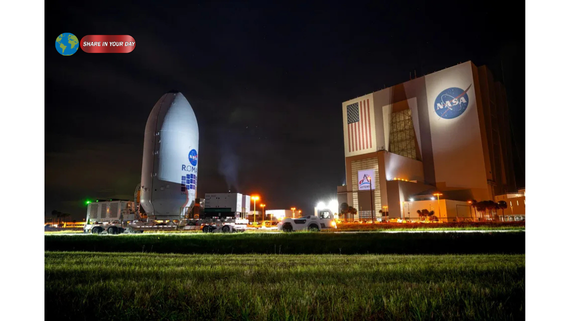
NASA says the launch is targeted for 7:26 a.m. EDT (11:26 UTC) on August 30. The observatory has already completed major prelaunch milestones, including final reviews and transportation to the launch complex. Space+1
The mission is attracting enormous attention because Roman is designed to do something existing space telescopes cannot easily accomplish: survey vast areas of the sky while maintaining powerful infrared imaging capabilities.
Here are seven key facts about the mission and why astronomers are watching its launch so closely.
1. The Nancy Grace Roman Space Telescope is ready for launch
NASA officially cleared the Nancy Grace Roman Space Telescope for launch after completing its Launch Readiness Review on August 28.
The review brought together NASA, SpaceX and mission teams to examine the spacecraft, launch vehicle and other critical systems. With the review complete, Roman moved into the final phase of preparations for its scheduled August 30 liftoff. Space
The telescope and its Falcon Heavy rocket were subsequently positioned at Launch Complex 39A, one of the most historic launch sites in the world.
The target launch time is 7:26 a.m. EDT. NASA has also prepared coverage beginning before liftoff, allowing viewers to follow the final countdown and launch preparations. NASA
However, as with every major launch, the schedule remains subject to weather and technical conditions.
NASA and SpaceX have identified a backup launch opportunity on August 31 if the first attempt cannot proceed. Space
2. Roman will launch on a SpaceX Falcon Heavy
The telescope will be carried into space by a SpaceX Falcon Heavy, one of the most powerful operational rockets available for launching large spacecraft.
Falcon Heavy uses three modified Falcon 9 first-stage boosters joined together. This configuration provides the substantial lifting capability needed to send Roman toward its eventual destination far beyond low Earth orbit.
The rocket and telescope have gone through a series of preparations in the weeks leading up to launch.
NASA previously reported that Roman was fueled with approximately 290 gallons, or 1,100 liters, of hydrazine. The observatory was then attached to its payload adapter before being enclosed inside the Falcon Heavy payload fairing. Space
That fairing protects the spacecraft during the violent vibrations, pressure changes and aerodynamic forces experienced during launch and ascent.
The final preparations represent years of development and testing coming together for a single launch attempt.
3. Roman is designed to survey enormous areas of space
One of the biggest advantages of the Nancy Grace Roman Space Telescope will be its unusually wide field of view.
NASA says Roman will have a field of view at least 100 times larger than Hubble’s while maintaining a high level of image quality. That combination will allow astronomers to survey enormous sections of the universe far more efficiently than a telescope designed primarily for narrow, detailed observations. NASA Science
This does not mean Roman will simply replace Hubble or the James Webb Space Telescope.
Instead, the observatories are designed to complement one another.
Hubble has transformed astronomy through decades of detailed observations across different wavelengths. Webb has opened an exceptionally powerful infrared window into the early universe, distant galaxies and planetary systems.
Roman will approach the cosmos differently.
Its enormous survey capability means astronomers can map broad regions of the sky and identify objects or phenomena that deserve closer examination.
That could include distant galaxies, supernovae, stars, planetary systems and other transient events.
4. The mission could help solve the mystery of dark energy
One of Roman’s central scientific goals is investigating dark energy, one of the biggest unanswered questions in modern cosmology.
Scientists know that the expansion of the universe is accelerating. The unknown component associated with that acceleration is commonly called dark energy.
But its physical nature remains uncertain.
Roman will conduct large-scale surveys designed to provide astronomers with new measurements of the universe’s expansion history and structure.
Those observations could help researchers determine whether current models of dark energy accurately describe the cosmos or whether new physics may be required.
NASA identifies dark energy and dark matter among Roman’s major scientific objectives. NASA Science+1
The implications could be profound.
A better understanding of dark energy could change scientists’ understanding of how the universe evolved and what its long-term future might look like.
5. Roman will investigate dark matter, too
Dark energy is not the only cosmic mystery on Roman’s agenda.
The telescope will also help scientists investigate dark matter.
Dark matter does not appear to emit or reflect light in the way ordinary matter does. Scientists instead infer its presence through gravitational effects on visible matter and light.
Because Roman will observe huge numbers of galaxies and stars, it will provide an enormous amount of data for studying how matter is distributed across the universe.
This is especially important because dark matter appears to play a major role in the formation and evolution of galaxies.
Roman’s wide-field surveys could reveal patterns that are difficult to detect with observations covering smaller regions.
The telescope’s mission therefore combines detailed astronomical measurement with a much broader statistical view of the universe.
6. Roman will search for exoplanets
The Nancy Grace Roman Space Telescope will also be a powerful tool for studying worlds beyond our solar system.
NASA expects Roman to conduct a statistical census of planetary systems in the Milky Way. Instead of focusing only on individual famous exoplanets, the mission will help astronomers understand how common different types of planetary systems are. NASA Science+1
That distinction is important.
Scientists have already confirmed thousands of exoplanets, but the known population represents only a fraction of the planets believed to exist in the galaxy.
Roman’s surveys will help researchers build a more complete picture.
The observatory will also carry a Coronagraph Instrument, designed to block the light from stars so that much fainter objects nearby can potentially be observed.
This technology could enable direct observations of some exoplanets and planet-forming environments.
The coronagraph is also an important technology demonstration because future space telescopes may rely on increasingly sophisticated methods to directly study Earth-like planets around other stars.
7. Roman will travel to a special location in space
After launch, Roman will not remain in low Earth orbit.
The spacecraft is headed toward the Sun-Earth Lagrange Point 2, commonly called L2.
This location is roughly 1.5 million kilometers, or about 930,000 miles, from Earth. It lies on the side of Earth opposite the Sun and provides a stable environment for astronomical observations.
NASA lists Sun-Earth L2 as Roman’s planned orbit. NASA Science
The journey will take approximately a month.
Once Roman reaches its destination, the mission will enter another critical phase.
Engineers will need to deploy and check the observatory’s systems, calibrate its instruments and make sure the telescope is ready for scientific observations.
NASA and mission teams expect a commissioning period lasting several months before Roman begins its full science program. Space
Why the Roman Space Telescope matters
The launch of the Nancy Grace Roman Space Telescope represents more than another spacecraft reaching orbit.
It is the beginning of a new approach to astronomical observation.
Modern astronomy increasingly depends on enormous datasets. Instead of studying only a handful of individual objects, scientists can examine millions or even billions of sources and look for statistical patterns.
Roman was designed for precisely this kind of work.
NASA says the observatory could measure light from as many as a billion galaxies during its mission lifetime. Its wide field of view will allow it to survey areas of the sky much faster than Hubble can. NASA Science
That makes Roman particularly valuable for discovering unexpected phenomena.
Astronomers cannot always predict what they will find when they survey huge portions of the universe.
A broad survey may uncover unusual galaxies, previously unknown planetary systems, transient events or gravitational effects that challenge existing theories.
Roman can therefore serve as both a scientific observatory and a cosmic discovery engine.
Roman will work alongside Hubble and Webb
It would be misleading to describe Roman as the successor that makes Hubble or Webb unnecessary.
The three observatories have different strengths.
Hubble excels at high-resolution observations and has accumulated an extraordinary scientific legacy since its launch in 1990.
Webb specializes in infrared astronomy and can investigate some of the earliest galaxies and distant objects in the universe.
Roman will combine infrared observations with an exceptionally wide field of view.
That means the telescopes can work together.
Roman may identify an interesting region or object across a huge survey area. Astronomers could then use Webb or Hubble to conduct deeper or more specialized observations.
The result could be a powerful network of complementary observatories rather than a competition between them.
What happens after launch?
The launch itself will be only the beginning.
Once Roman separates from Falcon Heavy, the spacecraft will need to establish communications with Earth and begin its journey toward L2.
Mission controllers will then conduct a series of checks and deployments.
Solar power systems and other spacecraft components must operate correctly. The telescope’s instruments will also require extensive calibration before they can deliver scientifically useful observations.
The observatory’s nominal mission is expected to last approximately five years, with NASA listing a 10-year goal. NASA Science
If the spacecraft performs as expected, astronomers could spend years analyzing its enormous collection of observations.
Some of the most important discoveries may not come immediately.
Large astronomical surveys often become more valuable as researchers combine observations with data from other observatories and develop new scientific techniques.
A major moment for astronomy
The countdown to the Nancy Grace Roman Space Telescope launch marks the culmination of years of engineering, testing and scientific planning.
The telescope is designed to look at the universe on a scale that is difficult for existing observatories to match.
Its mission combines several of modern astronomy’s biggest questions: What is dark energy? What is dark matter? How did galaxies evolve? How common are planetary systems? And how do planets form around other stars?
Those questions have no simple answers.
But Roman will give scientists a powerful new way to investigate them.
If the August 30 launch proceeds as planned, a new astronomical era will begin with a Falcon Heavy rising from Florida and carrying one of NASA’s most ambitious observatories toward L2.
The telescope’s greatest contribution may ultimately be the discoveries nobody has predicted yet.