Tyrannosaurus Rex Had a Body Temperature Similar to Humans, Study Finds
Scientists have finally put a number on one of the most intriguing questions surrounding Tyrannosaurus rex: How warm was the giant dinosaur?
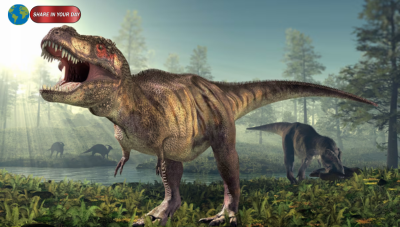
A new study has found that T. rex had an estimated body temperature of about 97.3 degrees Fahrenheit, or 36.3 degrees Celsius, placing the prehistoric predator surprisingly close to modern humans and large warm-blooded mammals. The research provides the clearest direct evidence yet that Tyrannosaurus rex was warm-blooded and capable of maintaining an elevated internal temperature rather than relying primarily on its surroundings for heat.
The findings, published September 16 in the journal Science Advances, add an important piece to decades of research into dinosaur metabolism. Scientists have increasingly suspected that many dinosaurs, particularly theropods related to modern birds, were capable of generating substantial body heat. However, determining the actual temperature of an animal that disappeared roughly 66 million years ago has been extremely difficult.
The new research changes that by turning fossilized T. rex teeth into a kind of prehistoric thermometer.
Scientists Used T. Rex Teeth as a Thermometer
Researchers from the University of California, Los Angeles, analyzed the chemical composition of fossilized tooth enamel from Tyrannosaurus rex specimens. The enamel contains stable isotopes of carbon and oxygen that form chemical bonds in patterns influenced by temperature.
By examining those bonds, scientists can estimate the temperature at which the tooth enamel originally formed. Unlike bone, which can be remodeled during an animal’s lifetime, tooth enamel is exceptionally durable and can preserve chemical information for millions of years.
The research team spent more than a decade refining the technique. One major challenge was the amount of fossil material required for the analysis. Because T. rex fossils are exceptionally valuable, museums are understandably cautious about destructive testing.
The UCLA researchers eventually reduced the amount of material needed by roughly 90 percent, allowing scientists to work with only tiny portions of fossilized teeth. Samples from the T. rex known as Thomas, housed at the Natural History Museum of Los Angeles County, were used in the study.
The estimated average temperature was approximately 97.3 degrees Fahrenheit, with an uncertainty of about 4.5 degrees Fahrenheit. That places T. rex well above the typical body temperatures of many modern reptiles and within the range of several warm-blooded mammals.
T. Rex Was Not a Typical Cold-Blooded Reptile
For generations, popular images portrayed dinosaurs as oversized reptiles that depended heavily on sunlight and environmental temperatures to become active.
Modern paleontology has gradually replaced that picture with a much more complicated understanding of dinosaur biology.
Today’s cold-blooded reptiles generally have body temperatures influenced strongly by their surroundings. Modern crocodilians, for example, can bask in sunlight to warm themselves and retreat into cooler environments when necessary.
The new T. rex temperature estimate points toward a different physiological strategy.
At roughly 36 degrees Celsius, Tyrannosaurus had a body temperature considerably higher than the typical temperatures associated with many modern reptiles. Its temperature was also lower than that of many modern birds, which can have body temperatures above 40 degrees Celsius.
That intermediate position is particularly interesting because birds are the surviving descendants of theropod dinosaurs, the same broad dinosaur group that included T. rex.
The result therefore adds another clue to the evolutionary transition between ancient dinosaurs and modern birds.
A Warm-Blooded T. Rex Could Have Been Highly Active
Maintaining a relatively high body temperature requires energy.
For T. rex, that likely meant consuming substantial amounts of food to support its metabolism. Researchers say the finding is consistent with the idea of Tyrannosaurus as an active predator or scavenger rather than a slow-moving animal that spent much of its time simply warming itself in the sun.
A warm internal temperature would also have given the dinosaur an important advantage in cooler environments.
T. rex fossils have been discovered across a huge portion of prehistoric North America. Evidence from Alaska has already challenged assumptions about where the species could survive. The latest research provides a physiological explanation for how such a large predator could remain active in environments that would have been difficult for many cold-blooded reptiles.
Using ancient climate models alongside the temperature estimate, researchers concluded that T. rex could potentially have inhabited an enormous area extending from regions corresponding to present-day Mexico toward Alaska.
The Discovery Could Change How Scientists Study Dinosaurs
The significance of the research extends beyond T. rex.
Scientists can potentially use the same chemical technique to investigate the body temperatures of other extinct animals. Researchers are interested in determining whether different dinosaur groups had similar metabolic strategies or whether dinosaurs developed a wide range of approaches to controlling body heat.
That question remains open.
A high body temperature does not automatically prove that every dinosaur was warm-blooded. Some enormous dinosaurs may have been able to retain heat simply because of their massive body size, a phenomenon known as gigantothermy. Other species may have used behavioral strategies to control their temperature.
T. rex presents a different case because its estimated temperature, geographical range and other physiological evidence collectively support the idea of endothermy.
The new study also demonstrates how valuable museum fossils can become as scientific technology improves. The teeth used in the research were collected decades ago, long before scientists had developed the ability to extract this kind of temperature information from ancient enamel.
More than 66 million years after T. rex disappeared, its fossilized teeth are still revealing new details about how the animal lived.
The image of Tyrannosaurus rex may have been shaped by its enormous jaws, powerful legs and famously intimidating teeth. But its temperature tells another part of the story: T. rex was not simply a giant reptile responding to the world around it.
It was a warm-bodied dinosaur capable of maintaining an internal temperature remarkably close to our own.