
Scotland, Wales and Northern Ireland Leaders Unite in Push for Self-Determination
Political leaders from Scotland, Wales and Northern Ireland have joined forces in an unprecedented push for greater self-determination, declaring that the people of their nations should have the right to decide their own constitutional futures.
The leaders of the Scottish National Party (SNP), Plaid Cymru and Sinn Féin met in Cardiff on Monday and signed a joint agreement calling for democratic control over decisions about independence and constitutional change.
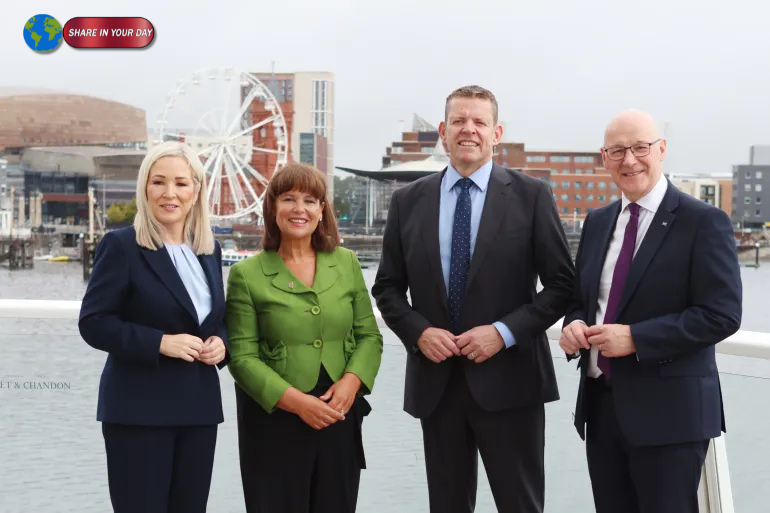
The gathering brought together SNP leader and Scottish First Minister John Swinney, Plaid Cymru leader Rhun ap Iorwerth and Sinn Féin figures including Northern Ireland First Minister Michelle O’Neill and party president Mary Lou McDonald.
Although the three parties have different political objectives and approaches to independence, they share a fundamental argument: decisions about the future of Scotland, Wales and Northern Ireland should ultimately be made by the people who live there.
A New Challenge to Westminster
The joint declaration represents a significant development in the long-running debate over the future of the United Kingdom.
The three nationalist parties said their nations possess a right to self-determination and argued that Westminster should not be able to prevent democratic processes concerning constitutional change.
The agreement stated that no UK government should have the authority to prevent people from deciding their own future. The leaders also described the meeting as evidence of growing momentum behind movements seeking independence or a new constitutional settlement.
For the first time, Scotland, Wales and Northern Ireland are all represented politically by major parties whose leadership is committed to moving away from the existing UK structure.
The agreement also looked beyond constitutional questions. The parties identified areas where they could cooperate, including renewable energy, economic development and relations with Europe.
Laura McAllister of Cardiff University described the wording of the agreement as deliberately broad, using the language of “self-determination” rather than focusing exclusively on immediate independence referendums.
That distinction is important because the three nations face very different constitutional circumstances.
Scotland’s Independence Question
Scotland has already held a referendum on independence.
In 2014, voters rejected independence by 55 percent to 45 percent. Since then, the SNP has continued to argue that Scotland should be given another opportunity to decide its future.
However, the UK government has resisted calls for a second referendum without Westminster approval.
Scotland’s constitutional debate has intensified in recent years as support for independence has remained substantial, although polling continues to show a divided electorate. A recent Survation poll cited by Al Jazeera placed support for Scottish independence at 47 percent.
Swinney has argued that the political momentum behind independence is growing and has used the Cardiff meeting to emphasize cooperation between the nations.
For the SNP, the central issue remains whether Scotland’s elected institutions should be able to determine when and how another independence vote takes place.
Wales Seeks a Different Future
Wales has traditionally had weaker support for independence than Scotland, but the issue has gained greater attention in recent years.
Plaid Cymru has pushed for greater Welsh autonomy while maintaining its longer-term commitment to independence.
Rhun ap Iorwerth has argued that the current political system needs a fundamental reset, with more authority transferred away from Westminster.
Unlike Scotland, Wales has never held an independence referendum. The Welsh Parliament, known as the Senedd, does not have an established unilateral legal mechanism for calling such a vote.
The Cardiff summit therefore gives Plaid Cymru an opportunity to place Welsh constitutional aspirations alongside the better-known independence debate in Scotland and the Irish reunification question in Northern Ireland.
A recent poll cited by Al Jazeera found support for Welsh independence at 32 percent, illustrating both the growing interest in the question and the substantial opposition that remains.
Northern Ireland Has a Different Legal Path
Northern Ireland’s position is different because the possibility of Irish reunification is explicitly addressed by the 1998 Good Friday Agreement.
Sinn Féin supports Northern Ireland leaving the United Kingdom and joining a united Ireland.
Under the agreement, the British government is required to hold a referendum on Irish unity if the Northern Ireland secretary believes it is likely that a majority would vote in favour of reunification.
That framework sets Northern Ireland apart from Scotland and Wales, where no equivalent automatic mechanism exists.
Michelle O’Neill has increasingly promoted the prospect of a border poll, while Sinn Féin has argued that preparations for possible constitutional change should begin.
A University of Liverpool survey cited by Al Jazeera found that 36 percent of respondents in Northern Ireland would currently vote for Irish reunification.
Westminster Rejects Immediate Constitutional Change
The nationalist leaders’ declaration is likely to face strong opposition from the UK government.
Prime Minister Andy Burnham has previously rejected the prospect of an imminent referendum on Northern Ireland’s constitutional status, saying in August that the issue was “off the table”.
The debate was further complicated by comments from US President Donald Trump during his visit to Ireland. Trump expressed support for Irish reunification, adding another international voice to an already sensitive constitutional debate.
The UK government, however, maintains that constitutional arrangements cannot simply be altered through unilateral declarations by devolved administrations or political parties.
That leaves the nationalist parties facing a significant political and legal challenge.
What Comes Next?
The Cardiff agreement does not itself create a legal route to independence for Scotland, Wales or Northern Ireland.
Instead, it represents an attempt to coordinate political pressure and present constitutional change as part of a wider democratic movement.
The three parties remain divided over timing, strategy and the precise constitutional arrangements they ultimately want. Scotland seeks independence, Plaid Cymru advocates Welsh independence, while Sinn Féin’s objective is Irish reunification.
Their cooperation nevertheless sends a clear political message: the constitutional future of the United Kingdom is becoming an increasingly prominent issue across its constituent nations.
The Cardiff meeting could therefore prove significant not because it immediately changes Britain’s constitutional structure, but because it brings three previously separate political movements together around a common principle.
For Westminster, the challenge is no longer limited to Scotland’s independence debate. Questions over sovereignty, devolution and national self-determination are now being raised simultaneously in Scotland, Wales and Northern Ireland.
Whether that growing cooperation develops into a sustained campaign for constitutional change remains uncertain. But the leaders gathered in Cardiff clearly believe the political landscape is shifting — and that the people of each nation should ultimately have the final say over what comes next.