The Late Show with Stephen Colbert has ended its CBS run with a major victory, winning Outstanding Variety Series at the 78th Emmy Awards on September 14, 2026.
The win came only months after CBS canceled the late-night program, giving Stephen Colbert and his longtime team an emotional final chapter. Colbert accepted the award alongside members of the show’s staff, using his speech to celebrate the hundreds of people who helped produce the program during its 11-year run.
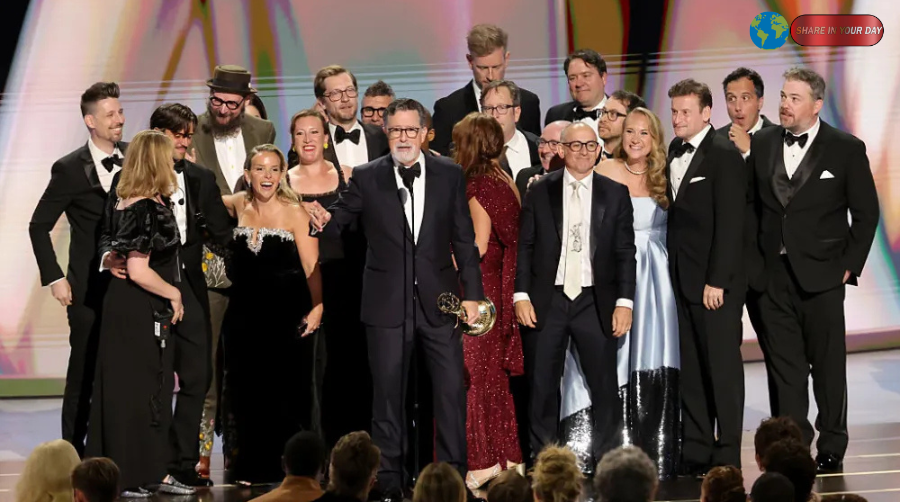
The victory was particularly notable because the show had already aired its final episode on May 21. Rather than ending its run without another major honor, The Late Show left television with an Emmy in hand.
The Late Show with Stephen Colbert Wins Its Final Emmy
The Television Academy confirmed The Late Show with Stephen Colbert as the winner of Outstanding Variety Series at the 78th Emmy Awards.
The program competed against several major late-night and variety shows, including The Daily Show, Jimmy Kimmel Live!, Last Week Tonight with John Oliver and Saturday Night Live.
The award gave Colbert and his staff an opportunity to celebrate the show after its unexpected conclusion.
For Colbert, the moment was about more than the trophy. He used his acceptance speech to recognize the large team behind a nightly television program and highlight the importance of late-night shows as workplaces where television professionals develop their careers.
He also delivered a message directly to the industry’s employers, encouraging them to hire members of his former staff.
Stephen Colbert Praises His Late-Night Team
During his acceptance speech, Colbert thanked the more than 200 people who worked on the program.
He emphasized that producing a late-night show requires a large group of people working together under tight deadlines. According to Colbert, that environment creates valuable opportunities for young professionals to learn how television is produced.
His message became one of the most memorable moments of the night when he promoted his former colleagues to potential employers.
Colbert essentially told the industry that his staff was available and encouraged networks and production companies to hire them.
The message was fitting for a program that had employed a large creative and production operation for more than a decade.
Rather than treating the Emmy as a personal achievement, Colbert framed the victory as recognition for the people who helped make The Late Show possible every night.
A Final Celebration After an Emotional Ending
The Emmy arrived several months after The Late Show aired its final episode.
The program ended on May 21, bringing Colbert’s 11-year run as host to a close. CBS had announced the cancellation in 2025, describing the decision as a financial one rather than a response to the show’s performance or content.
The cancellation became one of the biggest stories in late-night television.
Colbert had hosted The Late Show since 2015, when he succeeded David Letterman. Over the following decade, he developed a distinctive style that combined political satire, celebrity interviews, comedy sketches and commentary on current events.
The program also became a significant part of the late-night television landscape during a period of intense political and cultural change in the United States.
Its final Emmy therefore carried an added sense of closure.
Why the Emmy Win Matters
Winning Outstanding Variety Series after the show’s cancellation gives The Late Show a particularly unusual ending.
Television programs normally use Emmy victories to build momentum for another season. In this case, however, there is no next season waiting.
The award instead serves as recognition for the show’s final era.
It also demonstrates that the program remained highly competitive within one of television’s most established categories even after CBS decided to end it.
The Television Academy’s official results list The Late Show with Stephen Colbert as the winner of the category at the 78th Emmy Awards.
For Colbert and his staff, the timing made the victory even more meaningful.
Colbert’s Emotional Message to His Wife
Colbert also used his acceptance speech to thank his wife, Evelyn McGee-Colbert.
He described her as his favorite guest and reflected on her support throughout his career. He also remembered the unusual circumstances of the COVID-19 period, when she became both his audience and an important presence while the television industry was forced to adapt to remote production.
The personal moment added an emotional dimension to a speech that otherwise focused heavily on Colbert’s professional colleagues.
After thanking his wife, Colbert turned his attention to the viewers who had supported the show.
His message was simple: he thanked the audience for watching and said that the team had enjoyed making the program for them.
He ended with a farewell that acknowledged the show’s journey had reached its conclusion.
The Late Show’s Long Emmy History
The Emmy victory adds another major achievement to The Late Show’s history.
The program had received 42 Emmy nominations since it was first nominated in 2017, according to PEOPLE’s account of the show’s awards history.
Its latest win came during a particularly competitive year for television variety programming.
The category included several established shows with long histories at the Emmys. Saturday Night Live, for example, has accumulated an enormous number of nominations and wins throughout its decades on television, while Last Week Tonight with John Oliver has become one of HBO’s most consistently awarded programs.
Against that competition, The Late Show’s victory provided an especially strong final statement.
The Late Show Leaves Behind a Major Television Legacy
Colbert’s version of The Late Show became known for its combination of political humor, interviews and topical comedy.
The program also became a major platform for celebrities, politicians, authors, musicians and other public figures.
Over 11 years, Colbert interviewed a huge range of guests. During his Emmy acceptance speech, he joked about having interviewed at least 1,000 people during the show’s run.
That history helped establish The Late Show as more than simply another late-night program.
It became part of the broader cultural conversation, particularly when political events dominated the American news cycle.
Colbert’s background in political satire, developed during his years on The Colbert Report and The Daily Show, shaped much of the show’s identity.
His ability to combine jokes with serious commentary helped distinguish The Late Show from more traditional celebrity-driven late-night formats.
CBS’ Decision Still Defines the Ending
Despite the Emmy win, the cancellation remains an important part of the story.
CBS announced the decision to end The Late Show in July 2025. The network said the move was based on financial considerations and was not connected to the show’s performance, content or other issues at Paramount.
The decision generated considerable discussion throughout the entertainment industry.
At the time, Colbert also criticized Paramount’s settlement with President Donald Trump, adding a political dimension to the show’s final period.
The cancellation eventually transformed what might have been another awards season into a farewell campaign.
Instead of competing for an Emmy as a continuing series, The Late Show was effectively competing for recognition as a program approaching the end of its television life.
A Victory for the People Behind the Cameras
Perhaps the most significant aspect of Colbert’s Emmy speech was his focus on the staff.
Late-night television depends on hundreds of workers who are rarely visible to viewers. Writers, producers, directors, editors, camera operators, researchers, designers, stage crews and other specialists all contribute to a program that must be produced on a demanding schedule.
Colbert’s decision to publicly promote his former employees highlighted the uncertainty that follows the cancellation of a long-running television show.
His message was also a reminder that when a major program ends, the impact extends far beyond its host.
Entire teams suddenly have to find new opportunities.
By encouraging other productions to hire his former colleagues, Colbert used the industry’s biggest television awards stage to advocate for the people who helped build his show.
What Comes Next for Stephen Colbert?
The Emmy win closes one chapter of Colbert’s career, but it does not necessarily represent the end of his presence in television.
His 11-year run on The Late Show established him as one of America’s most recognizable late-night hosts. The Emmy victory also ensures that his final season will be remembered as an award-winning one.
For now, however, the immediate focus is on celebrating the program’s legacy.
Colbert ended his acceptance speech by thanking viewers and saying goodbye to the audience that had followed the show for more than a decade.
The sentiment was not one of bitterness. Instead, it was a farewell after a long professional journey.
The Late Show Gets the Ending Nobody Expected
The cancellation of The Late Show created an unusual television story.
A program that had already been told it was ending returned to the Emmy stage months later and won one of the industry’s most important awards.
For Colbert and his staff, the victory offers recognition at the exact moment their longtime workplace has disappeared.
The Emmy does not change the fact that The Late Show is over. But it gives the program a final achievement that its team can carry into whatever comes next.
More importantly, the award recognizes the work of the people behind the nightly broadcasts.
After 11 years, The Late Show with Stephen Colbert has taken its final bow. It leaves television not simply as a canceled late-night show, but as an Emmy-winning program that finished its run with its host celebrating the people who made it possible.
That makes the final chapter of The Late Show an unusually fitting one: a farewell, an award and a public thank-you to the team behind the cameras.