Nepal Floods: 5 Shocking Signs of Devastation
The Nepal floods have left entire communities struggling to understand the scale of a disaster that has killed hundreds of people, displaced survivors and left thousands still unaccounted for. In Devighat and other settlements along the Trishuli River system, residents have returned to find homes buried in mud, businesses destroyed and familiar streets transformed into fields of debris. TThe Guardian+1
The catastrophe began after a powerful glacial collapse and subsequent flood surge struck the Himalayan region on August 26. Water, rock, ice and mud moved through mountain valleys with devastating force, destroying roads, bridges, homes and other infrastructure in both Nepal and Tibet.
By August 30, authorities and local reports put the combined death toll at more than 800, while more than 3,000 people remained missing across Nepal and Tibet. In Nepal alone, officials reported hundreds of recovered bodies and thousands of people still unaccounted for. RReuters Connect+1
For families waiting for news, however, statistics tell only part of the story.
Nepal Floods Leave Devighat Buried in Mud
Devighat has become one of the most visible symbols of the destruction caused by the Nepal floods.
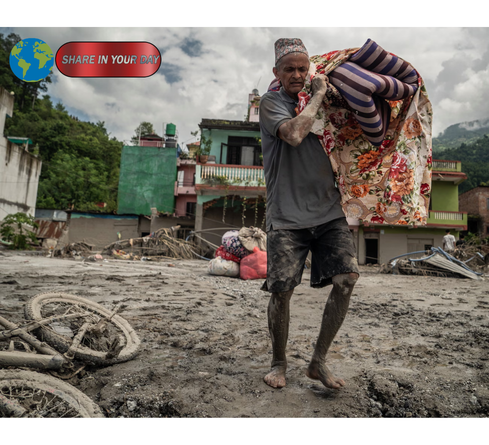
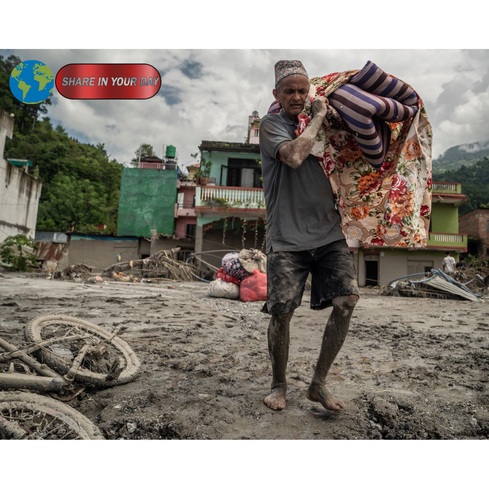
The settlement along the Trishuli River was hit by enormous quantities of water and debris. Buildings were damaged or destroyed, while thick layers of mud covered roads and properties.
Aerial images from the disaster zone show the extraordinary contrast. Green hills and farmland remain visible around areas that have been transformed into gray, debris-filled landscapes.
Residents returning to the area face a painful task: determining what can still be recovered from homes that were once places of security and livelihood.
In some locations, only portions of buildings remain standing. Furniture, household belongings and commercial equipment have been buried beneath mud and sediment.
The destruction has also disrupted the economic foundation of communities along the river.
Small businesses, hotels, shops and homes have been swept away or severely damaged. For families dependent on local commerce, agriculture, transport or tourism, rebuilding will require far more than simply clearing the mud.
Thousands Are Still Missing After the Disaster
The enormous number of missing people has made the emergency particularly difficult.
According to the latest reporting, nearly 3,300 people were still missing across Nepal and Tibet as of August 30. Reuters reported that Nepalese authorities had recovered 788 bodies, while Chinese authorities reported 16 deaths and 546 missing people in Tibet. RReuters Connect
The numbers have shifted rapidly as rescue teams reach previously inaccessible areas.
That makes the final death toll impossible to determine at this stage.
Many people disappeared when floodwaters swept through settlements and infrastructure. Others may have been trapped beneath mud, debris or collapsed structures.
The geography is making the search even harder.
The affected Himalayan region contains steep mountains, narrow valleys and difficult road networks. Landslides have damaged transport routes, while continuing rain and unstable river conditions have repeatedly complicated rescue operations.
For families, every new search operation brings a mixture of hope and fear.
Some are waiting for confirmation that missing relatives survived. Others are searching for remains so that their loved ones can finally be identified and given funeral rites.
Nepal Faces a Grim Struggle to Identify Victims
One of the most distressing consequences of the Nepal floods has been the difficulty of identifying people who have died.
Bodies have been recovered from rivers and flood-affected communities, but many have been badly damaged or buried for days beneath mud and water.
Authorities have therefore turned to forensic procedures, photographs and DNA collection to help establish identities.
Reuters reported that the condition of some remains has made visual identification extremely difficult. The distance that bodies were carried by floodwaters has added another layer of complexity. RReuters Connect
Hospitals and morgues have also faced severe pressure.
The number of recovered bodies has exceeded the capacity of some facilities, forcing authorities to seek additional cold-storage equipment and other resources.
In Chitwan, mass burials of unidentified victims have begun as officials deal with the growing number of remains. Reuters reported that authorities buried dozens of unidentified victims while recording information and collecting DNA samples in case relatives are later able to establish their identities. RReuters
The process is particularly sensitive in Nepal, where religious funeral traditions are deeply important to many families.
Authorities have said documentation and DNA records are intended to allow remains to be identified and reclaimed later.
Rescue Teams Face Dangerous Conditions
The search for survivors has continued despite the extraordinary challenges.
Thousands of security personnel have been deployed in Nepal, including police and military teams. Helicopters have been used to evacuate people and transport supplies from areas that remain difficult to reach by road. RReuters Connect
International assistance is also becoming an important part of the response.
India has sent specialists to support difficult rescue operations, including efforts involving workers believed to be trapped inside hydropower tunnels.
The hydropower sector has been particularly badly affected by the disaster.
Workers at several facilities were caught in areas struck by floodwaters and debris. Some sites have become extremely difficult to access because roads and bridges were destroyed.
Rescuers must therefore balance urgency with safety.
Another sudden rise in river levels could put rescue teams themselves at risk. Authorities have repeatedly warned communities to remain alert as rain continues and rivers remain unstable. AAP News
Fresh Flood Warnings Add to Fear
For survivors, the disaster is not necessarily over.
Authorities issued additional warnings after water levels rose in the Bhotekoshi River, raising fears of further flooding in already devastated communities. AAP News
That has created an unsettling cycle.
Residents want to return home to recover documents, valuables and possessions. Yet they may have to leave again if river levels rise.
In damaged communities, belongings are often scattered beneath mud. Some people are trying to recover whatever remains of their homes while keeping emergency supplies close at hand.
The danger is especially acute along riverbanks.
Buildings weakened by floodwaters may collapse. Roads can disappear beneath landslides, while bridges damaged by the initial disaster may no longer be safe to cross.
This means the recovery process must happen alongside continued emergency warnings.
What Caused the Nepal Floods?
The disaster was linked to a major collapse of ice and rock in the Himalayas that generated an enormous surge of water and debris.
The resulting flood traveled through river systems on both sides of the Nepal-China border.
Reuters previously reported that the initial event involved an ice-rock avalanche entering a river system in the Himalayan border region. Scientists have also warned that rising temperatures are contributing to instability in high-mountain environments. RReuters
The relationship between climate change and individual disasters can be complex.
Scientists do not necessarily attribute every single flood directly to global warming. However, warming temperatures are changing glaciers, snow cover, permafrost and other components of the Himalayan environment.
Those changes can increase the potential for dangerous glacial and landslide-related events.
Nepal is particularly vulnerable because millions of people live in mountainous and downstream areas exposed to floods, landslides and other natural hazards.
The Human Cost Goes Beyond the Death Toll
The most immediate measure of the disaster is the number of people killed or missing.
But the long-term impact could be much larger.
Thousands of families may have lost houses, businesses, farmland or sources of income. Roads and bridges will need reconstruction. Electricity and communications infrastructure must be repaired.
Schools and health facilities in affected areas have also suffered damage.
For children, disruption can continue long after floodwaters disappear.
For adults, the economic consequences could last for years.
The government will face the difficult task of rebuilding while also supporting families who have lost relatives and livelihoods.
International assistance may therefore become increasingly important.
The disaster has already attracted humanitarian support from several countries, while rescue and forensic specialists are helping Nepal deal with the immediate emergency.
Devighat Becomes a Symbol of Nepal’s Recovery Challenge
The images coming out of Devighat show why rebuilding will be such a difficult undertaking.
Entire sections of riverside communities have been transformed.
Where there were once homes and businesses, there are now piles of rocks, mud, broken concrete and uprooted trees. Rescue workers move through the debris searching for people and remains.
For survivors, returning to such a landscape can be emotionally overwhelming.
A house is more than a structure. It contains family photographs, documents, religious objects, clothing and memories accumulated over decades.
When those things disappear within minutes, recovery becomes both a physical and emotional process.
The Nepal floods have therefore created two simultaneous emergencies.
The first is the immediate search for survivors and missing people.
The second is the much longer effort to help communities rebuild lives after the physical destruction has been cleared.
A Disaster That Nepal Will Not Quickly Forget
The full consequences of the Himalayan floods will take months, and possibly years, to understand.
The death toll is still changing. Thousands remain missing. Rescue teams are continuing searches, while authorities are working to identify recovered remains and provide support to displaced families.
At the same time, communities must remain alert to further flooding and landslides.
The scale of the catastrophe has exposed the vulnerability of settlements located along Himalayan rivers and demonstrated how quickly a mountain disaster can spread across national borders.
For Devighat and other affected communities, the immediate priority is simple: find the missing, identify the dead, protect survivors and prevent further loss of life.
After that comes the harder question of rebuilding.
Homes can be reconstructed. Roads and bridges can eventually be replaced. Businesses can reopen.
But for thousands of families who have lost relatives, the consequences of the Nepal floods will never be measured only in buildings or infrastructure.
They will be measured in the people who did not return home.