George Clooney Venice 2026: 5 Bold Statements
George Clooney Venice 2026 became one of the biggest talking points at the Venice Film Festival after the Oscar-winning actor used a high-profile press conference to address politics, artificial intelligence, Hollywood’s changing media landscape and fellow actor Mark Ruffalo.
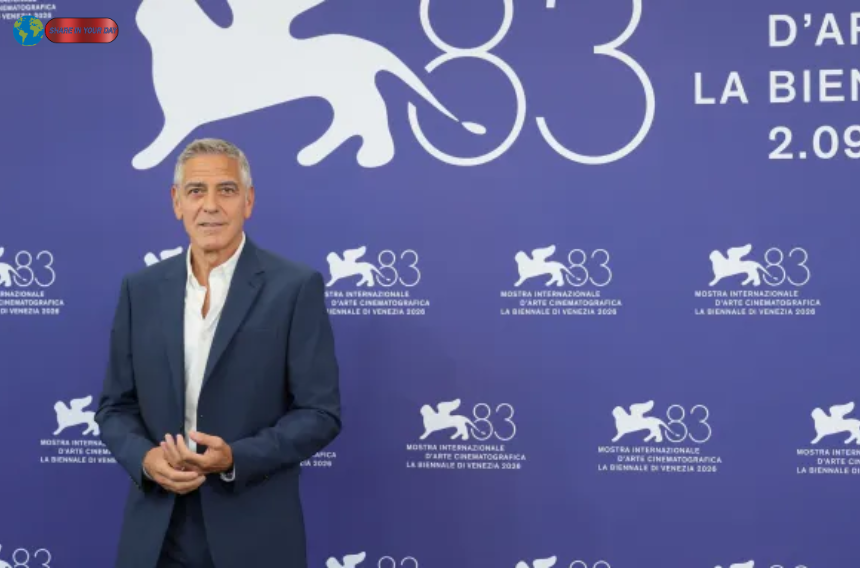
Clooney arrived on the Lido as one of the festival’s most celebrated guests. He is receiving the Golden Lion for Lifetime Achievement, recognizing a career spanning acting, directing, producing and political advocacy.
But the conversation quickly moved beyond movies.
During his Venice appearance, Clooney criticized comments and actions associated with U.S. Defense Secretary Pete Hegseth, defended Ruffalo’s right to express controversial opinions and questioned the potential consequences of the proposed Paramount-Warner Bros. transaction. He also warned about the growing influence of artificial intelligence on entertainment and journalism. DDeadline+1
Here are the five biggest takeaways from Clooney’s appearance.
1. George Clooney Venice 2026 Turns Political
The most striking aspect of George Clooney Venice 2026 was how directly the actor addressed American politics.
Clooney has never been particularly reluctant to discuss political issues. However, his latest comments arrived at a moment when Hollywood and American politics are again closely intertwined.
At Venice, Clooney criticized a social-media post involving Pete Hegseth and a Canadian cadet. The actor’s remarks reflected his broader concern about political leadership and the tone of public discourse.
Rather than treating politics as something separate from entertainment, Clooney argued that artists have a role in the public conversation.
His comments also came as the Venice Film Festival itself has increasingly become a platform for filmmakers and actors to discuss political and social issues.
The 2026 festival opened with Danny Boyle’s Ink, a film about journalism and Rupert Murdoch’s rise in the British newspaper industry. Other festival conversations have focused on war, journalism, democracy and the role of media. DDeadline+1
That environment gave Clooney an unusually broad stage for his remarks.
2. Clooney Defends Mark Ruffalo’s Right to Speak
One of the biggest headlines from the press conference involved Mark Ruffalo.
Ruffalo has become embroiled in a public dispute connected to the proposed Paramount-Warner Bros. deal. His comments about the transaction and its ownership structure have generated significant controversy.
Paramount has criticized some of Ruffalo’s statements, while more than 170 Jewish public figures have signed a letter supporting the actor amid accusations of antisemitism. Ruffalo has rejected those accusations. DDeadline+1
Clooney did not necessarily endorse every position Ruffalo has expressed.
Instead, he focused on the principle of allowing an actor to speak.
Clooney said he supported Ruffalo’s ability to speak freely, emphasizing that freedom of expression includes protecting opinions with which people may strongly disagree. FFacebook+1
That distinction is important.
Hollywood has long struggled with the question of whether actors should be separated from their political opinions. Studios, executives and performers increasingly operate in an environment where public comments can affect commercial relationships.
Clooney’s position was essentially that disagreement should not automatically become censorship.
3. George Clooney Questions the Paramount-Warner Bros. Deal
The proposed Paramount-Warner Bros. transaction was another major topic during the Venice appearance.
The deal has become one of the most closely watched stories in Hollywood because of its potential impact on studios, streaming, film production and employment.
Clooney expressed concern about the proposed merger and questioned how the economics of such a large transaction would ultimately work.
He also raised concerns about the potential impact on Hollywood jobs.
The issue goes far beyond the individual companies involved.
The entertainment industry has already undergone significant restructuring because of streaming, changing audience behavior, declining traditional television audiences and pressure to control production costs.
A major consolidation could create additional uncertainty for workers.
Reuters reported that Clooney questioned the financial logic of the proposed transaction and expressed concern about potential job losses. RReuters
For Clooney, the issue also connects to a larger concern about media ownership.
He has warned about the increasing concentration of influential media organizations in the hands of extremely wealthy individuals.
That concern places the Paramount-Warner Bros. proposal within a much broader debate over who controls the information and entertainment consumed by the public.
4. Clooney Warns Hollywood About Artificial Intelligence
Artificial intelligence was another major theme of George Clooney Venice 2026.
AI has rapidly become one of Hollywood’s most controversial issues.
Actors, writers, directors and producers are debating how AI-generated images, voices and performances should be used. At the same time, studios are examining whether AI can reduce costs or accelerate parts of the production process.
Clooney’s concern goes beyond employment.
He argued that AI and deepfake technology can make it increasingly difficult for audiences to distinguish authentic material from fabricated content. That could have serious consequences for both entertainment and journalism. RReuters
The problem is particularly significant for public figures.
Digital technology can potentially reproduce a person’s appearance or voice without requiring them to participate directly.
Clooney joked about the possibility of his image being used after his death, highlighting a concern that is becoming increasingly common among actors.
The underlying issue, however, is serious.
If audiences cannot determine whether a video, photograph or statement is genuine, trust in authentic information can decline.
That creates challenges not only for Hollywood but also for news organizations, political institutions and the public.
5. Venice Marks a Major Career Moment for Clooney
Despite the political headlines, George Clooney Venice 2026 is ultimately a celebration of his career.
Clooney is receiving the Golden Lion for Lifetime Achievement at the 83rd Venice International Film Festival.
The honor recognizes decades of work as an actor, filmmaker and producer.
His relationship with Venice is also unusually deep.
Clooney first appeared at the festival in 1998 with Out of Sight. Since then, the city and festival have been connected with several major moments in his professional life.
His Venice history includes appearances connected with films such as Good Night, and Good Luck., Michael Clayton, Gravity and Jay Kelly. AAP News
The festival has also been important to Clooney personally.
His relationship with Italy extends well beyond cinema, and his Lake Como home has made him a familiar figure in the country.
At 65, Clooney’s Golden Lion represents recognition of a career that has moved through several different stages.
He became a television star through ER, developed into a major Hollywood leading man and eventually established himself as a director and producer.
His career has also increasingly overlapped with activism and political advocacy.
Clooney’s Hollywood Influence Remains Strong
The attention surrounding Clooney’s Venice appearance demonstrates that his influence extends beyond his filmography.
Few actors can walk into a festival press conference and generate headlines about U.S. politics, free speech, artificial intelligence, media ownership and corporate consolidation in a single afternoon.
That influence comes partly from longevity.
Clooney has spent decades at the center of the entertainment industry. He has also developed a reputation for speaking publicly about political and social issues.
His statements therefore attract attention from audiences far beyond traditional movie fans.
The Venice setting made the moment even more significant.
Film festivals traditionally promote movies, awards campaigns and celebrity appearances. Yet major festivals increasingly serve as international forums where cultural figures discuss the political and economic forces affecting their industries.
Clooney’s appearance was a particularly clear example of that evolution.
Why Mark Ruffalo’s Dispute Matters
The Ruffalo controversy is important because it illustrates the tension between celebrity activism and corporate power.
Actors today have enormous platforms.
A single social-media post can reach millions of people within minutes. That gives performers a level of public influence that previous generations of Hollywood stars did not possess.
But that influence can also create professional risks.
Studios and corporations may disagree with actors’ political positions. Meanwhile, actors may fear that remaining silent could conflict with their personal principles.
Clooney’s defense of Ruffalo’s right to speak therefore touches on a broader question:
How much political freedom should performers have when they work for major entertainment companies?
There is no simple answer.
Companies have their own reputational and commercial interests. Actors have individual rights and public platforms.
The dispute surrounding Ruffalo demonstrates how difficult those interests can be to balance.
AI Could Change Hollywood More Than Any Merger
While the Paramount-Warner Bros. controversy generated headlines, Clooney’s comments about AI may prove even more important over the long term.
Hollywood is already moving toward an era in which digital tools can generate increasingly realistic images, voices and performances.
That could create opportunities for filmmakers.
It could also threaten traditional ideas about authorship and performance.
Actors may have to negotiate how their digital likenesses can be used. Writers may face questions about the role of AI-generated material. Directors could gain new tools while confronting new ethical challenges.
Clooney’s concern about deepfakes adds another dimension.
The issue is no longer simply whether AI will replace certain jobs.
It is also whether audiences will trust what they see.
If fake videos become indistinguishable from authentic recordings, the consequences could extend well beyond entertainment.
A Powerful Message From Venice
The significance of George Clooney Venice 2026 is therefore larger than a celebrity press conference.
Clooney used one of the world’s most prestigious film festivals to discuss several issues shaping the future of Hollywood and society.
He criticized political behavior.
He defended Mark Ruffalo’s right to express his views.
He questioned the proposed Paramount-Warner Bros. transaction.
He warned about artificial intelligence and deepfakes.
And he accepted one of the most prestigious honors of his career.
Together, those moments illustrate why Clooney remains such a prominent cultural figure.
He is not simply an actor receiving a lifetime achievement award.
He is also a filmmaker, producer and public figure whose opinions continue to attract global attention.
What Comes Next for Hollywood?
The issues raised by Clooney are unlikely to disappear after the Venice Film Festival ends.
The Paramount-Warner Bros. transaction will continue to face scrutiny.
The debate over Mark Ruffalo’s comments is likely to continue as Hollywood considers the boundaries of political expression.
AI will remain a central issue as studios, actors and filmmakers negotiate how emerging technology should be used.
And political conversations at film festivals are unlikely to disappear.
The entertainment business is increasingly connected to larger questions about technology, ownership, economics and democracy.
Clooney’s Venice appearance simply brought many of those debates into the same room.
Final Takeaway
George Clooney Venice 2026 delivered far more than a routine celebrity appearance.
While the actor was in Venice to receive a Golden Lion celebrating his career, his press conference became a wide-ranging discussion about the future of Hollywood and the broader political environment.
His support for Mark Ruffalo’s freedom to speak, concerns about the Paramount-Warner Bros. merger and warnings about AI all point toward the same underlying issue: the entertainment industry is undergoing profound change.
For Clooney, the answer is not to retreat from difficult conversations.
Instead, he appears determined to keep speaking — even when the subjects are politically charged, commercially sensitive or uncomfortable.
That may be exactly why his voice continues to carry so much weight in Hollywood.
Sources and Further Reading
- Deadline — George Clooney’s Venice press conference
- Reuters — Clooney discusses AI, politics and media ownership at Venice
- The Guardian — Clooney defends Mark Ruffalo