North Korea missile launch adds to rising U.S. tensions
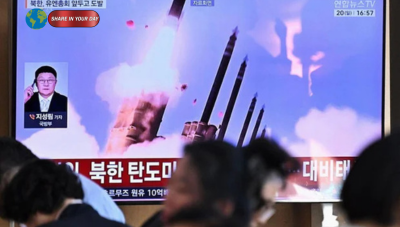
A new North Korea missile launch has increased pressure on the United States and its regional allies after Pyongyang fired two short-range ballistic missiles toward the sea on Sunday, South Korea’s military said.
The launches came at a particularly sensitive moment. North Korea has recently reinforced its claim that its nuclear status is permanent, while continuing to criticize U.S.-led military exercises in the region.
The two missiles were launched from the Wonsan area on North Korea’s eastern coast. South Korean authorities said the first traveled roughly 450 kilometers, or about 280 miles, while the second traveled more than 600 kilometers, or about 370 miles.
Both projectiles eventually landed in the sea.
The launches were separated by roughly three hours, according to South Korean authorities. Officials in Seoul and Washington were conducting further analysis to determine the precise characteristics of the second missile.
The latest tests represent another demonstration of North Korea’s missile capabilities at a time when diplomatic efforts between Washington and Pyongyang remain stalled.
North Korea missile launch follows criticism of U.S. military drills
The North Korea missile launch came shortly after Pyongyang sharply criticized U.S.-led military activity in the Asia-Pacific region.
Kim Yo Jong, the sister of North Korean leader Kim Jong Un and a senior official, has repeatedly accused Washington and its allies of increasing military pressure against North Korea.
She recently criticized the Pacific Vanguard exercise, a multinational military activity involving the United States, South Korea, Japan, Australia, New Zealand and Canada.
North Korea has long described military exercises involving the United States and South Korea as preparation for a potential invasion. Washington and its allies, meanwhile, describe such exercises as defensive activities designed to maintain readiness.
That disagreement has repeatedly contributed to periods of heightened tension on the Korean Peninsula.
Reuters reported that Kim Yo Jong warned North Korea could respond with measures it considers necessary if its security interests are threatened. Her statements came as Pyongyang continued to insist that its nuclear weapons program is essential to national security.
The timing of the latest missile launches therefore carries both military and political significance.
Two missiles launched from Wonsan
South Korea’s military said the first missile traveled approximately 450 kilometers before falling into the sea.
The second traveled more than 600 kilometers.
Japanese authorities also detected a suspected North Korean missile launch. Japan said the projectile did not land in its territorial waters or exclusive economic zone.
The launch location was the Wonsan area on North Korea’s east coast, a region that has been used for previous weapons tests.
Reuters reported that the first missile was believed to be from the Hwasong-11 family, although officials were still assessing the exact specifications of the weapons.
South Korean and U.S. authorities routinely work together to analyze North Korean missile launches. Such assessments can include the missile’s flight path, speed, altitude, range and possible configuration.
That information is important for determining whether a test represents a new weapons capability or another demonstration of an existing system.
For now, officials have characterized the weapons involved in Sunday’s launches as short-range ballistic missiles.
U.S. says launches posed no immediate threat
The United States Pacific Command said it was aware of the North Korean launches and was consulting with regional allies and partners.
The command said its initial assessment indicated that the launches did not pose an immediate threat to U.S. personnel or territory or to American allies.
That assessment does not mean the launches were considered insignificant.
Ballistic missile tests remain closely monitored because North Korea has developed a broad collection of missile systems ranging from short-range weapons to intercontinental ballistic missiles.
Short-range systems are particularly important to the security of South Korea and U.S. forces stationed on the Korean Peninsula because they can potentially reach targets across much of the region.
The latest tests also provide North Korean weapons engineers with opportunities to gather information about missile performance.
South Korea condemns the launches
South Korea’s presidential office called on North Korea to stop ballistic missile launches.
Seoul said such launches violate United Nations Security Council resolutions that prohibit North Korea from developing and testing ballistic missile technology.
South Korea’s military also emphasized that it remained prepared to respond to potential provocations while maintaining its alliance with the United States.
The South Korean government has continued to face the difficult task of balancing military preparedness with efforts to avoid an uncontrolled escalation.
The same challenge extends to Japan and the United States.
Tokyo closely monitors North Korean missile activity because some tests travel toward waters near Japan. Japanese officials have repeatedly raised concerns about the potential danger posed by North Korea’s expanding missile capabilities.
Pyongyang reinforces its nuclear position
The latest North Korea missile launch also followed a major statement from Pyongyang concerning its nuclear weapons program.
North Korea recently rejected criticism from the International Atomic Energy Agency and described its nuclear status as irreversible.
According to Reuters, North Korean officials rejected international calls for denuclearization and argued that the country’s nuclear deterrent was necessary for its security.
That position creates a major obstacle for any future negotiations with Washington.
For years, the United States and its allies have sought the eventual denuclearization of North Korea. Pyongyang, however, has increasingly presented its nuclear arsenal as a permanent part of its national defense strategy.
The disagreement over this fundamental issue has made diplomatic progress difficult.
Trump previously reduced military exercises
The latest launch is also notable because President Donald Trump previously ordered a reduction in a joint U.S.-South Korean military exercise.
Trump had linked the decision to his relationship with Kim Jong Un and expressed interest in reopening diplomatic engagement with the North Korean leader.
North Korea, however, did not respond by ending its weapons development.
Instead, Pyongyang continued to conduct missile-related military activities and publicly criticized American and allied exercises.
CBS News reported that the recent launches followed earlier weapons demonstrations, including a North Korean live-fire drill involving missiles, artillery and drones.
The developments illustrate the difficulty of using military exercises and diplomatic gestures to change North Korea’s behavior.
Reducing the scale of exercises has not prevented additional missile activity, while North Korea continues to describe American military cooperation with South Korea and Japan as a threat.
A broader cycle of military pressure
The latest launches are part of a broader cycle that has repeatedly unfolded on the Korean Peninsula.
North Korea conducts a weapons test.
The United States, South Korea or Japan condemns the activity.
North Korea then criticizes allied military exercises and describes them as evidence of hostile intentions.
The cycle can then produce additional military demonstrations.
This pattern makes the regional security environment difficult to stabilize.
At the same time, each new missile test can provide North Korea with technical data that may help improve its weapons programs.
Recent North Korean military exercises have involved multiple types of weapons operating together. Earlier this month, Pyongyang conducted a live-fire exercise involving missiles, artillery and drones, according to North Korean state media and South Korean assessments.
Such exercises can demonstrate how different weapons might be integrated during a conflict.
Russia and China add another dimension
North Korea’s strategic environment has also changed as its relationships with Russia and China have developed.
Reuters reported that North Korea has strengthened military ties with Russia since the two countries signed a mutual defense treaty in 2024. Analysts have also pointed to North Korean military involvement connected to Russia’s war in Ukraine as a factor affecting Pyongyang’s military experience and relationships.
These developments add complexity to efforts by Washington and its allies to pressure North Korea over its nuclear and missile programs.
China remains an important regional power because of its economic and political relationship with North Korea and its influence in Northeast Asia.
For the United States, South Korea and Japan, maintaining coordination is therefore an important part of responding to North Korean weapons activity.
What the missile launch means for diplomacy
The North Korea missile launch does not automatically mean that a new military confrontation is imminent.
The U.S. military said the latest launches did not present an immediate threat to U.S. territory or personnel.
However, the tests highlight the continuing gap between Washington’s diplomatic objectives and Pyongyang’s stated position.
The United States has continued to emphasize security commitments to South Korea and Japan while remaining interested in diplomacy.
North Korea, meanwhile, has increasingly demanded recognition of its nuclear status and an end to what it calls Washington’s hostile policy.
Those positions remain far apart.
The challenge for diplomats is finding a way to reduce military tensions without accepting terms that either side considers unacceptable.
Regional allies remain on alert
South Korea and Japan are likely to continue closely monitoring North Korea’s missile activity.
For Seoul, the threat is particularly immediate because North Korean short-range missile systems can reach targets across the Korean Peninsula.
Japan also remains concerned about missiles that travel toward waters around the Japanese archipelago.
The United States has significant military forces in the region and maintains defense agreements with both South Korea and Japan.
That network means a North Korean weapons test is not simply a bilateral issue between Washington and Pyongyang. It affects a wider regional security structure.
North Korea missile launch keeps pressure on Washington
The latest North Korea missile launch demonstrates that Pyongyang continues to use missile testing as both a military activity and a form of political signaling.
The two short-range ballistic missiles launched Sunday did not strike land and were assessed by the United States as posing no immediate threat.
Nevertheless, the tests came alongside increasingly firm North Korean statements about its nuclear weapons program and repeated criticism of U.S.-led military exercises.
The result is a familiar but increasingly complicated security dilemma.
Washington wants to maintain deterrence while leaving room for diplomacy. Seoul wants to protect its population while avoiding a dangerous escalation. Tokyo wants to monitor missile developments that could threaten its territory and surrounding waters.
North Korea, for its part, continues to argue that its nuclear and missile programs are necessary for national security.
The immediate question is not simply where the latest missiles landed. It is whether the competing military and diplomatic pressures surrounding the Korean Peninsula will lead to another round of weapons demonstrations or eventually create space for renewed negotiations.
For now, the two launches from Wonsan show that North Korea is continuing to develop and demonstrate its military capabilities even as Washington signals interest in diplomacy.
The missile tests therefore add another chapter to a long-running confrontation in which military readiness, nuclear policy and diplomatic engagement remain closely connected.