Bill Gates AI Warning: 5 Shocking Risks Revealed
The latest Bill Gates AI warning marks a striking change in tone from one of technology’s most influential longtime optimists. In a new essay, the Microsoft co-founder argues that the world is entering a turbulent period in which artificial intelligence could transform employment, education, national security and everyday life faster than governments are prepared to handle.
Gates’ warning is not an argument that artificial intelligence should be stopped. Instead, he says society needs to move much faster to prepare for its consequences.
His concerns range from mass job displacement to the possibility that AI could weaken critical thinking. He is also calling for new forms of international cooperation and policies designed to ensure that the economic benefits of AI do not flow primarily to technology companies and their shareholders.
The shift is notable because Gates has previously emphasized AI’s enormous potential. Earlier this year, he wrote that AI would initially help workers become more productive, while acknowledging that some employees would need retraining and support as the technology developed.
Now, however, his message has become considerably more urgent.
Bill Gates AI Warning Focuses on Jobs
One of the most important elements of the Bill Gates AI warning concerns employment.
Gates believes the effects of AI will extend well beyond today’s familiar examples of chatbots, coding assistants and automated office software. As AI systems become more capable, companies could increasingly automate tasks that once required large numbers of employees.
That could eventually affect both white-collar and blue-collar workers.
According to reporting on Gates’ latest proposals, he expects increasingly capable robotics to expand the impact of automation into areas such as construction, hospitality and other physical jobs.
That creates a difficult economic problem.
When a company replaces a worker with software or a machine, the company can potentially reduce labor costs while increasing productivity. But governments still depend heavily on taxes associated with human employment.
If millions of people work fewer hours or lose their jobs, the traditional relationship between employment, income and government revenue could become increasingly difficult to maintain.
Gates therefore believes policymakers should begin preparing before large-scale displacement becomes an established reality.
Human-Reserved Jobs Could Become a New Policy
Perhaps the most unusual proposal in Gates’ new argument is the idea of “Human Reserved” jobs.
The concept is relatively straightforward. Some jobs could be deliberately protected from complete automation even if an AI system could technically perform them more efficiently.
Gates has pointed to areas such as childcare and jury service as examples of work where maintaining a human role could have value beyond simple economic efficiency.
Healthcare and education are also particularly important to this debate because human interaction can be part of the service itself.
A machine might be able to provide information. That does not necessarily mean people will consider it an adequate replacement for empathy, judgment and personal connection.
The proposal nevertheless raises difficult questions.
Who decides which occupations should be protected? How would governments define a job as “human reserved”? Would companies be required to employ people even when an automated alternative is cheaper?
Those questions could make the policy extremely difficult to implement.
Still, Gates’ argument highlights a fundamental issue: economic efficiency is not always the same thing as social value.
A society might technically be able to automate a particular activity while still deciding that humans should continue performing it.
Bill Gates AI Warning Revives the Robot Tax Debate
Another major part of the discussion involves taxation.
Gates has supported the idea of taxing automation for years. In 2017, he argued that governments could use a robot tax to slow the pace of automation and generate money for socially valuable employment, including care for older people and work with children.
His latest thinking returns to the same basic problem in a more advanced AI environment.
If businesses can replace taxable human labor with AI systems or robots, governments could lose part of the tax base that traditionally finances public services.
Gates therefore argues that governments should reconsider how AI-driven economic activity is taxed.
The idea is controversial.
Critics argue that taxing robots or AI could discourage investment and reduce productivity. The International Federation of Robotics, for example, has argued that automation can create new employment through higher productivity and that taxing production technology could harm competitiveness.
That disagreement is unlikely to disappear soon.
The larger question is whether governments should tax the technology itself or instead tax the profits and wealth created by the technology.
Either approach could become increasingly important if AI dramatically increases corporate productivity while reducing the need for human labor.
AI Could Change More Than Employment
The Bill Gates AI warning is not limited to jobs.
Gates is also concerned about how AI could affect people’s ability to think independently.
AI systems can provide answers almost instantly. That convenience can be extremely valuable, but it also creates a potential dependency problem.
If students routinely allow AI to perform difficult reasoning for them, for example, they may receive faster answers while developing fewer independent problem-solving skills.
Gates has described this as a major concern for education. AI could become an extraordinary learning tool, but it could also undermine critical thinking if people use it as a substitute for thinking rather than as an aid to learning.
The issue extends beyond schools.
Generative AI can produce persuasive text, images and other material at enormous scale. Combined with deepfakes, personalized fraud and misinformation, that capability could make it increasingly difficult for people to distinguish reliable information from fabricated material.
The technology therefore creates a paradox.
AI could make people more informed and productive while simultaneously making the information environment harder to trust.
Gates Wants Stronger Global AI Governance
Another central theme is governance.
Gates argues that governments are not sufficiently prepared for AI’s rapid development. He wants countries to create institutions capable of addressing AI risks across areas including employment, national security, education and biological threats.
He has also emphasized international cooperation.
That is particularly difficult because the world’s leading AI powers are also economic and geopolitical competitors.
The United States and China are at the center of the global AI race. Gates believes cooperation between the two countries will be necessary if governments want to manage risks that do not stop at national borders. Reuters reported that Gates is seeking discussions with Chinese President Xi Jinping about possible approaches to AI governance.
His proposed approach has been compared with international institutions created to manage other technologies and global risks.
The underlying principle is simple: if AI systems operate globally, national regulation alone may not be enough.
Why Gates’ Change in Tone Matters
The significance of the latest Bill Gates AI warning goes beyond any individual policy proposal.
Gates has spent decades associated with technological optimism. His career was built around the belief that computers and software could dramatically expand human capabilities.
He still believes AI can produce enormous benefits.
However, his latest essay suggests that optimism now comes with a much stronger sense of urgency.
That distinction matters.
Gates is not saying that AI innovation should stop. He is arguing that innovation without preparation could create consequences that governments and communities may struggle to reverse.
His position also reflects a broader debate taking place across the technology industry.
AI companies are racing to build increasingly capable systems. Investors are pouring enormous amounts of money into AI infrastructure. Businesses are experimenting with automation.
Meanwhile, governments are attempting to develop rules quickly enough to keep pace.
That creates an obvious imbalance.
Technology can be developed and deployed globally in months or years. Government institutions can take considerably longer to negotiate, legislate and implement new policies.
Gates’ warning is essentially that this gap cannot be ignored.
The Biggest Question: Who Benefits From AI?
At the heart of the debate is an economic question.
Who will benefit most from artificial intelligence?
If AI makes workers more productive, the benefits could include higher wages, lower prices and better products and services.
But productivity gains do not automatically guarantee that everyone benefits equally.
A company that automates a large department may become significantly more profitable. Yet the workers whose tasks disappear may not immediately find equally valuable employment.
That is why Gates is emphasizing taxation, retraining, social safety nets and protected human employment.
His argument is that governments should not simply wait for the market to solve the problem after displacement occurs.
Instead, policymakers should prepare before the transition becomes too disruptive.
What Gates’ AI Warning Means for Workers
For ordinary workers, the message is neither that every job will disappear nor that AI can safely be ignored.
The more realistic possibility is that the tasks within many jobs will change.
Employees who learn to work effectively alongside AI may become more productive. Meanwhile, workers whose responsibilities can be automated almost entirely could face greater pressure.
This means adaptability could become increasingly important.
The challenge, however, is that not everyone has the same access to education, technology or training.
That is why the debate cannot be reduced to telling workers to “learn AI.”
Some occupations will change because their tasks are automated. Others may disappear. New occupations may emerge, but there is no guarantee that they will appear in the same locations, pay similar salaries or require the same skills.
That transition could create significant social and economic disruption.
AI Still Has Enormous Potential
Despite the severity of his warnings, Gates has not abandoned his belief that AI can do tremendous good.
Healthcare remains one of the strongest examples.
AI could assist researchers, doctors and public-health organizations with analyzing information, accelerating scientific discovery and delivering services more efficiently.
The technology could also have major implications for agriculture, education and scientific research.
Gates’ own philanthropic work is increasingly connected to AI-powered approaches to global health and development. Reuters reported that the Gates Foundation is planning major spending through 2045, with AI playing an increasing role in health initiatives.
That is why his position is better understood as cautious optimism rather than outright opposition to AI.
He believes the technology could deliver extraordinary benefits.
His concern is that society may fail to distribute those benefits fairly or manage the risks effectively.
The AI Debate Is Entering a New Phase
The latest Bill Gates AI warning arrives at a moment when artificial intelligence is moving from an experimental technology into a central part of the economy.
The debate is therefore changing.
Earlier conversations focused heavily on whether AI could eventually become powerful.
Now the question is increasingly about what happens after powerful AI becomes widely available.
Who owns it?
Who controls it?
Who gets displaced?
Who pays for the transition?
And who decides which applications are acceptable?
These questions cannot be answered by technology companies alone.
They require governments, businesses, workers, educators and the public to participate in the discussion.
Gates’ decision to return publicly to the AI debate suggests that he believes the window for preparation is closing.
His warning may ultimately prove too pessimistic. It may also prove too cautious.
What is increasingly difficult to dispute, however, is that artificial intelligence is changing faster than many institutions were designed to handle.
The choices made today will determine whether that transformation produces broadly shared prosperity or a deeper divide between those who own AI and those whose work it replaces.
For Gates, that is precisely why governments cannot afford to wait.
The AI revolution is already underway. The real question is whether society will shape it—or simply react to its consequences.
Image ALT Text
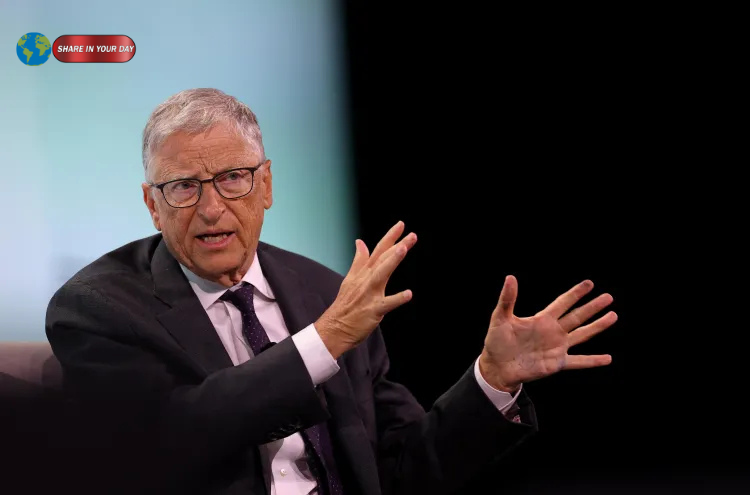
Bill Gates AI warning about artificial intelligence, jobs and global AI regulation
Suggested Image
Use a properly licensed editorial image of Bill Gates speaking at a technology or policy event, or an official image from a source that permits republication. Avoid copying The Verge‘s image without checking its licensing terms.