Samsung 1100Hz Odyssey Monitor Is a Gaming Shock
The Samsung 1100Hz Odyssey monitor is officially turning one of the biggest numbers in gaming displays into reality. Samsung has unveiled its 2027 Odyssey gaming monitor lineup at Gamescom 2026, with the new 27-inch Odyssey G6 taking the spotlight as the world’s first gaming monitor capable of reaching a staggering 1,100Hz refresh rate.
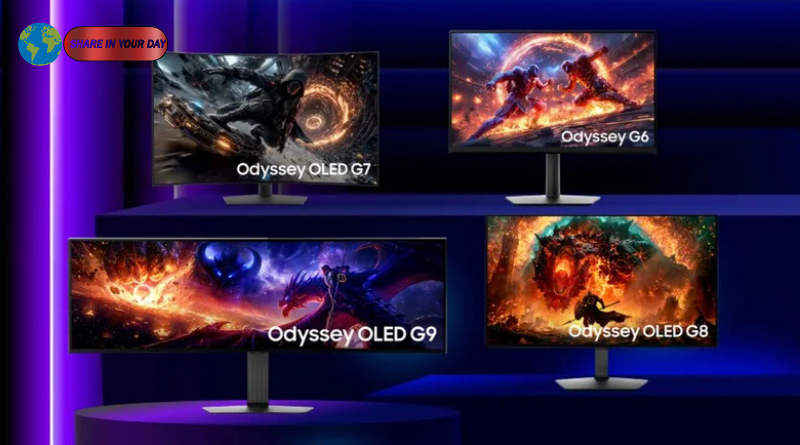
The announcement pushes Samsung’s race for faster gaming displays into territory that would have seemed excessive only a few years ago. The new Odyssey G6 is designed primarily for competitive players who value motion clarity and responsiveness, while Samsung’s wider lineup also targets gamers who want OLED picture quality, ultrawide screens and cinematic experiences.
The company has also introduced new OLED versions of the Odyssey G9, G8 and G7. Together, the four displays show Samsung pursuing several different definitions of premium gaming rather than simply increasing refresh rates across every model.
Samsung 1100Hz Odyssey Monitor Sets a New Speed Record
The headline product is the 27-inch Odyssey G6, also known as the G60H.
Samsung describes it as the world’s first 1,100Hz gaming monitor. The display uses a Fast IPS panel and offers a 1ms response time, giving competitive gamers a combination of extremely high refresh rates and fast pixel response.
However, there is an important detail behind the headline number.
The 1,100Hz refresh rate is available when the monitor operates in HD resolution. Gamers who prefer higher image detail can switch to QHD mode, where the display can reach 600Hz.
That means the monitor is not simply running 1,100Hz at its full native resolution. Instead, Samsung has created a dual-mode display that allows users to prioritize speed or resolution depending on the game.
For esports players, that flexibility could be more meaningful than the headline specification itself.
Fast competitive shooters can benefit from extremely high refresh rates when a gaming PC can generate enough frames. Meanwhile, slower-paced games can make better use of QHD resolution and its 600Hz refresh rate.
Samsung says the Odyssey G6 will become available globally during the second half of 2026, although specific pricing and market launch details have not yet been announced.
Why a 1100Hz Gaming Monitor Matters
A refresh rate of 1,100Hz sounds almost unbelievable because most gaming monitors operate far below that level.
Yet the concept is straightforward. A higher refresh rate allows a display to update the image more frequently. When paired with a sufficiently powerful computer, this can produce smoother motion and potentially reduce the amount of time between individual frames.
That can be particularly relevant in competitive games where players constantly track fast-moving targets.
Still, the benefits are not identical for every gamer.
A player using a mainstream graphics card may never generate enough frames to take full advantage of 1,100Hz. Even high-end gaming hardware faces substantial demands when attempting to maintain extremely high frame rates.
For that reason, the Samsung 1100Hz Odyssey monitor is likely to appeal most strongly to professional esports players, enthusiasts and competitive gamers who are willing to optimize their entire systems around speed.
The 1,100Hz figure is therefore as much a statement about the future direction of gaming displays as it is a practical feature for everyday players.
Samsung Odyssey G6 Also Supports 600Hz QHD Gaming
The Odyssey G6 becomes more interesting when its dual-mode capabilities are considered.
At HD resolution, the monitor can reach 1,100Hz. Switching to QHD lowers the maximum refresh rate to 600Hz, but the player gains substantially more image detail. Samsung says the monitor is designed to let users choose between sharper QHD visuals and extreme refresh-rate performance.
That approach reflects a broader trend in gaming monitors.
Rather than forcing consumers to choose between resolution and speed, manufacturers are increasingly developing displays that can change their operating modes. This can make a single monitor useful for different types of games.
Competitive shooters may favor the highest possible refresh rate. Racing games and multiplayer titles can benefit from smoother motion, while single-player adventures may place greater emphasis on resolution and image quality.
The G6 therefore represents more than a race toward the biggest refresh-rate number. It also demonstrates how flexible display modes are becoming a major feature in premium gaming hardware.
Odyssey OLED G9 Brings 360Hz to 49 Inches
Samsung’s new Odyssey OLED G9 takes a very different approach.
Instead of focusing on a relatively compact competitive display, the OLED G9 combines a massive 49-inch screen with high-end OLED technology and a 360Hz refresh rate.
Samsung calls it the world’s first 49-inch DQHD gaming monitor with a 360Hz refresh rate. The display has a 5120 x 1440 resolution and uses a fifth-generation QD-OLED panel with Samsung’s Penta Tandem technology.
The OLED G9 can also switch into a lower-resolution Dual HD mode at 2560 x 720, where it can reach up to 720Hz.
That gives the monitor two dramatically different personalities.
At 5120 x 1440 and 360Hz, it is designed for immersive ultrawide gaming with a huge field of view. At 2560 x 720 and 720Hz, it becomes much more focused on raw speed.
The monitor also offers a 0.03ms GtG response time and peak brightness of up to 1,300 nits under Samsung’s specified testing conditions.
For gamers who want a giant OLED display without sacrificing competitive performance, the OLED G9 could be one of the most ambitious models in Samsung’s new lineup.
Odyssey OLED G8 Offers Three Refresh Modes
The new 32-inch Odyssey OLED G8 takes flexibility even further.
Samsung has designed the monitor with three different display modes. Gamers can use UHD resolution at 360Hz, QHD at 520Hz or FHD at 680Hz.
This gives users a wide range of options depending on the game and hardware.
UHD at 360Hz offers the highest resolution and is likely to appeal to gamers who want detailed visuals without giving up high-speed performance. QHD at 520Hz offers a middle ground, while FHD at 680Hz focuses heavily on competitive performance.
The OLED G8 also uses Samsung’s fifth-generation QD-OLED technology and Penta Tandem panel design. It includes a 0.03ms GtG response time, DisplayHDR TrueBlack 600 support and compatibility with AMD FreeSync Premium Pro and NVIDIA G-SYNC Compatible technology.
Samsung is also adding a Glare Free coating that the company says is 54% less glossy than conventional anti-reflection film.
That could make a difference for players who use their gaming monitors in rooms with strong daylight or other external light sources.
Samsung Introduces a 42-Inch Curved OLED G7
The fourth major announcement is the Odyssey OLED G7.
This model is aimed at gamers who want a much larger screen without moving to an ultrawide aspect ratio.
Samsung describes it as the world’s first 42-inch 16:9 curved OLED gaming monitor. It combines 4K resolution, a 165Hz refresh rate and a 1000R curvature.
The larger screen gives the OLED G7 approximately 72% more screen area than Samsung’s previous 32-inch model, according to the company.
Its 1000R curvature is intended to bring the edges of the screen closer to the player’s field of view. Samsung is positioning the display particularly toward cinematic games, RPGs and open-world titles where immersion is more important than achieving extreme competitive refresh rates.
Like the OLED G8, the G7 also features Glare Free technology to reduce reflections.
This makes the G7 an interesting contrast to the 1,100Hz G6. One display is built around competitive speed, while the other emphasizes scale, OLED image quality and immersion.
Samsung Is Expanding HDR10+ Gaming
The new Odyssey lineup is not only about hardware.
Samsung also announced plans to expand its HDR10+ GAMING ecosystem through a partnership with Activision Blizzard. The company says HDR10+ GAMING support will expand to more than 20 AAA titles by the first half of 2027.
One of the highlighted games is Call of Duty: Modern Warfare 4.
HDR10+ GAMING is intended to improve the way compatible displays handle brightness, contrast and color. The goal is to make game scenes better reflect the creative intent of developers while providing a more dynamic visual experience.
Samsung is also continuing its work on Odyssey 3D gaming technology. The company plans to demonstrate new supported titles, including Cyberpunk 2077 and Cronos: The New Dawn, at Gamescom.
That suggests Samsung sees the future of gaming displays as being about more than refresh rates alone.
What the Samsung 1100Hz Odyssey Monitor Means for Gamers
The arrival of the Samsung 1100Hz Odyssey monitor raises an obvious question: do gamers actually need 1,100Hz?
For most people, probably not.
A high refresh rate is only useful when the gaming system can produce enough frames to take advantage of it. Running a game at 1,100 frames per second is an enormous technical challenge, especially at higher resolutions.
However, flagship display technology often moves beyond what most consumers immediately need.
Years ago, 144Hz gaming monitors were considered high-end. Then 240Hz became increasingly common among competitive players. More recently, 360Hz, 500Hz and even higher refresh rates have entered the market.
Samsung’s 1,100Hz display represents another step in that progression.
It also creates a clear marketing advantage. A monitor capable of 1,100Hz instantly communicates that Samsung is targeting the extreme end of gaming performance.
That competition could ultimately benefit consumers if the technology developed for ultra-high-refresh displays begins appearing in more affordable products.
The New Odyssey Lineup Has Something for Every Gamer
One of the most notable aspects of Samsung’s announcement is how different the four displays are.
The Odyssey G6 targets competitive FPS gaming with its 1,100Hz maximum refresh rate and 600Hz QHD mode.
The OLED G9 targets gamers who want an enormous ultrawide OLED display without sacrificing high refresh rates.
The OLED G8 combines 4K OLED image quality with three performance modes, reaching up to 680Hz at FHD resolution.
Meanwhile, the OLED G7 is designed for players who prioritize large-screen immersion, offering a 42-inch curved 4K OLED panel at 165Hz.
This makes the 2027 Odyssey lineup less about a single flagship monitor and more about giving gamers different ways to build premium setups.
[Internal Link Suggestion: Add your website’s existing article about the best gaming monitors here.]
Samsung Has Not Revealed Prices Yet
There is still one major piece of information missing.
Samsung has not announced pricing for the new Odyssey models. The company also says launch timing will vary by market.
That means it is too early to determine how competitive these monitors will be from a value perspective.
Ultra-high-refresh displays generally require powerful hardware to reach their full potential, while OLED panels and large ultrawide screens can also add to production costs.
For buyers, the eventual pricing will be critical.
A 1,100Hz gaming monitor could become an important product for professional esports and high-end enthusiasts, but its value for mainstream players will depend heavily on how much Samsung charges.
The same applies to the OLED G9, G8 and G7. Their specifications are impressive, but real-world value will ultimately depend on pricing, availability and performance in independent testing.
Samsung Is Pushing Gaming Displays Into New Territory
The Samsung 1100Hz Odyssey monitor is undoubtedly the headline of the company’s Gamescom announcement, but the broader message is arguably more important.
Samsung is experimenting with different combinations of refresh rate, resolution, screen size, OLED technology and display modes.
The result is a lineup that stretches from an esports-focused 27-inch monitor to a massive 49-inch OLED ultrawide.
Samsung’s strategy also reflects how gaming displays are evolving. Competitive players want faster screens, while enthusiasts increasingly expect OLED contrast, HDR performance, large formats and flexible resolution modes from the same class of premium products.
The new Odyssey lineup attempts to address all of those demands.
For consumers, the most exciting development may not be the 1,100Hz number itself. It could be the continued movement toward displays that allow gamers to change performance characteristics depending on what they are playing.
The Odyssey G6, G8 and G9 all demonstrate that idea in different ways.
As Samsung prepares to bring the new lineup to global markets, gamers will be watching closely for pricing, availability and real-world performance.
For now, one thing is clear: Samsung has made the race for the fastest gaming monitor considerably more dramatic.
And with the Odyssey G6 reaching 1,100Hz, the next generation of gaming displays has officially entered a new speed era.
[Internal Link Suggestion: Add a relevant Samsung, gaming monitor, gaming hardware, or esports article from your website here.]