Dolly Parton Opry Tribute: Emotional Night of Hits
The Dolly Parton Opry tribute brought Nashville together for an emotional night dedicated entirely to the music and legacy of one of country music’s most beloved stars. The Grand Ole Opry devoted its Saturday, Aug. 29 performance to Parton just days after the legendary singer-songwriter died at age 80.
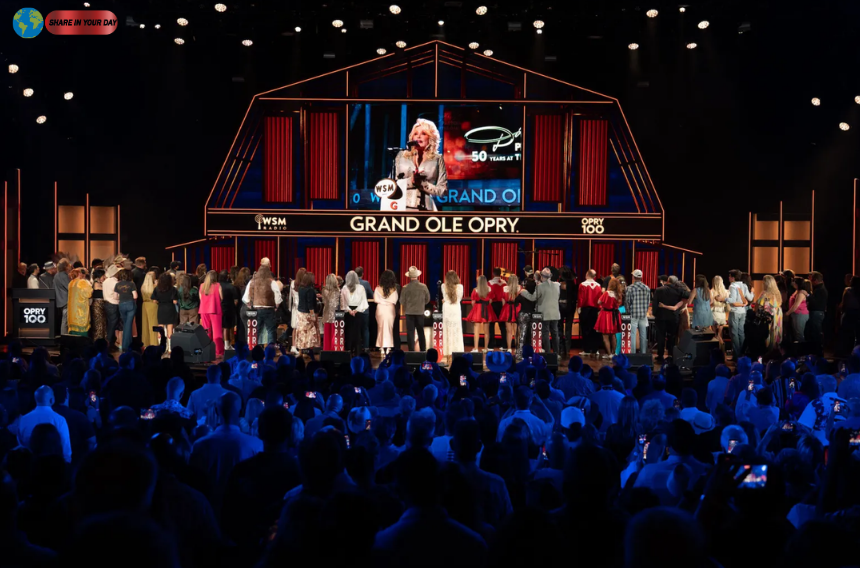
The special performance came at a deeply emotional moment for country music. Parton’s death on Aug. 25 prompted tributes from artists across generations, reflecting the extraordinary reach of her songwriting, singing, business career and philanthropy.
At the Grand Ole Opry, however, the tribute carried particular significance.
Parton was not simply another country star who appeared at the historic Nashville venue. She was an Opry member and one of the artists whose career became deeply connected to the institution.
The evening therefore served as both a musical celebration and a farewell.
Dolly Parton Opry Tribute Honors a Country Icon
The Dolly Parton Opry tribute featured a lineup of performers who helped celebrate different parts of Parton’s enormous musical legacy.
Among those appearing were Carly Pearce, Jelly Roll, Kathy Mattea, Ketch Secor, Molly Tuttle and Channing Wilson. Parton’s niece, Jada Star, also performed, adding an especially personal element to the evening.
The show was designed around Parton’s music rather than a conventional memorial format.
That distinction mattered.
Parton’s catalog contains songs that have become part of American popular culture. Her compositions have been recorded by artists in country, pop, rock and other genres, allowing her influence to extend far beyond the traditional boundaries of Nashville.
Songs such as “Jolene,” “9 to 5” and “I Will Always Love You” have remained recognizable decades after their original releases.
Her ability to turn personal stories into universal songs became one of the defining characteristics of her career.
Jada Star Brings Family Connection to the Stage
One of the most poignant moments came from Parton’s niece, Jada Star.
Star performed “The Orchard,” a song from the family’s 2024 collaborative album Smoky Mountain DNA: Family, Faith & Fables. Her appearance gave the tribute a direct connection to Parton’s family and musical roots.
The significance of that performance went beyond simply honoring an iconic singer.
Parton’s career had always been closely connected to family.
She grew up in a large family in the Smoky Mountains of Tennessee, where music played a central role in everyday life. That upbringing influenced her songwriting and remained an important part of the stories she told throughout her career.
Her music frequently drew on family, poverty, faith, ambition, heartbreak and perseverance.
Those themes helped make her songs accessible to listeners who had never experienced her particular background.
Carly Pearce Pays Tribute to Her Mentor
Carly Pearce was among the performers taking part in the Opry celebration.
Pearce’s connection to Parton made her participation especially meaningful. Before becoming a major country star herself, Pearce worked at Dollywood, the Tennessee theme park founded by Parton, and later became a member of the Grand Ole Opry in 2021.
Parton’s influence on younger female country artists has been substantial.
She demonstrated that a woman could become a successful songwriter, performer and business leader while maintaining control over her artistic identity.
Pearce’s appearance therefore represented more than another tribute performance.
It showed how Parton’s influence continued through artists who followed her.
Jelly Roll Joins the Emotional Celebration
Jelly Roll also appeared during the evening, participating in a group performance of “9 to 5.”
The song was an obvious choice for a celebration of Parton’s music.
Released in 1980, “9 to 5” became one of Parton’s signature songs and eventually grew into a cultural anthem about working life and economic frustration.
Its inclusion also highlighted the unusual breadth of Parton’s appeal.
The song was originally written for the 1980 film 9 to 5, in which Parton made her acting debut alongside Jane Fonda and Lily Tomlin.
The record became one of Parton’s biggest crossover successes.
Decades later, its themes remain recognizable to audiences well beyond country music.
Dolly Parton’s Connection to the Grand Ole Opry
The Grand Ole Opry was an important part of Parton’s career from an early stage.
Parton made her first appearance at the Opry as a young performer and was introduced by Johnny Cash, according to Rolling Stone’s obituary of the singer.
That early appearance helped connect Parton to one of country music’s most important institutions.
Over the following decades, she developed from an ambitious young songwriter into an international superstar.
Her relationship with the Opry continued throughout her career.
She was inducted as a member in 1969, beginning a connection that would last for more than half a century.
Her final Opry performance came in 2019.
That long history explains why dedicating an entire performance to Parton carried such emotional weight.
The venue was not simply celebrating a famous former performer.
It was honoring one of its own.
A Career That Changed Country Music
Parton’s influence on country music is difficult to measure because it extends across so many different areas.
She was a songwriter before she became a global celebrity.
Her songwriting ability helped establish her as a serious creative force at a time when Nashville’s music business was dominated by men.
She wrote songs that other performers could transform into major hits while also building her own identity as a recording artist.
“I Will Always Love You” is perhaps the clearest example.
Parton originally wrote the song as a farewell to Porter Wagoner after their professional partnership ended. The song became a country hit for Parton before Whitney Houston’s 1992 recording transformed it into a worldwide pop phenomenon.
Houston’s version spent 14 weeks at No. 1 on the Billboard Hot 100, turning Parton’s composition into one of the most commercially successful songs ever recorded.
That history illustrates Parton’s extraordinary songwriting power.
She could write songs that worked within country music while also possessing emotional themes broad enough to reach audiences around the world.
The Dolly Parton Opry Tribute Reflects Her Wider Legacy
The Dolly Parton Opry tribute also comes at a time when the world is reflecting on what Parton represented beyond music.
Her career eventually expanded into movies, television, business, theme parks and philanthropy.
Perhaps most importantly, she used her success to build programs designed to help other people.
Her Imagination Library became one of her most recognized philanthropic projects, providing books to children.
She also donated $1 million toward COVID-19 vaccine research, a contribution that became another example of her willingness to use her wealth and influence for public causes.
That combination of entertainment and philanthropy helped create an unusually broad public image.
Parton was simultaneously a country superstar, songwriter, actress, entrepreneur and philanthropist.
Why Dolly Parton’s Music Remains So Powerful
Parton’s music has survived because it often focuses on emotions rather than trends.
She wrote about loneliness.
She wrote about ambition.
She wrote about family.
She wrote about poverty and work.
She wrote about love and loss.
Those subjects do not become outdated.
Even songs recorded decades ago can still feel relevant because the emotions behind them remain familiar.
That is one reason artists continue covering Parton’s work.
It is also why a tribute show at the Grand Ole Opry can bring together musicians with very different musical backgrounds.
Each performer can find something personal in her catalog.
A Legacy Shared Across Generations
The performers at the Opry represented multiple generations of country music.
That is fitting for Parton’s legacy.
She became famous during the 1960s and 1970s, reached new audiences through film and pop music in the 1980s and continued releasing and performing music long into the 21st century.
Younger artists continued to cite her as an influence.
Her songs were repeatedly introduced to new audiences through covers, television appearances, films and collaborations.
The result is a rare kind of musical longevity.
Parton’s audience was not limited to people who grew up listening to her original recordings.
Her music continued to reach new listeners.
Tributes Continue Around the World
The Grand Ole Opry performance was only one part of a much larger wave of tributes.
Artists including Paul McCartney, Beyoncé, Taylor Swift and Jack White have publicly honored Parton’s legacy following her death.
Other performers have also incorporated Parton’s songs into their concerts.
Orville Peck recently performed “I Will Always Love You” in London, dedicating the song to Parton. Ella Langley performed “Jolene” during an Alabama concert.
The sheer variety of artists paying tribute demonstrates the reach of Parton’s influence.
Her music belongs to country music.
But it does not belong only to country music.
Dolly Parton’s Final Chapter
Parton died on Aug. 25, 2026, at the age of 80 after a brief battle with cancer. Her team confirmed that she died surrounded by loved ones in Nashville.
Her death came after decades of public success and a career that had already become legendary.
Yet the news still shocked fans.
Parton had remained a visible cultural figure for generations, making her absence difficult for many people to comprehend.
Her final public appearance came in June 2026 at the opening of a Tennessee truck stop named in her honor.
Just weeks later, she was gone.
The timing has made the Opry’s tribute even more emotional.
The Opry Says Goodbye Through Music
Rather than attempting to summarize Parton’s life in a single speech, the Grand Ole Opry allowed her songs to speak.
That may be the most appropriate tribute possible.
Parton built her career around storytelling.
She understood that songs could preserve memories, express feelings and connect strangers who had nothing else in common.
The Opry performance continued that tradition.
Each song became another reminder of the extraordinary body of work she left behind.
For the artists onstage, it was an opportunity to say goodbye.
For the audience, it was a chance to remember.
And for the Grand Ole Opry, it was a way to honor one of its most important members.
Dolly Parton’s Legacy Will Continue
The Dolly Parton Opry tribute was ultimately about more than one night in Nashville.
It was about the continuing life of Parton’s music.
Her recordings will remain available.
Her songs will continue to be covered.
Her stories will continue to be retold.
And artists who grew up listening to her will continue introducing her music to future generations.
That may be the strongest measure of a songwriter’s success.
Parton did not simply create hits.
She created songs that became part of people’s lives.
The Grand Ole Opry recognized that legacy with a night devoted to her music, bringing together artists who understood the importance of the woman they were honoring.
Parton’s death marks the end of an extraordinary personal chapter.
But it does not mark the end of her influence.
From “Jolene” to “9 to 5” and “I Will Always Love You,” her songs will continue to travel far beyond Nashville.
And as the Grand Ole Opry demonstrated, one of country music’s most enduring voices can still fill the room even after she is no longer there to sing.