Made in America: How AI is keeping this U.S. factory competitive
AI in manufacturing is moving from an experimental technology to a practical tool on the factory floor, helping American manufacturers identify problems faster, reduce waste and compete with lower-cost production overseas.
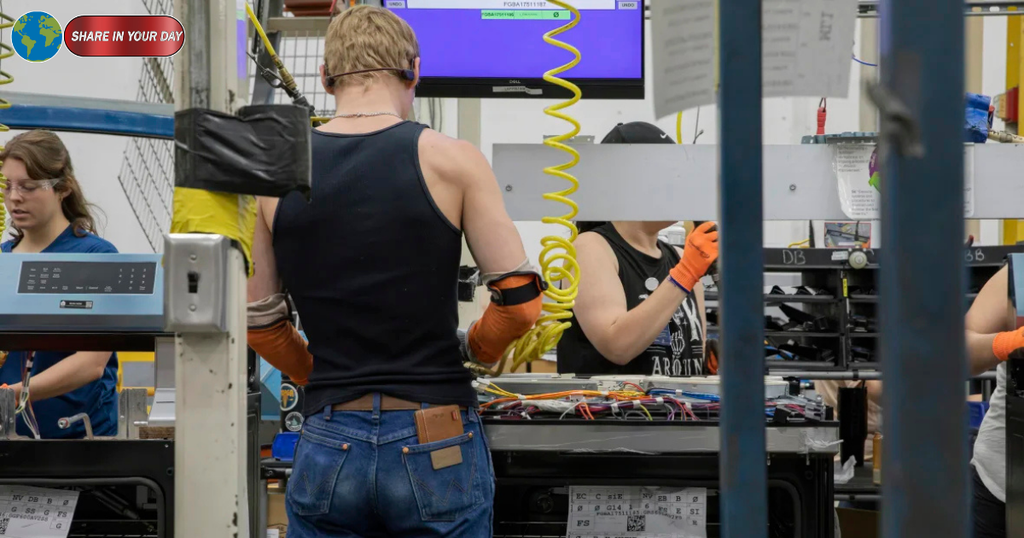
At a GE Appliances-owned plant in rural northwest Georgia, autonomous vehicles move parts through the facility, robots help assemble cooking appliances, and artificial-intelligence-powered cameras and sensors monitor production for mistakes.
The technology is designed to do something manufacturers have pursued for decades: make production faster, more reliable and less expensive.
But the transformation is not simply about replacing workers with machines.
Instead, the experience at GE Appliances shows how artificial intelligence can change the way people work inside a factory. AI systems can analyze enormous quantities of production data, identify patterns that might otherwise be missed and alert managers before equipment failures become expensive disruptions.
The developments come as manufacturers face intense pressure to produce high-quality goods while competing against factories in countries where labor costs can be significantly lower.
AI in manufacturing is changing the factory floor
The GE Appliances plant in LaFayette, Georgia, provides a useful example of how AI in manufacturing is being deployed in real-world production.
According to NPR reporting, cameras throughout the plant are trained to detect production anomalies. If a system identifies a problem, such as an incorrectly installed oven gasket, it can trigger an alert and stop the affected part of the production line.
That means workers can respond to problems much sooner.
For factory managers, speed can have a direct financial impact. Bill Good, GE Appliances’ vice president of manufacturing, told NPR that stopping an assembly line can cost between $300 and $500 per minute.
In that environment, identifying a problem several minutes earlier can translate into substantial savings.
The objective is therefore not merely to make factories more automated. It is to make them more responsive.
AI in manufacturing is built on years of data
One reason GE Appliances can use AI at this scale is that the company has spent more than a decade collecting information from cameras, sensors and production equipment.
That data is now being brought together through the company’s Brilliant Factory platform.
The system provides managers with a real-time view of manufacturing operations across the company’s major appliance plants.
Managers can see which machines are down, which products are being sent for repair and which materials are being scrapped.
Previously, much of that information would have required phone calls, reports or manual investigation.
Now, digital systems can provide the information almost immediately.
That shift is important because AI is only as useful as the data surrounding it.
A factory equipped with sensors but no effective data infrastructure may collect enormous quantities of information without being able to turn it into meaningful action.
GE Appliances’ experience demonstrates why industrial AI is often the result of years of investment rather than a sudden overnight transformation.
Predictive maintenance could save factories millions
One of the most valuable applications of AI in manufacturing is predictive maintenance.
Traditional maintenance often follows a schedule. A machine may be inspected or serviced after a certain number of operating hours.
Predictive maintenance takes a different approach.
AI systems can examine signals from equipment and identify patterns associated with potential failures.
For example, if a motor begins operating at an unusually high temperature, an AI system can flag the change as a potential warning sign.
Instead of waiting for the motor to fail, managers can schedule maintenance before the breakdown occurs.
That can be extremely important on a modern assembly line.
A single equipment failure can interrupt production across an entire facility. The longer the line remains stopped, the greater the financial loss.
AI therefore has the potential to change maintenance from a reactive process into a proactive one.
The technology does not eliminate the need for technicians. Instead, it can give technicians better information about where problems are developing and which equipment needs attention first.
AI-powered quality control is becoming more important
Quality control is another area where artificial intelligence is gaining ground.
Human inspectors remain important in manufacturing, but people can become fatigued, particularly when examining thousands of similar products over long shifts.
Computer-vision systems can continuously inspect products for specific defects.
At GE Appliances, AI-powered cameras are being trained to recognize production errors.
The advantage is consistency.
An AI system can monitor the same process repeatedly and compare what it sees against predefined standards.
When the system detects an anomaly, workers can investigate.
This creates a partnership between humans and machines.
The machine provides continuous monitoring and rapid detection. The human provides judgment, physical intervention and problem-solving when something goes wrong.
That distinction is important in the broader debate over whether AI will eliminate manufacturing jobs.
Will AI replace factory workers?
The rise of AI in manufacturing naturally raises concerns about employment.
Automation has already changed factory work for generations. Robots have taken over many repetitive physical tasks, while computer systems have transformed planning, inventory management and quality control.
Artificial intelligence adds another layer because it can analyze information and make recommendations that previously required considerable human experience.
Yet the GE Appliances example suggests a more complicated picture than simple job replacement.
Bill Good told NPR that he does not expect AI to replace large populations of workers in the foreseeable future.
Instead, he argues that AI can help American factories remain competitive.
That distinction matters.
If AI allows a U.S. factory to manufacture products more efficiently, it may help keep production inside the country rather than moving to lower-cost overseas facilities.
In that sense, technology could protect some manufacturing employment even as it changes the nature of individual jobs.
AI is changing the skills factories need
The growth of AI and automation is also likely to change what manufacturers expect from workers.
Traditional factory skills remain valuable, but employees increasingly need to understand digital systems, automated equipment and data.
A technician may need to interpret information generated by sensors.
An operator may need to work alongside automated vehicles and robotic systems.
A supervisor may need to understand AI-generated reports before deciding how to adjust production.
This means the future manufacturing workforce may require a combination of physical and digital skills.
Workers who understand both the factory process and the technology controlling it could become especially valuable.
The change also creates a challenge for employers.
Manufacturers need to invest not only in machines and software but also in training people to use those systems effectively.
AI can help factories respond to demand
Another important application is production planning.
Manufacturers have to make decisions about how many products to produce and when to produce them.
Too much inventory can tie up money and create waste.
Too little inventory can leave customers waiting and cause manufacturers to lose sales.
GE Appliances is using AI to help forecast market demand.
Better forecasting can allow factories to adjust production more quickly as consumer demand changes.
That flexibility can be particularly important in industries where product preferences shift rapidly.
Instead of committing to a production schedule far in advance and accepting the consequences when demand changes, manufacturers can use data to make more informed adjustments.
The result is a more flexible production system.
AI in manufacturing could strengthen U.S. factories
The American manufacturing sector faces a difficult competitive environment.
Factories in the United States generally have higher labor costs than facilities in many developing economies.
That makes productivity especially important.
If a U.S. factory can produce more goods with fewer defects, less downtime and less wasted material, it can narrow part of the cost gap.
This is where AI in manufacturing could have a strategic role.
The technology cannot eliminate every difference between countries.
However, it can help American manufacturers compete on factors other than labor costs.
Speed, quality, flexibility and reliability can all become competitive advantages.
GE Appliances has already invested heavily in its Georgia operations. NPR reported that the company added 600 jobs in the state as part of a $180 million expansion.
That development illustrates the more complicated relationship between automation and employment.
A highly automated factory can still create jobs if improved productivity supports expansion.
AI does not make human expertise obsolete
One of the most striking points from the GE Appliances example is the relationship between AI and experienced manufacturing workers.
Artificial intelligence can identify patterns in data that humans may overlook.
However, experienced workers understand the physical realities behind those patterns.
They know how equipment behaves.
They understand production constraints.
They can recognize unusual situations that may not fit neatly into a computer model.
For that reason, the most effective factories may not be those that attempt to remove humans from the process.
They may instead be the factories that use technology to make experienced workers more effective.
An AI system might identify a potential problem.
A technician can determine what is actually happening.
A production manager can decide how to respond.
That combination creates a human-machine workflow rather than a simple replacement model.
The factory of the future will be more data-driven
The GE Appliances case reflects a broader industrial trend.
Manufacturers around the world are investing in sensors, robotics, computer vision, predictive maintenance and artificial intelligence.
Industrial AI is becoming a major technology market. Research from IoT Analytics estimated that the global industrial AI market reached $43.6 billion in 2024 and could grow to $153.9 billion by 2030. IIoT Analytics
The growth reflects a wider shift toward smart manufacturing.
Factories are increasingly connected systems.
Machines generate data.
Sensors monitor equipment.
Cameras inspect products.
Software analyzes performance.
AI connects those streams of information and attempts to identify what should happen next.
That represents a significant change from the traditional factory model.
The biggest advantage may be speed
For manufacturers, the most important benefit of AI may ultimately be speed.
A production problem that takes an hour to discover can be much more expensive than a problem identified within seconds.
The same principle applies to equipment maintenance, quality control and production planning.
AI can monitor information continuously.
That means factories can potentially move from discovering problems after they happen to identifying warning signs before they become major failures.
The economic impact can accumulate quickly.
If a factory improves quality by even a small percentage, reduces downtime and cuts material waste, the savings can become substantial over the course of a year.
That is why manufacturers are increasingly interested in practical AI applications rather than technology simply for its own sake.
What AI means for the future of manufacturing jobs
The debate over manufacturing employment will continue as AI adoption expands.
Some tasks will undoubtedly become automated.
Other jobs may change significantly.
At the same time, new positions can emerge around maintaining automated systems, managing data, developing industrial AI applications and overseeing increasingly sophisticated production environments.
The transition will not necessarily be painless.
Workers whose jobs are heavily based on repetitive tasks may face greater pressure to retrain.
Companies will also have to decide how quickly to introduce automation and how much responsibility to give AI systems.
But the GE Appliances example provides a more nuanced picture than the idea that factories are simply becoming worker-free.
People remain central to the operation.
The machines are becoming smarter.
AI in manufacturing marks a new industrial competition
The rise of AI in manufacturing is ultimately about more than individual factories.
It is becoming part of a broader competition over where products are designed, manufactured and shipped.
Countries with advanced manufacturing capabilities are investing in artificial intelligence because productivity can influence their ability to compete globally.
The United States, China, Europe, Japan and South Korea are all developing industrial AI capabilities in different ways.
Meanwhile, demand for AI-related hardware is also influencing factory activity across Asia and Europe. Recent global manufacturing data showed stronger factory activity in August, with AI-related hardware demand contributing to growth in several Asian economies. RReuters
The competition therefore extends beyond software.
It includes chips, robots, sensors, industrial equipment, energy infrastructure and the skilled workers needed to operate them.
The next phase of the factory is already here
The transformation underway at GE Appliances offers a glimpse of what manufacturing could look like over the coming years.
Factories will continue to use robots for physical tasks.
Sensors will collect more information.
Computer vision will monitor production.
AI will analyze increasingly complex datasets.
And workers will increasingly interact with digital systems as part of their everyday responsibilities.
The most important question may not be whether AI replaces factory workers.
Instead, it may be whether manufacturers can use AI effectively enough to create more competitive factories while giving workers the skills necessary to succeed in them.
At GE Appliances, the early results suggest that AI can help factories find problems faster, reduce waste and improve efficiency.
For American manufacturing, those gains could matter enormously.
The factory of the future may not be a place without people.
It may be a place where people have better information, machines are more responsive and production problems are identified before they become expensive.
That is the emerging promise of AI in manufacturing — not simply automation, but a fundamentally more intelligent way of running the factory floor.