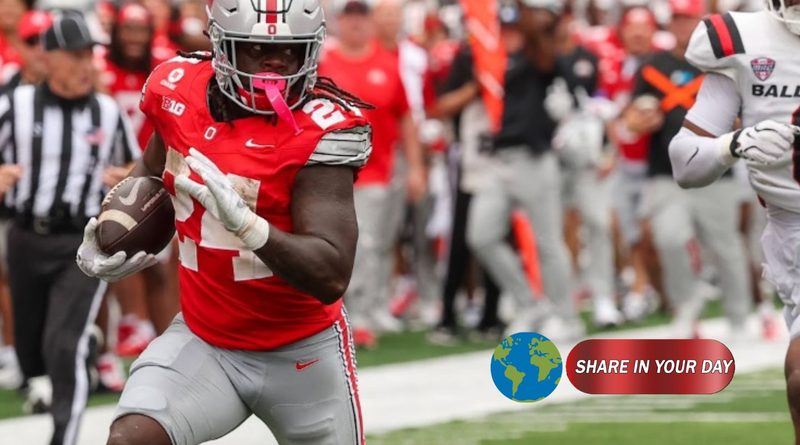
Ohio State Run Game Finds Its Rhythm After Halftime
The Ohio State run game entered the 2026 season opener with plenty to prove, and Saturday’s 56-3 victory over Ball State provided an encouraging but revealing first test.
For much of the first half, the Buckeyes struggled to establish the physical rushing attack that head coach Ryan Day and new offensive coordinator Arthur Smith had emphasized throughout the offseason. Ohio State managed only 30 rushing yards during the opening 30 minutes, including just three yards in the second quarter.
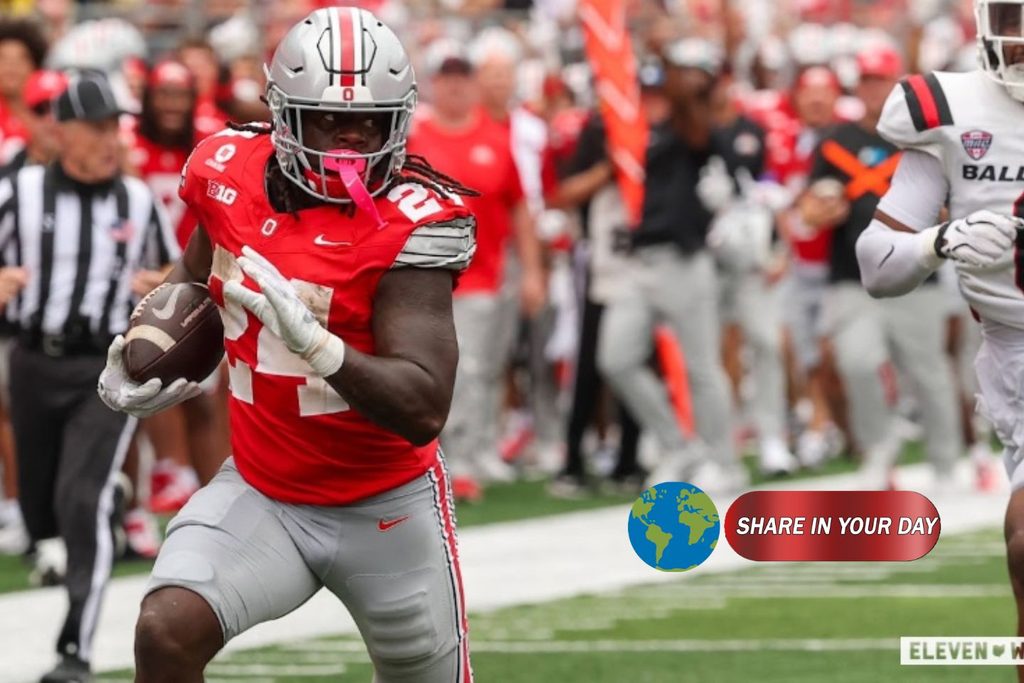
Then everything changed.
The Buckeyes came out of halftime with a noticeably different approach and quickly began creating the kind of running lanes that had been missing earlier in the afternoon. Two explosive rushing touchdowns helped transform the performance, and Ohio State eventually finished with 237 rushing yards on 35 carries, along with three touchdowns on the ground.
The final numbers looked impressive.
The first-half struggles, however, showed that there is still work to do before the competition becomes significantly tougher.
That matters because Ohio State’s next opponent is No. 5 Texas.
Ohio State Run Game Struggles Early
The first half was not what Ohio State envisioned when it entered the season ranked No. 1 nationally.
Ball State was unable to stay competitive on the scoreboard, but the Cardinals initially did enough to make the Buckeyes work for rushing yards. Ohio State’s ground attack generated only 30 yards during the opening half, with the second quarter particularly quiet.
For a program that spent the offseason looking for improvement in its rushing offense, that start immediately attracted attention.
The situation was especially interesting because Ohio State has invested significant resources into rebuilding the identity of its offensive line and running game.
The Buckeyes entered 2026 with an experienced offensive line, a new offensive coordinator in Smith and high expectations for sophomore running back Bo Jackson after his productive freshman season.
Those pieces were expected to help Ohio State become more consistent on the ground.
Against Ball State, though, consistency did not arrive immediately.
Instead, the Buckeyes needed halftime adjustments to unlock the offense.
The Ohio State Run Game Changes After Halftime
Ryan Day acknowledged after the game that the first-half rushing performance was not good enough.
The Buckeyes’ coaching staff identified several areas that needed attention, with offensive coordinator Arthur Smith and offensive line coach Tyler Bowen making adjustments to the way the line operated.
One of the key areas was movement.
That adjustment helped Ohio State create more favorable situations for its running backs. The Buckeyes were able to get defenders moving laterally and create openings that had not consistently been available during the first half.
The difference was immediate.
Day pointed specifically to Ohio State’s first two drives of the second half as evidence that the changes were working.
Instead of repeatedly running into congestion, the Buckeyes began finding space.
Once that happened, Ohio State’s speed and athleticism became much more difficult for Ball State to contain.
That is an important distinction.
The issue was not necessarily a lack of talent in the backfield. Rather, the offense needed to create the conditions that allowed those runners to use their abilities.
Explosive Plays Transform the Buckeyes’ Ground Attack
The most noticeable difference in the second half was the emergence of explosive rushing plays.
Ohio State did not simply grind out four or five yards at a time. The Buckeyes broke through for long touchdown runs that dramatically changed the statistical picture.
Those explosive plays also helped demonstrate why Ohio State believes its rushing attack can become much more dangerous in 2026.
A successful running game does not always require spectacular plays. However, explosive runs can quickly change defensive strategy.
Once a defense knows that a running back can break a play for 40, 50 or more yards, linebackers and safeties become more cautious. That can create additional space for both the rushing and passing attacks.
Ohio State eventually finished with 237 rushing yards on 35 attempts.
That works out to nearly 6.8 yards per carry, a substantial improvement from what the Buckeyes showed during the opening half.
The final total therefore tells two different stories.
One is the story of a dominant offensive performance.
The other is the story of an offense that needed time to figure out how to consistently move the football on the ground.
Bo Jackson Remains a Major Part of the Equation
One of the biggest reasons for optimism surrounding Ohio State’s rushing offense is Bo Jackson.
The sophomore running back entered the season carrying considerable expectations after producing more than 1,000 rushing yards as a freshman.
His presence gives the Buckeyes a proven option in the backfield and allows the coaching staff to build around a player who has already demonstrated that he can handle a significant workload.
Jackson is also part of a larger running back group that gives Ohio State flexibility.
The Buckeyes do not need to rely exclusively on one runner. That depth can become particularly important as the season progresses and opponents begin preparing specifically for Ohio State’s offensive tendencies.
Freshman Legend Bey also showed why the Buckeyes have reason to be excited about the future of the position.
The combination of experienced backs and younger playmakers gives Ohio State multiple ways to attack defenses.
But the offensive line remains the key.
If the blocking is inconsistent, even talented running backs can struggle to find room.
If the line consistently creates openings, Ohio State has the speed to turn ordinary runs into game-changing plays.
Arthur Smith’s Influence Will Be Closely Watched
The 2026 season represents a significant offensive transition for Ohio State.
Smith has taken over as offensive coordinator, bringing a new approach and a different perspective to the Buckeyes’ offense.
That makes the first game particularly interesting from a schematic standpoint.
Ohio State scored 56 points and moved the ball effectively overall, so there is little reason to view the opener as a failure.
Still, the rushing performance provided Smith and his staff with valuable information.
The first half exposed areas that need to be corrected.
The second half showed how quickly the offense can improve when those adjustments are successful.
That could become one of the most important themes of Ohio State’s season.
The best offenses are not necessarily the ones that execute perfectly from the opening snap. They are often the ones capable of identifying problems and fixing them before the next opponent can exploit them.
Ohio State demonstrated that ability against Ball State.
The challenge now is doing it against elite competition.
The Texas Test Changes Everything
Ball State was always going to provide only a limited measurement of Ohio State’s championship potential.
The Buckeyes entered the game as the No. 1 team in the country, while Ball State was a significant underdog.
The next opponent will provide a dramatically different challenge.
Texas opened its season with a 59-7 victory over Texas State and looked dominant on both sides of the football. Quarterback Arch Manning threw for 305 yards and four touchdowns, while the Longhorns’ defense forced three turnovers.
That means Ohio State’s rushing improvement could not have arrived at a more important time.
Against Texas, the Buckeyes will need to establish some level of balance.
If Ohio State becomes one-dimensional, Texas will have the defensive personnel to make life difficult for quarterback Julian Sayin.
The opposite is also true.
If Ohio State can run effectively, Texas will be forced to respect the ground game. That could create more opportunities for Sayin and an explosive receiving corps led by Jeremiah Smith.
The rushing attack could therefore influence much more than the rushing statistics.
Jeremiah Smith Gives Ohio State Another Offensive Weapon
While the running game was the focus of concern during the first half, Ohio State’s passing attack provided a major source of stability.
Jeremiah Smith delivered another spectacular performance, catching eight passes for 151 yards and two touchdowns in the season opener.
His production creates a difficult problem for opposing defenses.
Defensive coordinators cannot simply load the box to stop Ohio State’s running backs because Sayin has dangerous weapons on the outside.
At the same time, playing lighter boxes to protect against Ohio State’s passing attack can give the Buckeyes more favorable rushing opportunities.
That is where the second-half rushing improvement becomes particularly significant.
The better Ohio State runs the ball, the harder it becomes for defenses to focus exclusively on Smith and the passing game.
And the better Ohio State throws the ball, the more room its running backs could find.
That complementary relationship will be critical against Texas.
Ryan Day Wants the Improvement to Continue
Day was encouraged by the second-half response but did not treat the performance as a finished product.
That is understandable.
Ohio State accomplished its primary objective by dominating Ball State, but the coaching staff knows that the margin for error will shrink considerably in upcoming games.
Day specifically noted that weaknesses can become more significant as the level of competition increases.
That is perhaps the most important takeaway from the rushing performance.
Against Ball State, Ohio State had enough talent to overcome an inconsistent first half.
Against Texas, Oregon, Indiana, USC and other major opponents later in the season, those same problems could become much more costly.
The Buckeyes therefore have only a short window to turn Saturday’s second-half improvement into a consistent identity.
What Ohio State Must Fix Before Texas
The first priority is consistency.
Ohio State cannot afford to wait until halftime to establish its rushing attack against a top-five opponent.
The offensive line must create movement earlier, and the running backs must maximize whatever openings appear.
The second priority is maintaining explosiveness.
The long touchdown runs demonstrated what the Buckeyes can do when the blocking and execution come together. The challenge is producing explosive opportunities without becoming overly dependent on them.
The third priority is physicality.
Ohio State’s rushing identity will ultimately be tested against defensive fronts that are capable of matching the Buckeyes’ size and athleticism.
The Texas game will provide the first real indication of whether the changes made during the offseason have produced the desired results.
A Promising Start With a Warning Attached
Ohio State’s 56-3 victory over Ball State could hardly have gone better from a scoreboard perspective.
The defense was dominant.
The passing game was explosive.
Sayin looked comfortable, and Smith once again demonstrated why he is considered one of the most dangerous receivers in college football.
Yet the Ohio State run game remains one of the most intriguing storylines coming out of the opener.
Thirty rushing yards in the first half is not the standard the Buckeyes expect.
Two explosive rushing touchdowns and 237 total rushing yards in the final statistics, however, show the potential that exists within this offense.
The difference came after halftime, when the coaching staff made adjustments and the offensive line began creating more movement.
That response may ultimately prove more valuable than the raw statistics.
Ohio State showed that it can recognize a problem, make changes and produce a dramatically better result.
Now comes the difficult part.
Texas will not be Ball State.
The Longhorns enter the matchup after a 59-7 opening-week victory and will bring a much more talented defense into the contest.
For Ohio State, the question is simple: Was the second-half rushing surge the beginning of a new identity, or merely a product of facing an overmatched opponent?
The answer could tell us a great deal about the Buckeyes’ championship prospects.
For now, there is reason for optimism.
Ohio State finished its opener with 237 rushing yards and three rushing touchdowns after struggling badly on the ground during the opening 30 minutes.
That turnaround gives Day and his coaching staff something valuable heading into Week 2: evidence that the rushing attack can respond when adjustments are made.
Against Texas, they will find out whether it can start fast, stay physical and produce at that level for an entire game.