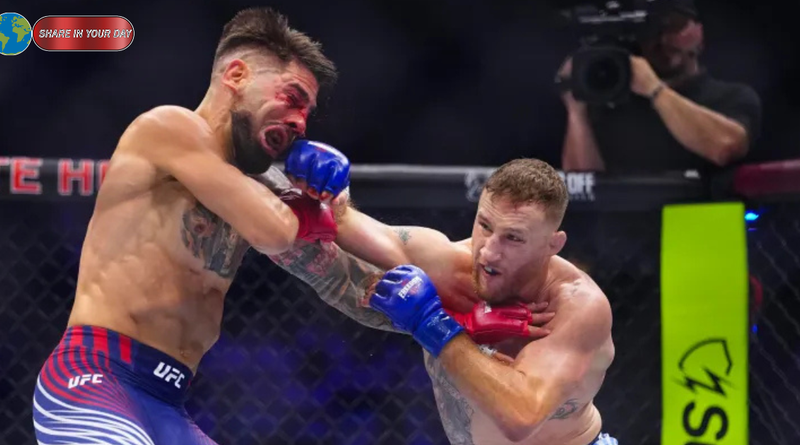
Justin Gaethje Ilia Topuria: 3 Keys to the Win
The Justin Gaethje Ilia Topuria matchup produced one of the most significant results of 2026, and Gaethje now believes he knows exactly why he was able to solve one of the UFC’s most dangerous fighters.
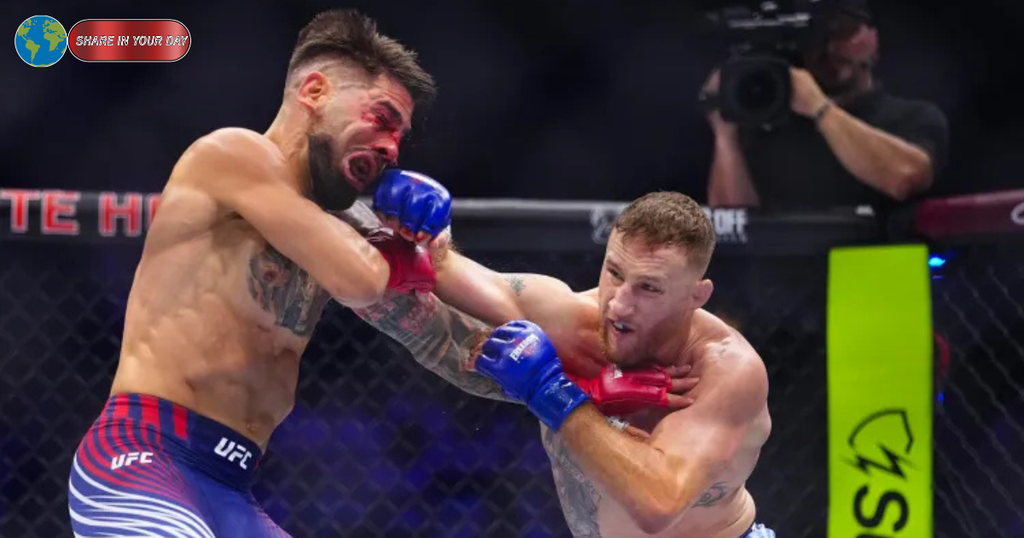
Gaethje defeated Topuria in the UFC White House main event to become the undisputed UFC lightweight champion for the first time. The victory was particularly notable because Topuria entered the fight undefeated and had already established himself as one of the sport’s most feared finishers.
Several months after the fight, Gaethje has offered a detailed explanation of what he saw inside the Octagon. According to the new champion, Topuria’s movement became surprisingly predictable because his feet followed a repetitive rhythm.
That observation became a central part of Gaethje’s strategy.
MMA Fighting reported that Gaethje recently discussed the victory while speaking with Demetrious Johnson. He pointed to Topuria’s footwork, preparation and mindset as major factors behind the result. MMMA Fighting
Justin Gaethje Ilia Topuria Fight Changed Everything
Before the matchup, Topuria had built an extraordinary reputation.
He entered the UFC White House fight unbeaten and had already captured a championship at featherweight before moving up to lightweight. His confidence was understandable. However, Gaethje believed that confidence eventually became a weakness.
The fight itself unfolded differently from what many observers expected.
Gaethje survived a difficult second round before taking control and applying increasing pressure. By the end of the fourth round, Topuria’s corner stopped the contest, giving Gaethje the biggest victory of his career and the undisputed lightweight championship. MMMA Fighting
For Gaethje, however, the result was not simply a matter of surviving Topuria’s power and returning fire.
He believes the fight was won through preparation.
The veteran contender studied how Topuria moved and identified a pattern that he could repeatedly exploit. Rather than allowing Topuria to dictate the range, Gaethje wanted to disrupt his rhythm.
That distinction became crucial.
Gaethje Identified a Major Footwork Weakness
The biggest revelation from Gaethje was his assessment of Topuria’s movement.
He said Topuria rarely changed the rhythm of his feet. Instead, Gaethje saw a repetitive pattern involving forward and backward movement, with comparatively little lateral movement.
That gave the champion something he could anticipate.
In MMA, predictability can be extremely dangerous. A fighter does not necessarily need to be slow to become readable. Even an explosive athlete can become easier to counter if his movement follows the same pattern repeatedly.
Gaethje explained that his strategy was essentially to interrupt Topuria’s footwork.
The idea was straightforward: instead of simply reacting to Topuria’s attacks, Gaethje wanted to interfere with the movement that created those attacks.
That allowed him to control the timing of exchanges.
The difference is subtle but important. A fighter who consistently moves forward and backward can potentially be timed more easily than someone who constantly changes direction. Lateral movement forces an opponent to adjust angles, reset positioning and reconsider attack timing.
Gaethje said he had not seen Topuria consistently make that adjustment.
That, in his view, made the former champion “very easy to predict.” MMMA Fighting
Why Rhythm Matters in MMA
Footwork is one of the most important foundations of mixed martial arts.
A fighter’s feet determine distance, balance and the ability to generate offense. They also influence defensive reactions.
When movement becomes repetitive, an opponent can begin recognizing patterns.
That does not mean every forward step is predictable. Rather, repeated movement can create opportunities for an opponent to anticipate when an attack or retreat is likely to occur.
Gaethje’s approach was therefore less about waiting for one spectacular opening and more about constantly disrupting Topuria’s preferred rhythm.
That is particularly important against a fighter like Topuria.
Topuria has built much of his success around explosive attacks and precise timing. If an opponent can prevent him from establishing a comfortable rhythm, the effectiveness of those attacks can be reduced.
Gaethje appears to have understood that before the fight.
Instead of attempting to match Topuria’s explosiveness at every moment, he focused on making Topuria uncomfortable.
Topuria’s Preparation Also Came Under Scrutiny
Gaethje’s analysis did not stop at footwork.
He also questioned Topuria’s preparation during the 12 weeks before the fight.
According to Gaethje, Topuria made emotional mistakes and approached the matchup as though it could be handled in the same way as his previous victories.
That was a critical mistake in Gaethje’s opinion.
Every opponent creates a different tactical problem. A strategy that worked perfectly in one fight cannot automatically be reproduced in another.
Gaethje drew on his own experience to explain the point.
He argued that fighters can make mistakes when they attempt to recreate a previous “perfect performance.” Instead of focusing entirely on the current opponent, they can become attached to what worked previously.
That mindset can make preparation less flexible.
MMA is especially unforgiving because opponents can force completely different types of exchanges. A striker who dominates one opponent at long range might find another fighter constantly closing distance. A grappler who controls one opponent from top position might face someone with significantly stronger submission defense.
Every matchup is its own puzzle.
Gaethje believes Topuria failed to treat their contest with enough individuality.
The Mental Battle Behind the UFC White House Result
The psychological element of the fight is also worth considering.
Topuria entered the contest with enormous confidence. His unbeaten record had reinforced the belief that he could handle virtually any challenge placed in front of him.
But confidence can become dangerous when it turns into expectation.
Gaethje suggested that Topuria did not fully expect to encounter someone who could remain competitive with him for an extended period.
That expectation may have influenced his preparation.
The longer the fight continued, the more Gaethje was able to impose his physical style and pressure. What began as a competitive contest eventually became a defining performance for the veteran.
This is one reason the result was so significant.
Topuria was not simply beaten by a fighter who caught him with one unexpected punch. Gaethje gradually solved the matchup and broke down the former champion over multiple rounds.
That makes the victory particularly important for Gaethje’s legacy.
Gaethje’s Patience Became a Major Advantage
Another important factor was Gaethje’s ability to remain composed after a difficult second round.
A fighter facing Topuria cannot afford to panic.
Topuria’s reputation was built in part on his ability to create sudden finishing sequences. An opponent who becomes reckless after taking damage can quickly find himself in serious trouble.
Gaethje instead remained in the fight.
He absorbed the difficult moments and continued executing his strategy.
That patience eventually paid off.
As the fight progressed, Gaethje’s pressure became increasingly difficult for Topuria to handle. The fourth-round stoppage demonstrated how dramatically the momentum had shifted.
The result also showed that Gaethje’s championship-level experience remained a major asset.
He had already competed in numerous high-level fights against elite opposition. Those experiences helped him remain comfortable during periods when the fight did not go exactly according to plan.
What the Result Means for Topuria
For Topuria, the loss represents the first defeat of his professional MMA career.
That makes the aftermath particularly important.
A first loss can force a fighter to reconsider aspects of his preparation, tactics and mentality. Topuria now has an opportunity to examine what went wrong and determine whether Gaethje exposed a repeatable weakness or simply executed an exceptional game plan on one night.
Topuria has already shown signs of resilience.
MMA Fighting previously reported that he responded to the defeat by reflecting on the experience and emphasizing the lessons he took from his first professional loss. MMMA Fighting
That response could become important if the two fighters eventually meet again.
A rematch would not simply be about physical adjustments. Topuria would need to show that he can vary his movement and prevent Gaethje from reading the same patterns.
He would also need to demonstrate that the psychological impact of the first fight has not changed his approach.
Could Justin Gaethje and Ilia Topuria Fight Again?
The possibility of a rematch has already generated considerable discussion.
UFC commentator Jon Anik recently suggested that the promotion could be interested in booking Gaethje against Topuria again. According to Anik, internal discussions may have considered the rematch as a potential first title defense for Gaethje. MMMA Fighting
However, there is an obvious obstacle.
Gaethje has indicated that he does not plan to compete again during 2026. That means the lightweight division could continue moving while he takes time away from competition.
Several contenders remain relevant to the title picture.
A rematch with Topuria would also carry enormous commercial interest. Their first meeting was one of the biggest fights of Gaethje’s career, and the unusual circumstances surrounding the UFC White House event added another layer of attention.
But there are sporting questions as well.
Would Topuria benefit from immediately facing Gaethje again?
Some observers have already expressed concern about that possibility. Veteran fighter Matt Brown recently argued that Topuria could benefit from a less demanding comeback fight rather than immediately entering another high-risk contest with Gaethje. MMMA Fighting
That debate could become increasingly important as the lightweight division develops.
The Most Important Lesson From Gaethje’s Victory
The biggest lesson from the Justin Gaethje Ilia Topuria fight may be that elite MMA competition is often decided by details.
Topuria did not suddenly become a poor fighter.
Gaethje simply identified a pattern and built his strategy around it.
The footwork observation was especially important because it connected directly to the larger tactical battle. If Topuria moved forward and backward in a consistent rhythm, Gaethje could anticipate when to attack, when to interrupt and when to create defensive reactions.
At the highest level, those small advantages can decide championship fights.
Gaethje also demonstrated the value of adaptability.
Rather than assuming the fight would unfold according to a predetermined script, he adjusted to what Topuria gave him. He survived difficult moments, maintained his composure and continued attacking the weaknesses he had identified.
That combination ultimately produced a career-defining victory.
A New Chapter for the UFC Lightweight Division
Gaethje’s victory has also reshaped the UFC lightweight championship picture.
For years, the division has been one of the deepest and most competitive weight classes in MMA. The arrival of Gaethje as undisputed champion adds another compelling storyline.
The champion now has to defend the title against a group of dangerous contenders.
Topuria remains one of the most intriguing possibilities. However, other fighters are also positioning themselves for championship opportunities.
That uncertainty could make the next stage of Gaethje’s career particularly interesting.
If he returns in 2027, the question will be whether the UFC chooses the biggest commercial matchup or the strongest sporting contender.
A Topuria rematch would provide both enormous attention and a clear narrative. But the first fight also demonstrated how difficult the matchup could be for Topuria.
Gaethje already knows what he wants to target.
Topuria, meanwhile, now knows exactly what Gaethje saw.
That makes a potential rematch fascinating.
Final Takeaway
The Justin Gaethje Ilia Topuria fight was ultimately decided by more than power and toughness.
Gaethje believes he identified a predictable movement pattern in Topuria’s footwork and built his strategy around disrupting it. He also believes Topuria entered the contest carrying too much confidence and attempted to recreate elements of previous victories rather than treating the matchup as a completely new challenge. MMMA Fighting
Whether those weaknesses can be corrected remains one of the biggest questions surrounding Topuria’s future.
For Gaethje, the victory transformed him from longtime contender into undisputed lightweight champion.
For Topuria, it created the first major test of his career outside the comfort zone of an undefeated record.
If the two eventually meet again, the tactical story will be very different.
Gaethje will know that Topuria is aware of the footwork issue. Topuria will know that Gaethje is looking for the same patterns. And both fighters will have to prove that they can make meaningful adjustments.
That is what makes a potential rematch so compelling.
The first fight showed that Gaethje could solve Topuria.
The next question is whether Topuria can solve Gaethje.
Image SEO
Recommended image: Use a properly licensed editorial image of Justin Gaethje and Ilia Topuria from the UFC White House event.
ALT text: Justin Gaethje Ilia Topuria UFC White House title fight
External source: MMA Fighting source article
Internal links: These require your actual website/domain and existing article URLs. I have not invented internal URLs because doing so could create broken links.
This version is structured for WordPress and uses the focus keyword naturally rather than forcing artificial keyword repetition.