Home Compostable Food Serviceware Market Poised for Major Growth
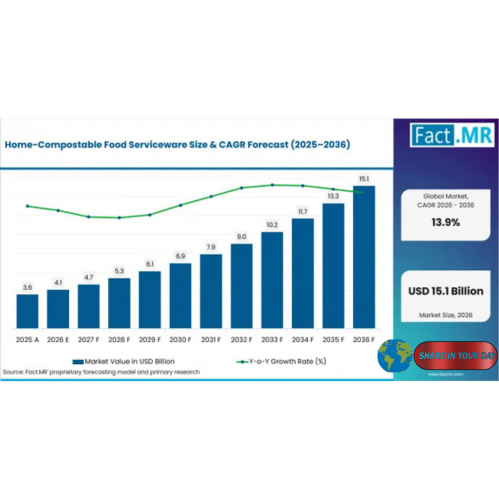
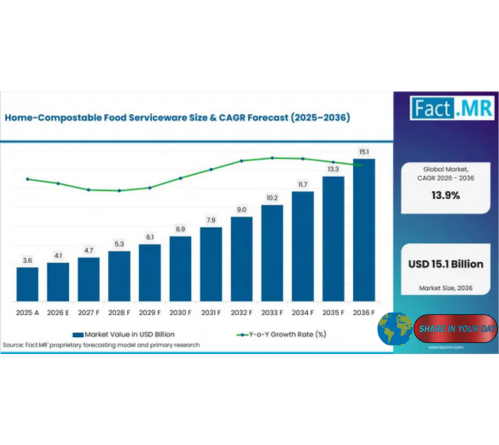
The home compostable food serviceware market is entering a major growth phase as restaurants, quick-service restaurants (QSRs), caterers and institutional food operators look for alternatives to conventional plastic products. According to Fact.MR, the global market is valued at approximately $4.12 billion in 2026 and is projected to reach $15.14 billion by 2036, representing a compound annual growth rate of 13.9%.
The shift reflects more than consumer interest in sustainability. Foodservice businesses are facing growing pressure to reduce plastic use, comply with packaging policies and provide clearer end-of-life options for disposable products.
At the same time, manufacturers are developing new materials and product formats that can deliver the performance expected from conventional foodservice items. Cups, plates, bowls, trays, clamshells and cutlery are increasingly being designed around compostability claims and specific certification requirements.
The result is a market where sustainability, convenience and regulatory compliance are becoming increasingly interconnected.
1. Home Compostable Food Serviceware Market Could Reach $15.1 Billion
The size of the opportunity is one of the clearest signals that compostable serviceware is moving beyond a niche sustainability category.
Fact.MR estimates that the market will expand from $4.12 billion in 2026 to $15.14 billion in 2036. That represents an absolute opportunity of roughly $11 billion over the forecast period.
A 13.9% CAGR would make this one of the faster-growing segments within sustainable foodservice packaging.
Several forces are contributing to that outlook. Foodservice operators purchase disposable products in high volumes, making even small changes in packaging specifications capable of producing significant demand.
QSR chains are particularly important because they rely on standardized packaging across large numbers of locations. Once a compostable cup, container or lid passes performance and operational testing, it can potentially be deployed across multiple restaurants.
The same principle applies to cafeterias, universities, hospitals, event venues and catering businesses.
This scale creates an attractive opportunity for manufacturers that can combine reliable performance with credible compostability certifications.
2. Cups Are Emerging as a Key Product Segment
Among the different product categories, cups are projected to account for 24% of the home compostable food serviceware market in 2026, according to Fact.MR.
That position is not surprising.
Cups are among the most frequently used disposable foodservice products. Coffee shops, fast-food restaurants, convenience stores, events and institutional cafeterias can consume large quantities every day.
However, making a compostable cup is more complicated than simply replacing conventional plastic with a plant-based material.
A cup must withstand liquids, temperature changes and handling during transportation and consumption. Its lining also needs to provide sufficient resistance to moisture and, depending on the application, oils and other substances.
That makes material and coating technology especially important.
Fact.MR identifies PHA as the leading material category, with an estimated 27% share in 2026. PHA can be used in coatings and linings designed to support compostability while maintaining the functionality required for foodservice applications.
The combination of high-volume beverage consumption and advances in compostable lining technology could therefore make cups a major entry point for broader foodservice conversion.
3. PHA Technology Is Changing Compostable Serviceware
Material innovation is becoming one of the most important elements of the home compostable food serviceware market.
Fact.MR expects PHA, or polyhydroxyalkanoates, to represent 27% of the market by material in 2026.
PHA is particularly relevant because manufacturers can use it in coatings and lining systems for products such as cups and bowls.
This matters because traditional paper foodservice products often require a barrier layer. Without an appropriate lining, paper can absorb liquids and lose structural integrity.
The development of compostable barrier materials provides manufacturers with another route to reduce reliance on conventional plastic coatings.
Other material categories remain important as well. The market includes starch blends, molded fiber, home-compostable PLA blends and paper combined with compostable coatings.
Each material has different performance characteristics, costs and certification considerations.
Consequently, the competitive landscape is unlikely to be determined by a single material alone. Instead, manufacturers are likely to compete by application, temperature range, durability, barrier performance, price and end-of-life certification.
4. QSRs Could Become the Biggest Growth Engine
Quick-service restaurants are expected to play a central role in future market expansion.
Fact.MR estimates that QSRs will account for 31% of the home compostable food serviceware market in 2026, making them the leading end-use category.
The reason is straightforward: QSR businesses use large amounts of standardized disposable packaging.
A restaurant serving thousands of takeaway meals each week can create substantial demand for compostable cups, lids, clamshells, trays and cutlery.
Large chains also have the purchasing power to negotiate supply contracts and encourage manufacturers to develop products that meet specific requirements.
However, adoption depends on more than the availability of compostable products.
Restaurants need reliable waste-management systems, clear customer instructions and appropriate collection infrastructure. If compostable products are placed in the wrong waste stream, their environmental advantages can be reduced.
Therefore, successful adoption will likely require coordination between restaurants, packaging suppliers, waste-management companies and composting facilities.
This is particularly important for QSR operators that want to make credible sustainability claims across thousands of locations.
5. Certification Is Becoming a Critical Purchasing Factor
Another major trend in the home compostable food serviceware market is the growing importance of certification.
Fact.MR estimates that products carrying a home-compost certification could represent 48% of the market in 2026.
Certification can provide manufacturers and foodservice brands with a clearer basis for communicating product claims.
That distinction matters because “biodegradable,” “compostable” and “home compostable” do not necessarily mean the same thing.
A product designed for industrial composting may require controlled temperature, humidity and processing conditions that are not available in a typical household composting environment.
Home-compostable products are instead designed around conditions associated with domestic composting systems and relevant certification standards.
For brands, this creates an important marketing and compliance issue.
Packaging claims need to match the certification actually held by the product. Instructions should also explain how consumers are expected to dispose of the item.
As the market expands, certification could therefore become a purchasing filter for distributors, restaurant chains and institutional buyers.
Regional Growth Creates New Opportunities
The global outlook is supported by growth across several major markets.
Fact.MR projects the United States to record a 15.1% CAGR through 2036, while the United Kingdom is expected to grow at 14.5%. Australia is projected at 14.2%, Germany at 13.9% and France at 13.4%.
These markets have different regulatory environments and foodservice structures, but they share several common characteristics.
Businesses are increasingly reviewing the environmental impact of disposable packaging. Governments and regulators are also introducing policies that influence material selection, packaging design and waste management.
In the United Kingdom, for example, the Plastic Packaging Tax creates additional considerations around packaging materials and recycled content.
Meanwhile, European markets continue to develop policies aimed at reducing problematic single-use packaging and improving resource efficiency.
The United States represents another significant opportunity because of its large food-away-from-home sector and the scale of QSR operations.
Fact.MR points to U.S. food-away-from-home spending as important demand context for foodservice packaging. The U.S. Department of Agriculture’s Economic Research Service reported that inflation-adjusted U.S. food-away-from-home spending reached approximately $1.41 trillion in 2025.
That enormous foodservice economy provides a substantial potential customer base for alternative serviceware formats.
Why Sustainability Alone Will Not Guarantee Success
Despite strong growth projections, the home compostable food serviceware market faces several challenges.
The biggest issue is that compostability does not automatically solve the waste-management problem.
A certified product still needs an appropriate disposal pathway. In some locations, household composting may be common, while in others consumers may have limited access to suitable composting systems.
Contamination is another concern.
If compostable packaging enters recycling streams, it can create processing challenges. Conversely, if conventional plastic enters an organics stream, it can contaminate compost.
Clear labeling and consumer education are therefore essential.
Cost is another consideration. Conventional plastic remains deeply embedded in global foodservice supply chains, with established manufacturing infrastructure and large production volumes.
Compostable alternatives must compete not only on sustainability but also on price, reliability, availability and ease of use.
For this reason, the strongest market opportunities are likely to emerge where the environmental and operational benefits clearly justify the additional cost.
Foodservice Brands Are Looking Beyond Plastic Replacement
The next phase of market development could involve a broader redesign of foodservice packaging rather than simple one-for-one material substitution.
Instead of asking whether a plastic container can be replaced with a compostable version, companies are increasingly considering the entire packaging system.
That includes the material, coating, printing, labeling, lid, disposal instructions and waste-collection process.
This approach can help reduce confusion for consumers and improve the likelihood that products reach the intended recovery pathway.
It also creates opportunities for companies that can provide complete packaging solutions rather than individual components.
Suppliers capable of combining molded fiber, compostable coatings and certified barrier technologies could benefit as foodservice operators seek simplified procurement.
Competitive Landscape Is Becoming More Specialized
The competitive environment includes established foodservice packaging companies as well as specialist sustainable-material suppliers.
Fact.MR identifies Vegware, BioPak, Huhtamaki and World Centric among the leading companies in the market.
Their positions reflect a wider shift in the packaging industry toward products that combine functionality with environmental credentials.
BioPak, for example, has promoted PHA-based cups and identified home-compostability certification for relevant products. Such developments illustrate how material innovation is moving directly into finished foodservice products.
Meanwhile, broader packaging manufacturers can leverage existing relationships with restaurants, distributors and institutional buyers.
The competitive advantage may ultimately come from a combination of factors: manufacturing scale, certification expertise, product performance, geographic distribution and the ability to meet large customer specifications.
What Comes Next for the Home Compostable Food Serviceware Market?
The next decade could be transformative for compostable foodservice products.
With Fact.MR forecasting the market to reach $15.14 billion by 2036, the category is positioned to move further into mainstream foodservice procurement.
Cups are expected to remain a major product category, while QSRs could continue to provide significant demand because of their high packaging volumes.
At the material level, PHA and other compostable technologies will likely receive continued investment as manufacturers attempt to improve heat resistance, moisture protection, durability and cost efficiency.
Certification will also remain important.
As foodservice brands make stronger environmental claims, buyers and consumers are likely to demand clearer evidence that products meet the stated compostability requirements.
Ultimately, the market’s success will depend on whether compostable serviceware can deliver three things at the same time: reliable performance, credible certification and a practical end-of-life pathway.
That combination could determine which products move from sustainability-focused pilot programs into everyday foodservice operations.
Conclusion
The home compostable food serviceware market is on track for substantial expansion, with Fact.MR projecting growth from $4.12 billion in 2026 to $15.14 billion by 2036 at a 13.9% CAGR.
The opportunity is being driven by QSR adoption, demand for sustainable takeaway packaging, advances in materials such as PHA and increasing attention to compostability certification.
Cups are projected to lead the product segment, PHA is expected to hold the largest material share, QSRs are positioned as the largest end-use segment and home-compost certification is forecast to dominate the certification category.
However, market growth will depend on more than consumer demand for greener products. Packaging companies and foodservice operators must also address costs, certification, labeling, collection systems and consumer education.
If those challenges are managed effectively, home-compostable serviceware could become an increasingly important part of the global transition toward more sustainable foodservice packaging.
Suggested External Links
- Fact.MR — Home-Compostable Food Serviceware Market: https://www.factmr.com/report/home-compostable-food-serviceware-market
- USDA Economic Research Service — Food-away-from-home spending: https://www.ers.usda.gov/
- U.S. Environmental Protection Agency — Sustainable Materials Management: https://www.epa.gov/smm
Suggested Internal Links
Add links to relevant articles on your website, such as:
- Sustainable Food Packaging Trends
- Compostable Packaging vs. Biodegradable Packaging
- PHA Bioplastics Explained
- Sustainable Restaurant Packaging
- Future of the Foodservice Packaging Industry
Image ALT Text
Home compostable food serviceware market growth with sustainable cups, plates and food containers
Featured Image Suggestion
Use a high-quality image showing compostable cups, molded-fiber food containers, plates and cutlery in a modern restaurant or takeaway setting. The image should visually communicate sustainable foodservice packaging rather than generic environmental imagery.