Roman Space Telescope Breakthrough: NASA’s Next Giant Leap in Space Exploration
The Roman Space Telescope breakthrough marks a defining moment in modern astronomy, as NASA officially completes its next-generation observatory designed to transform humanity’s understanding of the universe. With construction finalized and launch preparations underway, the Nancy Grace Roman Space Telescope is now poised to become one of the most powerful scientific instruments ever sent into space.
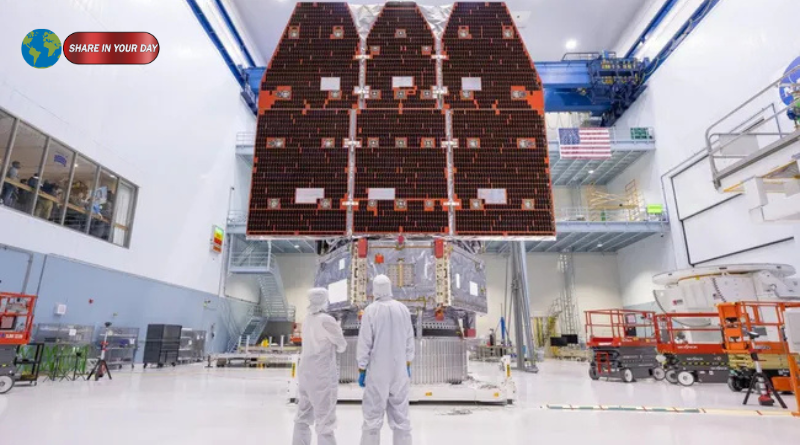
Unveiled in April 2026, the telescope represents decades of research, engineering, and ambition. More importantly, it signals a new era of discovery—one that could reshape our understanding of dark energy, distant galaxies, and even the possibility of life beyond Earth.
A Historic Milestone for NASA
NASA confirmed that the Roman Space Telescope is now fully assembled and entering its final testing phase before launch. The mission is currently projected to launch as early as September 2026—months ahead of schedule and under budget, a rare achievement for a project of this scale.
This milestone places the Roman Telescope alongside legendary observatories like Hubble and the James Webb Space Telescope. However, unlike its predecessors, Roman is designed to survey the universe on a much larger scale, enabling scientists to observe vast cosmic structures in unprecedented detail.
The telescope will eventually be launched aboard a SpaceX Falcon Heavy rocket and positioned roughly one million miles from Earth at the Sun-Earth L2 point, where it will operate in a stable environment ideal for deep-space observations.
What Makes Roman Truly Revolutionary
At the heart of the Roman Space Telescope breakthrough is its extraordinary imaging capability. While its primary mirror is similar in size to Hubble’s—about 2.4 meters wide—its field of view is at least 100 times larger.
This means Roman can capture massive sections of the sky in a single image, dramatically accelerating the pace of astronomical surveys.
Key Capabilities Include:
- Wide-Field Imaging: Able to scan huge areas of space quickly
- High Resolution: Comparable sharpness to Hubble images
- Advanced Coronagraph: Blocks starlight to directly observe exoplanets
- Massive Data Output: Expected to generate tens of thousands of terabytes
Together, these features allow Roman to function as both a survey telescope and a precision instrument, bridging a gap that has long existed in space observation.
Unlocking the Mystery of Dark Energy
One of the primary goals of the Roman mission is to investigate dark energy—the mysterious force believed to be driving the accelerated expansion of the universe.
Scientists estimate that dark energy makes up roughly 68% of the universe, yet its nature remains largely unknown. Roman will use multiple observational techniques, including:
- Weak gravitational lensing
- Supernova measurements
- Galaxy clustering
These methods will help researchers determine whether dark energy is a constant force or something that evolves over time.
This research could fundamentally change our understanding of physics and the fate of the universe itself.
A New Era of Exoplanet Discovery
Another major aspect of the Roman Space Telescope breakthrough is its ability to detect exoplanets—planets orbiting stars outside our solar system.
Using a technique known as gravitational microlensing, Roman is expected to discover tens of thousands of new worlds, including planets that are otherwise invisible to traditional telescopes.
Some estimates suggest the telescope could identify over 100,000 exoplanets during its mission, significantly expanding our knowledge of planetary systems.
Even more exciting, Roman’s coronagraph instrument will allow scientists to directly image some of these planets by blocking out the overwhelming light of their host stars.
Mapping Billions of Galaxies
Roman is not just about finding planets—it is also designed to map the large-scale structure of the universe.
Over its mission lifetime, the telescope is expected to observe light from billions of galaxies, creating one of the most comprehensive cosmic maps ever produced.
These maps will help scientists understand how galaxies form and evolve, as well as how matter is distributed across the universe.
In addition, Roman’s wide-field surveys will enable the detection of rare cosmic events, such as:
- Supernova explosions
- Black hole activity
- Gravitational lensing events
This capability makes Roman a powerful tool for both planned observations and unexpected discoveries.
Faster, Broader, Smarter Exploration
Compared to earlier telescopes, Roman offers a dramatic leap in efficiency. It can scan the sky up to 1,000 times faster than Hubble when conducting large-area surveys.
This speed allows astronomers to gather more data in less time, opening the door to discoveries that were previously impossible due to observational limitations.
Moreover, Roman will work in tandem with other space telescopes. While the James Webb Space Telescope focuses on detailed, close-up observations, Roman will provide the broader context by surveying vast regions of space.
This complementary approach ensures a more complete understanding of the cosmos.
Why This Breakthrough Matters Now
The timing of the Roman Space Telescope breakthrough is particularly significant. As global interest in space exploration continues to grow, missions like Roman demonstrate how international collaboration and technological innovation can push the boundaries of science.
The year 2026 is expected to be a landmark for space exploration, with multiple high-profile missions launching around the world. Roman stands at the center of this momentum, representing NASA’s most ambitious astrophysics mission of the decade.
Furthermore, the telescope’s ability to remain on schedule and under budget highlights improvements in project management and engineering efficiency—key factors for future missions.
Challenges Ahead Before Launch
Despite its completion, the Roman Space Telescope still faces several critical steps before liftoff.
Engineers must conduct rigorous environmental testing, including:
- Vibration tests
- Acoustic simulations
- Thermal vacuum testing
These tests ensure the telescope can withstand the extreme conditions of launch and space operation.
Once testing is complete, the observatory will be transported to NASA’s Kennedy Space Center for final launch preparations.
The Future of Space Observation
Looking ahead, the Roman Space Telescope is expected to operate for at least five years, though its mission could be extended depending on performance and scientific output.
During this time, it will generate an unprecedented volume of data, fueling research for decades to come.
More importantly, Roman is seen as a stepping stone toward even more advanced missions, such as NASA’s proposed Habitable Worlds Observatory, which aims to search for signs of life on Earth-like planets.
Conclusion: A Giant Leap Into the Unknown
The Roman Space Telescope breakthrough is more than just a technological achievement—it is a gateway to new knowledge about the universe.
By combining wide-field imaging, advanced instrumentation, and cutting-edge science, NASA’s latest observatory is set to redefine how we explore space.
As the countdown to launch begins, one thing is clear: the Roman Space Telescope will not just observe the universe—it will change how we understand it.