Tesla Cybercab Steering Wheel Sightings Raise New Questions
The Tesla Cybercab steering wheel has suddenly become one of the most talked-about details surrounding Tesla’s ambitious robotaxi program. The vehicle was originally presented as a radical step toward fully autonomous transportation, with no steering wheel, no pedals and no conventional driver controls.
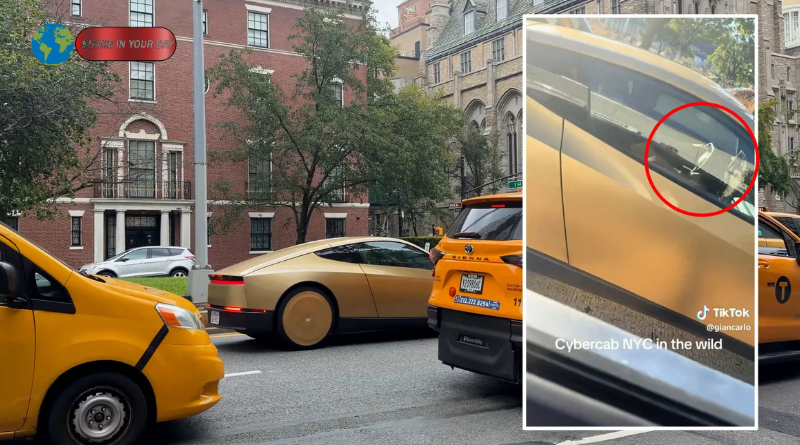
Now, however, Cybercabs spotted testing in New York City have been equipped with steering wheels and human drivers.
At first glance, the development appears to contradict one of the most recognizable features of Tesla’s robotaxi concept. However, the reality is more complicated. The vehicles being tested in New York are operating under a supervised self-driving system, meaning a human must remain capable of taking control.
That distinction is important because Tesla’s production Cybercab and its current autonomous service in Austin are designed around a different philosophy.
The discovery nevertheless highlights a major challenge facing Tesla: developing a vehicle that can operate safely without a human driver while simultaneously gathering the enormous amount of real-world data needed to improve autonomous driving technology.
What the Tesla Cybercab Steering Wheel Is Doing There
The Tesla Cybercab steering wheel spotted in New York is not necessarily evidence that Tesla has abandoned its original design.
According to Futurism, Tesla’s New York vehicles are being overseen by humans sitting in the driver’s position. Officials confirmed that the cars are testing a “supervised” self-driving system, which requires the human operator to remain capable of taking over at any time.
That makes the steering wheel a practical testing tool rather than proof that every Cybercab will eventually be sold with traditional controls.
Tesla has not disclosed how many Cybercabs are being tested in New York or exactly how long the testing program will continue. The company is also not currently positioned to launch an autonomous robotaxi service in the city.
Instead, the testing appears focused on collecting driving data.
This approach is common in the development of autonomous vehicles. A manufacturer needs to expose its software and sensors to thousands of different road situations, including complicated intersections, pedestrians, cyclists, construction zones, emergency vehicles and unpredictable human drivers.
A human-controlled testing configuration provides an additional layer of safety while the autonomous system is being evaluated.
The Original Cybercab Was Designed Without a Wheel
The presence of a steering wheel is particularly striking because it goes against the central idea behind the Cybercab.
When Tesla unveiled the vehicle in 2024, the company presented it as a purpose-built autonomous robotaxi. Unlike conventional Tesla vehicles, the Cybercab was designed without a steering wheel or pedals.
The production version currently operating in Austin also follows that philosophy. Recent reports describe the Cybercab as a two-seat vehicle without traditional manual controls.
That design is more than a styling decision.
Removing the steering wheel and pedals signals that Tesla expects the vehicle’s autonomous system to handle the entire driving task. Passengers are not supposed to take over when the road becomes difficult.
Instead, the vehicle is expected to make those decisions itself.
Tesla has also pushed the concept further by removing conventional features such as side mirrors from the Cybercab. The company is effectively trying to redesign the automobile around autonomous operation rather than adapting an ordinary passenger car to self-driving technology.
That makes the appearance of a physical steering wheel in testing vehicles especially interesting.
New York Is a Different Challenge for Tesla
New York presents an enormous challenge for autonomous driving systems.
The city has dense traffic, pedestrians crossing unpredictably, bicycles moving between lanes, double-parked vehicles, delivery trucks, construction activity and complicated intersections.
For an autonomous vehicle developer, those conditions create an unusually demanding environment.
Tesla’s decision to test Cybercabs with human operators therefore makes practical sense. The company can gather data from difficult urban environments while maintaining a human fallback.
However, there is an important regulatory issue.
Futurism reported that Tesla had not yet started the permit application process for autonomous vehicle testing with the New York Department of Motor Vehicles. That means the company’s current New York operation should not be interpreted as an imminent launch of a fully autonomous Tesla robotaxi service there.
Instead, the vehicles are being used to collect information and evaluate Tesla’s autonomous-driving technology.
This could ultimately help Tesla improve its software before attempting a broader deployment.
Tesla Still Has a Long Road Ahead
The Tesla Cybercab steering wheel story comes at a time when Tesla is trying to prove that its robotaxi strategy can move from demonstrations to a scalable commercial service.
The company has already begun offering Cybercab rides in Austin, Texas. But the fleet remains small.
Futurism reported that Tesla was operating only 45 Cybercabs in Austin at the time of its report. That is tiny compared with the scale of the robotaxi networks Tesla ultimately hopes to build.
Tesla’s competitors have a substantial head start.
Waymo, for example, has already built a large commercial autonomous ride-hailing operation. Futurism cited figures showing Waymo completing more than half a million paid rides per week during the first quarter of 2026.
That difference in scale matters.
Tesla has enormous manufacturing capacity and a large global vehicle fleet. If its autonomous technology reaches the necessary level of reliability, the company could potentially scale faster than smaller autonomous-driving competitors.
But reaching that point is the difficult part.
Tesla’s Biggest Advantage Could Also Be Its Biggest Test
Tesla’s strategy differs from some competitors because the company has spent years building a massive fleet of vehicles equipped with cameras and autonomous-driving hardware.
That gives Tesla access to enormous quantities of real-world driving information.
The challenge is turning that data into a system that can reliably handle unusual situations without human supervision.
A human driver can recognize that a strange situation requires caution almost instantly. An autonomous system has to interpret the environment using sensors, software and trained models before deciding what to do.
That is why supervised testing remains valuable.
A vehicle equipped with a steering wheel gives engineers an opportunity to test autonomous functions while preserving the ability for a human operator to intervene.
The Tesla Cybercab steering wheel therefore represents a contradiction only on the surface. The physical control may be temporary or limited to development vehicles, while the ultimate production vehicle remains designed around autonomous operation.
Tesla Has Already Shown Another Form of Manual Control
The steering-wheel discovery is not the only recent development to complicate the image of the Cybercab as a completely control-free vehicle.
Several passengers recently discovered a hidden virtual joystick interface inside Cybercabs operating in Austin.
The system reportedly provides controls related to movement, stopping, reversing and other vehicle functions. Reports suggest the interface is intended primarily for operational purposes rather than ordinary passenger driving.
That discovery reinforces an important point about autonomous vehicles.
Even a vehicle designed to drive itself may still require mechanisms for technicians, fleet operators or emergency personnel to move or control it under certain circumstances.
Tesla’s challenge is deciding how those controls should exist without undermining the safety philosophy of a vehicle that is supposed to operate without a driver.
The company has not publicly suggested that Cybercab passengers will receive a conventional manual driving option.
Regulatory Scrutiny Is Growing
Tesla’s robotaxi ambitions are also facing regulatory attention.
The National Highway Traffic Safety Administration has begun examining Tesla’s Cybercab certification and compliance with federal vehicle-safety requirements. Reuters reported that regulators are auditing approximately 1,000 Cybercabs after Tesla introduced vehicles without steering wheels, pedals or conventional mirrors.
The unusual design creates a difficult regulatory question.
Many existing vehicle regulations were written with human drivers in mind. Traditional requirements assume the presence of controls that allow a person to steer, brake and operate the vehicle.
A completely autonomous vehicle challenges those assumptions.
Tesla is therefore not simply developing new software. It is also testing the boundaries of how vehicles are regulated.
The outcome could influence the entire autonomous-vehicle industry.
If regulators determine that steering-wheel-free vehicles can operate safely under existing rules or through appropriate exemptions and certifications, more manufacturers could pursue similar designs.
If regulators take a stricter approach, companies may have to rethink how quickly they can deploy purpose-built robotaxis.
The Tesla Cybercab Steering Wheel May Actually Be Good News
Although the images of steering-wheel-equipped Cybercabs have generated plenty of attention, they do not necessarily represent a failure of Tesla’s autonomous strategy.
In some ways, they could demonstrate that Tesla is taking a more conventional engineering approach during development.
Testing a complicated autonomous system with a human fallback is safer than immediately deploying an immature system without one.
The important question is what happens next.
If Tesla eventually removes the steering wheel from testing vehicles because its autonomous technology becomes sufficiently reliable, the change will represent genuine progress.
If the company continues relying heavily on human operators for an extended period, however, it could indicate that the road to fully autonomous Cybercabs is longer than Tesla’s most ambitious forecasts suggest.
That distinction will matter to investors, regulators and potential passengers.
Tesla’s Robotaxi Vision Faces a Critical Test
Tesla has positioned the Cybercab as one of the most important products in its future.
The company is not simply trying to sell another electric vehicle. It wants to create a transportation platform in which autonomous cars can operate as robotaxis and generate revenue without a traditional driver.
That vision could fundamentally change Tesla’s business model.
But the transition from demonstration to reliable commercial autonomy is difficult.
Waymo and other competitors have spent years operating autonomous vehicles in controlled geographic areas. Tesla must now demonstrate that its own approach can deliver comparable safety and reliability while scaling to much larger numbers.
The current Cybercab fleet is still small, and New York testing remains supervised.
Meanwhile, regulators are examining Tesla’s unconventional vehicle design.
All of those factors suggest that the Cybercab’s transformation into a truly driverless vehicle will not happen overnight.
What the Steering Wheel Really Tells Us
The most important lesson from the Tesla Cybercab steering wheel sightings is not that Tesla has abandoned its wheel-free robotaxi.
Instead, the development shows how complicated the transition to autonomous transportation really is.
Tesla’s final Cybercab design can still be steering-wheel-free. The vehicles operating as public robotaxis in Austin remain based on that concept.
But development and testing vehicles can look very different.
For Tesla, a steering wheel provides a practical safety mechanism while engineers collect data and evaluate autonomous performance in challenging environments such as New York City.
The bigger question is whether Tesla can eventually eliminate that human fallback without compromising safety.
That is the real test.
Tesla has already demonstrated that it can build a futuristic car without traditional driving controls. Now it must prove that the technology controlling that car is reliable enough to make those controls unnecessary.
Until then, the sight of a Cybercab with a steering wheel is a reminder that the autonomous future Tesla has promised is still very much a work in progress.
What Happens Next?
Tesla’s next major challenge will be expanding its autonomous operations while satisfying regulators and proving that its technology can perform safely in increasingly complicated environments.
New York could become an important testing ground because of the city’s demanding streets. However, the presence of human drivers means the current vehicles should not be confused with a fully autonomous commercial service.
The Cybercab’s ultimate promise remains unchanged: a compact electric vehicle capable of transporting passengers without a human driver.
Whether Tesla can deliver that promise at scale remains one of the most closely watched questions in the automotive and technology industries.
For now, the steering wheel is still there when Tesla needs a human to take control.
The real milestone will be the day it no longer needs one.