Tesla Flying Car: Elon Musk Reveals Rocket-Powered Roadster
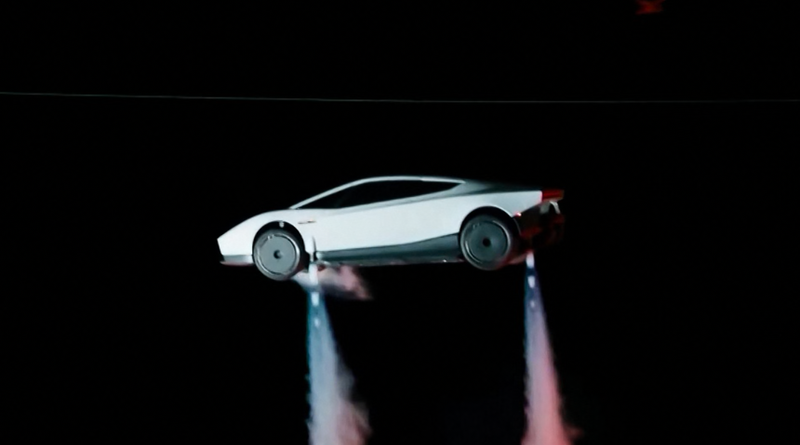
Elon Musk has unveiled an extraordinary new Tesla sports car capable of performing brief airborne manoeuvres, bringing a long-promised vision of flying vehicles closer to reality. The demonstration took place in Texas on October 15, 2026, where the billionaire showcased a redesigned Roadster featuring technology inspired by his aerospace company, SpaceX.
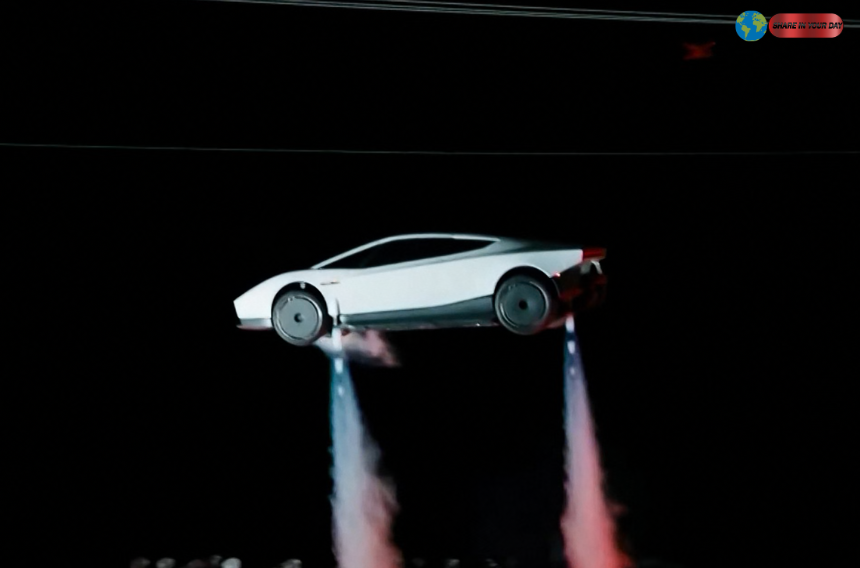
The vehicle attracted attention after appearing to drive upside down along a specially designed ramp before launching into the air, performing a mid-air manoeuvre and landing back on its wheels. Another demonstration showed the car jumping over a line of Tesla vehicles.
Although Musk described the development as a major step forward for flying cars, important questions remain about safety, practical use and whether the vehicle will eventually be approved for ordinary road travel.
Tesla says production of the next-generation Roadster is planned for 2028, although the company has previously delayed the model several times.
Tesla Flying Car Uses SpaceX-Inspired Technology
The new Roadster combines electric-car engineering with technology inspired by rocket systems. Rather than relying on conventional wings or helicopter-style rotors, the vehicle uses compressed air and thrusters to perform its unusual aerial movements.
During the presentation, Tesla executives explained that the car incorporates an underbody suction system designed to hold it against a surface. This technology helped the vehicle travel along a specially constructed curved ramp, including an upside-down section.
The car then used its thruster system to perform airborne manoeuvres.
According to the presentation, the system includes 10 nozzles supplied by two high-pressure air tanks. Together, these components are intended to provide the thrust needed for short flights and controlled movement through the air.
Musk said the vehicle could perform rolls and other gymnastic movements, comparing its operation to a rocket.
The technology represents an unusual combination of automotive and aerospace engineering. However, the demonstration alone does not establish how effectively the system would operate outside a controlled testing environment.
Elon Musk Demonstrates Dramatic Roadster Stunts
The unveiling focused heavily on performance rather than conventional driving features.
During the event, the vehicle climbed a specially designed ramp and remained attached to its underside using suction. It subsequently launched into the air, rotated and landed on its wheels.
A further demonstration showed the Roadster clearing a row of Tesla vehicles.
The car was remotely controlled during the demonstration rather than carrying a human driver. Musk indicated that the decision was made to avoid putting anyone at risk during the experimental performance.
He also acknowledged that the vehicle was not necessarily designed around conventional safety priorities.
The presentation was intended to demonstrate the possibilities of combining advanced electric-car technology with systems developed for aerospace applications.
However, spectacular stunts do not automatically establish that a vehicle can operate safely in everyday conditions. Additional testing would be necessary to demonstrate its reliability, durability and suitability for real-world use.
Can Tesla’s Flying Car Actually Fly?
The distinction between a car that briefly leaves the ground and one that can function as an aircraft is important.
Tesla demonstrated that its prototype could perform short airborne movements under controlled conditions. It has not yet established that the vehicle can sustain flight over meaningful distances, travel between destinations or operate like a conventional aircraft.
A practical flying vehicle must overcome several engineering challenges. These include managing weight, maintaining stability, controlling movement in different weather conditions and ensuring safe take-off and landing procedures.
A road vehicle also needs to satisfy requirements that differ significantly from those applied to aircraft.
Cars are designed around road handling, collision protection and passenger safety. Aircraft, meanwhile, must meet demanding standards for flight control, structural integrity and airworthiness.
Combining these requirements in a single vehicle is a considerable challenge.
Consequently, the Roadster’s airborne demonstration should be viewed as an experimental achievement rather than proof that fully practical flying cars are ready for widespread use.
Tesla Roadster Production Expected in 2028
The next-generation Tesla Roadster has been anticipated for years.
Tesla first introduced plans for the redesigned sports car in 2017, initially suggesting that production would begin much earlier than the latest target.
However, the project experienced repeated delays as the company continued developing its electric vehicles and other technologies.
Following the October 2026 unveiling, Musk said production was planned to begin in 2028.
That timeline remains a future target rather than confirmation that customers will receive vehicles by that date.
Questions also remain about the final specifications, pricing, driving range and performance of the production model. The capabilities demonstrated by a prototype may not necessarily be identical to those offered in a commercially available vehicle.
The company must also address the technical and regulatory requirements associated with the Roadster’s proposed airborne functions.
Safety and Legal Questions Remain
One of the biggest challenges facing the Tesla flying car is whether its airborne capabilities can be used legally and safely.
A vehicle designed to operate on public roads must comply with relevant automotive safety regulations. Any aircraft-like operation may also introduce additional aviation requirements, depending on the technology and jurisdiction involved.
Musk acknowledged during the event that the vehicle might not be legal in every jurisdiction.
This raises questions about where owners could use its airborne features and whether the technology would be restricted to specially controlled environments.
There are also practical concerns about operating a vehicle that generates lift or thrust near other road users. Reliable control systems, emergency procedures and appropriate operating conditions would be essential before such technology could be adopted widely.
Until further testing and regulatory clarification take place, the Roadster’s flying capabilities should not be assumed to be available for unrestricted public use.
Could Flying Cars Change the Future of Transportation?
The Roadster demonstration highlights the continuing ambition to combine technologies from different industries.
Electric propulsion has already transformed parts of the automotive market, while advances in batteries, lightweight materials and electronic control systems have encouraged new approaches to transportation.
Several companies are also developing electric aircraft and other vehicles designed for short-distance aerial travel. These projects generally face significant challenges involving certification, infrastructure, cost and operational safety.
Tesla’s approach is different because it attempts to combine the performance of an electric sports car with rocket-inspired propulsion technology.
If the concept becomes commercially viable, it could expand the possibilities of high-performance vehicle engineering. Nevertheless, it remains unclear whether the airborne features will have practical applications beyond demonstrations and specialized use.
For now, the Roadster is better understood as an ambitious technological experiment than a replacement for conventional cars or aircraft.
Conclusion: A Bold Vision With Challenges Ahead
Elon Musk’s latest Roadster unveiling has reignited interest in the idea of flying cars. By combining electric-car engineering with SpaceX-inspired thrusters, Tesla has demonstrated a vehicle capable of brief airborne manoeuvres that would have seemed extraordinary in a conventional automotive setting.
However, major questions remain about sustained flight, safety, legal approval and commercial availability.
Tesla is targeting 2028 for production, but the company’s history of changing delivery schedules means that the timeline should be treated cautiously.
The demonstration offers a glimpse of what future vehicle engineering might achieve. Whether it ultimately leads to a practical flying car will depend on further development, independent testing and regulatory approval.
For now, Tesla has shown an ambitious prototype. Turning that spectacle into a safe, reliable and commercially available vehicle will be the more difficult test.