Federal Reserve Leadership Transition Sparks Legal Crisis at the Heart of US Monetary Power
The Federal Reserve leadership transition is facing one of its most uncertain and legally complex moments in decades, as a long-running ambiguity in US law suddenly moves from academic debate into a real-world political confrontation.
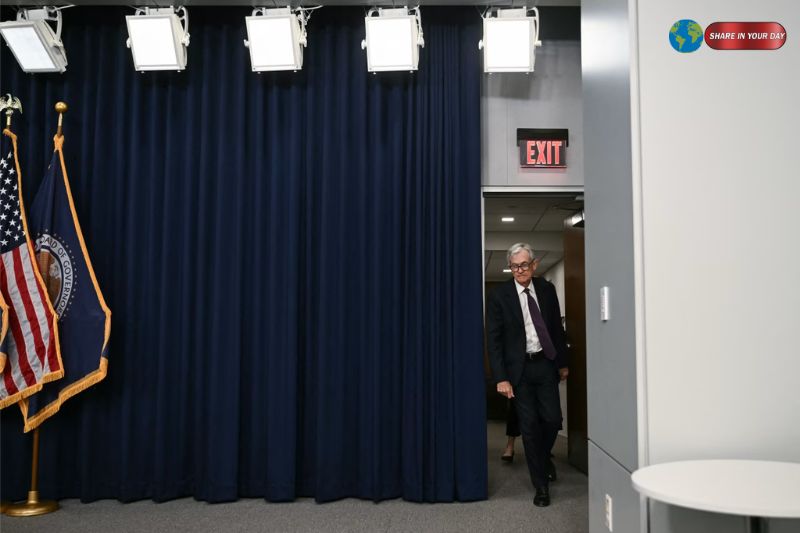
At the center of the dispute is Federal Reserve Chair Jerome Powell, whose term as chair ends on May 15, while his broader term as a Fed governor continues until 2028. The gap between these two timelines has created an institutional gray zone with no clearly defined legal resolution, raising urgent questions about who leads the US central bank if no successor is confirmed in time.
The issue has escalated into a broader conflict between the White House and the Federal Reserve, with implications for monetary policy independence, financial stability, and constitutional boundaries between political and independent institutions.
A Legal Grey Zone Decades in the Making
At the core of the dispute is a simple but unresolved question: what happens when a Fed chair’s term expires but a successor has not yet been confirmed by the Senate?
The Federal Reserve Act clearly defines how governors are appointed and how long they serve. However, it does not explicitly address how leadership should be handled when the chair position becomes vacant due to a timing gap between terms.
This omission dates back to structural changes made in the late 1970s, when Congress required Senate confirmation for the Fed chair role but did not fully clarify transitional authority mechanisms.
As a result, two competing interpretations have emerged:
- The president may have authority to appoint an acting chair from existing Fed governors.
- The Federal Reserve may internally manage continuity through its own governance structure, including temporary leadership arrangements.
This ambiguity has remained largely theoretical for decades—but is now becoming urgent.
Powell’s Position: Continuity Through Internal Authority
Jerome Powell has taken the position that he can remain in leadership in a transitional capacity if no successor is confirmed by the Senate in time.
Under this view, Powell would continue operating as a temporary or “pro tempore” chair until a new chair is formally installed. Supporters of this interpretation argue that the Fed’s internal structure, particularly the Federal Open Market Committee (FOMC), allows for continuity even in the absence of a formally confirmed chair.
The FOMC, which is responsible for setting interest rates, operates independently of presidential direction and has historically maintained continuity even during leadership transitions.
Some senior Federal Reserve officials have signaled support for this continuity approach, arguing that abrupt leadership changes could disrupt monetary policy at a sensitive time for inflation and economic stability.
The White House View: Presidential Authority in Question
The opposing interpretation argues that once the chair’s term expires, the president has authority under general vacancy laws to appoint an acting replacement.
This view relies on broader federal vacancy statutes and past legal analyses suggesting that the executive branch retains authority to fill temporary leadership gaps in independent agencies.
Under this framework, the president could appoint a sitting Fed governor as acting chair until Senate confirmation of a permanent replacement.
However, legal experts remain deeply divided on whether this authority extends to the Federal Reserve chair role, given the institution’s unique legal structure and strong tradition of independence.
The ambiguity has created a potential constitutional standoff between the executive branch and one of the most powerful independent institutions in the United States.
Historical Precedent: A Problem From 1978 That Never Fully Went Away
The last time a similar situation emerged was in 1978, when uncertainty arose over Fed leadership during a transition period between administrations.
At that time, legal advisors concluded that the president could, in principle, appoint a replacement from among existing governors. However, the situation was never tested in court, and subsequent administrations avoided allowing such a gap to occur again.
Since then, every Fed chair transition has been carefully timed to ensure Senate confirmation before the previous term expired.
This long-standing practice has effectively masked the underlying legal uncertainty—until now.
Why This Fight Matters Beyond Legal Technicalities
While the dispute may appear procedural, its implications are significant for the global financial system.
The Federal Reserve is widely regarded as the most powerful central bank in the world, controlling interest rates, liquidity, and monetary policy that influence global markets.
A contested leadership transition raises several risks:
- Market volatility due to uncertainty over policy direction
- Political pressure on interest rates, potentially undermining inflation control
- Reduced institutional independence, if executive authority expands
- Legal challenges, potentially reaching the Supreme Court
Even the perception of political influence over the Fed can affect investor confidence and bond markets.
Political Pressure and Intensifying Institutional Tensions
The leadership dispute is unfolding alongside broader political tension between the White House and the Federal Reserve.
President Donald Trump has repeatedly criticized the Fed’s monetary policy, particularly its approach to interest rates. His administration has also nominated a successor candidate for Powell, but Senate confirmation delays have complicated the timeline.
At the same time, legal and political challenges surrounding Powell have intensified scrutiny of the transition process, further complicating confirmation prospects for any nominee.
The combination of political pressure, legal ambiguity, and institutional independence has turned a routine leadership transition into a high-stakes governance dispute.
A Supreme Court Factor Looms in the Background
Legal experts note that any attempt by the president to install an acting Fed chair against the Fed’s interpretation would almost certainly be challenged in court.
The Supreme Court has increasingly been drawn into disputes involving executive authority over independent agencies, and similar cases are already under review.
A ruling in such a case could ultimately define:
- Whether the president can remove or replace Fed leadership without cause
- How independent agencies interpret leadership vacancies
- The limits of executive power over monetary policy institutions
The outcome could reshape not only the Federal Reserve but also the broader structure of US regulatory independence.
Conclusion: A Small Legal Gap With Massive Consequences
What began as a technical gap in federal law has evolved into a potential constitutional showdown over the independence of the US central bank.
The Federal Reserve leadership transition now sits at the center of a broader debate about how much control the executive branch should have over monetary policy institutions designed to operate independently of politics.
With Powell’s term approaching its end and no confirmed successor guaranteed in time, the United States may be heading toward one of the most consequential leadership disputes in modern Fed history.
The resolution—whether through Senate confirmation, internal Fed governance, or Supreme Court intervention—could define the balance of power between Washington’s political leadership and the nation’s central bank for years to come.