
Trump Pushes Back on AI Regulation as Mail Voting Order Faces New Legal Setback
President Donald Trump is pushing back against calls for tighter controls on artificial intelligence, arguing that the United States must maintain its technological advantage over China as debate grows about the risks posed by rapidly advancing AI systems.
The comments came as several major issues dominated the U.S. news cycle, including a new federal court ruling blocking part of Trump’s effort to restrict mail voting, growing concerns about the pace of artificial intelligence development and renewed attention to how children learn to solve problems independently.
Trump’s position on AI puts him at odds with some technology leaders who have recently warned that the industry may be moving faster than safety systems can keep up. At the same time, AI is increasingly becoming a political issue in the United States, with lawmakers and communities debating everything from workplace disruption to the enormous energy demands of data centers.
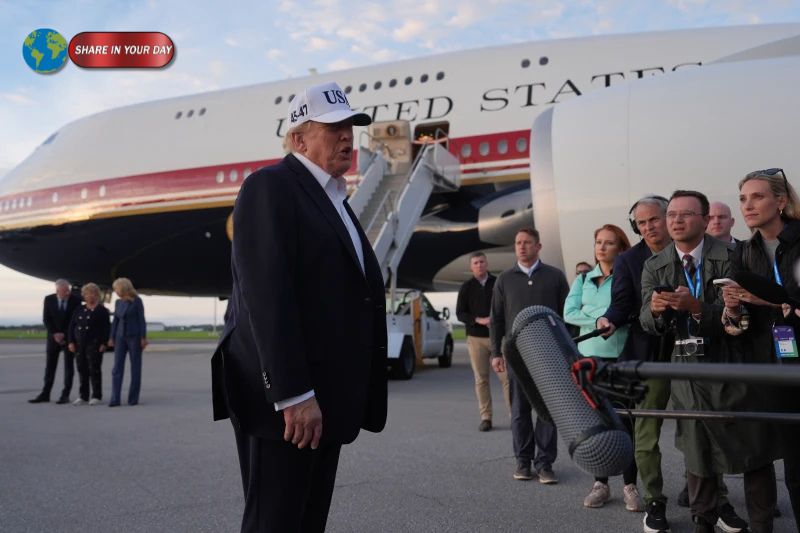
Trump says US cannot afford to fall behind China in AI
Trump said Sunday that the United States currently holds an advantage over China in artificial intelligence and made clear that he wants Washington to preserve that lead.
The president indicated that some regulation could eventually be necessary but did not outline a specific regulatory framework. His comments reflected a broader concern within the administration that excessive government intervention could slow American companies while allowing Chinese technology firms to catch up.
Trump has repeatedly emphasized the strategic importance of AI, treating the technology as an area where global leadership could have major economic, military and geopolitical consequences.
But his comments came at a moment when some technology executives are urging caution.
Dario Amodei, chief executive of Anthropic, has argued that AI development needs to slow enough for safety measures to catch up. The concern is not simply about today’s chatbots and automated systems, but about increasingly powerful models whose capabilities could become difficult to predict or control.
Trump later rejected the suggestion that he was ignoring AI’s dangers. He acknowledged that technology moving rapidly without sufficient oversight could create opportunities for harmful actors, although he did not identify specific groups or threats.
The disagreement highlights a growing tension between two priorities: moving quickly enough to maintain American technological leadership while establishing safeguards before increasingly capable AI systems create serious problems.
AI is also emerging as an important issue ahead of the U.S. midterm elections. Political leaders from both parties are facing pressure from voters concerned about the effects of automation, data centers, electricity consumption and potential changes to employment.
Former President Barack Obama has also argued that Democrats should make artificial intelligence part of their political agenda.
The issue could receive even more attention later this month when Chinese President Xi Jinping is expected to meet Trump at the White House. Artificial intelligence is likely to be among the subjects discussed as Washington and Beijing compete for technological influence.
Federal judge blocks Trump’s mail voting order
Another major development came in federal court, where Judge Carl J. Nichols issued a preliminary injunction against Trump’s effort to change rules surrounding mail voting.
The Washington judge’s decision represents another legal obstacle for the administration as it seeks to impose nationwide changes ahead of the midterm elections.
Trump’s administration has pursued measures intended to establish a nationwide system for verifying eligible voters. Election officials and opponents of the policy have raised concerns about whether such changes can realistically be implemented so close to an election.
Nichols concluded that allowing the policy to proceed could put legitimate absentee and mail-in ballots at risk of being rejected.
The ruling is particularly significant because voting procedures are generally administered through a complex network of state and local election authorities. Any attempt to impose major changes nationally can therefore produce conflicts over federal authority, election administration and voter access.
The Supreme Court is expected to become involved in the dispute, meaning the legal fight over mail voting could continue well beyond the latest district court ruling.
The controversy arrives as officials prepare for another closely watched election cycle, with voting rules already a major source of political disagreement across the country.
Experts say children need opportunities to struggle
Away from Washington politics and technology policy, educators are also examining an increasingly familiar problem: how much help children should receive when they encounter difficult tasks.
With answers available almost instantly through search engines, smartphones and artificial intelligence, parents can sometimes be tempted to solve problems for children rather than allowing them to work through challenges themselves.
Developmental experts say that instinct can have unintended consequences.
Children develop problem-solving abilities through practice. Working through a difficult puzzle, figuring out how to complete a task or dealing with a problem without immediate assistance can build confidence and independence.
That does not mean parents should never intervene. Instead, experts emphasize finding the balance between providing support and allowing children enough space to discover solutions themselves.
Too little opportunity to struggle can make ordinary challenges feel overwhelming later, particularly when young people are accustomed to having adults or technology provide immediate answers.
The lesson has become especially relevant in the age of artificial intelligence, when sophisticated tools can produce answers, explanations and solutions within seconds.
The challenge for parents and educators is therefore not simply deciding whether technology is good or bad. It is determining when technology helps children learn and when it prevents them from developing the ability to think independently.
Ancient Roman artwork unveiled after decades underground
In Rome, history lovers have another reason to look toward the past.
A major ancient Roman fresco and mosaic complex has been restored and opened to the public following decades of archaeological work.
The artwork was discovered during excavations near the Baths of Trajan, close to the Colosseum. Archaeologists uncovered the remains roughly three decades ago, but restoration work has allowed the public to see the site in a dramatically different condition.
The complex includes a large wall fresco known as the “Painted City” and an enormous mosaic depicting a maritime settlement.
Despite spending centuries underground, parts of the artwork still retain visible blue and terra cotta tones. The restoration has helped reveal details that would otherwise remain hidden beneath layers of time.
The mosaic is particularly striking for its scale. Its depiction of a maritime city offers historians and visitors a glimpse into the artistic ambitions and cultural imagination of ancient Rome.
The unveiling provides a rare connection between modern Rome and the civilization that transformed the city into one of the ancient world’s most important centers.
From artificial intelligence and election law to childhood development and ancient art, the day’s major stories illustrate how quickly the news cycle can move between technology, politics, education and history.
For the United States, the debate over AI regulation and mail voting will continue to develop, with courts, lawmakers and voters likely to play major roles in determining what comes next.