Full Article (1200+ words)
Trump Christian Meme Revealed: 7 Shocking Facts
The Trump Christian meme controversy has quickly become one of the most talked-about political and cultural flashpoints of 2026. What began as a social media post escalated into a national debate involving religion, politics, artificial intelligence, and influence within Donald Trump’s inner circle.
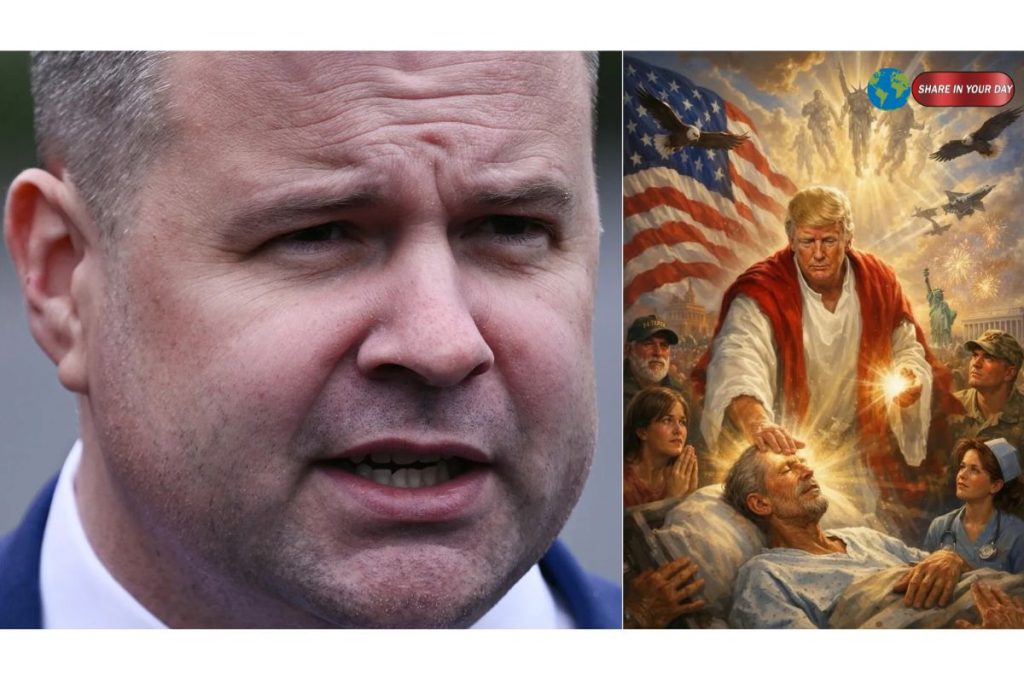
The incident centers on an AI-generated image that appeared to depict former U.S. President Donald Trump as a Christ-like figure healing a sick man. The post, shared on Truth Social, was later deleted—but not before igniting widespread backlash, especially among Christian communities.
Here are the key facts, context, and implications behind the Trump Christian meme controversy.
1. The Trump Christian Meme That Sparked Outrage
The Trump Christian meme showed Trump dressed in a robe-like garment, placing his hand on a man in a hospital bed, with glowing light suggesting a miraculous healing.
Many viewers interpreted the image as portraying Trump in the role of Jesus Christ. The symbolism—combined with religious imagery and divine light—made the message unmistakable to critics.
The reaction was immediate and intense. Religious leaders, conservative commentators, and even some of Trump’s allies condemned the post as offensive and inappropriate.
2. Bill Pulte’s Role Behind the Scenes
A major revelation from Axios is that Bill Pulte played a key role in bringing the meme to Trump’s attention.
Pulte, who leads the Federal Housing Finance Agency, reportedly showed or discussed the AI-generated image with Trump before it was posted.
While it remains unclear whether Pulte created or directly sent the image, his involvement highlights how content can reach influential figures through informal networks.
This detail shifts the narrative from a simple social media misstep to a deeper question: who influences presidential messaging in the digital age?
3. Why the Meme Triggered Religious Backlash
The Trump Christian meme struck a nerve for several reasons:
- It appeared to equate a political figure with Jesus Christ
- It was posted close to major Christian observances
- It came amid broader tensions between Trump and religious leaders
Prominent Christian voices labeled the image as “blasphemous” and “deeply offensive.”
Even within Trump’s political base—traditionally supported by evangelical Christians—there was visible discomfort.
This reaction underscores a critical boundary in political messaging: religious symbolism remains highly sensitive, even among loyal supporters.
4. Trump’s Response: “I Thought It Was a Doctor”
After the backlash, Trump offered a surprising explanation. He claimed he believed the image depicted him as a doctor or healer, not as Jesus Christ.
He suggested the image was related to the Red Cross and framed it as a metaphor for helping people.
However, critics found this explanation unconvincing. The visual elements—robes, divine lighting, and religious symbolism—clearly aligned with traditional depictions of Christ.
The response raised further questions about whether the post was misunderstood—or simply poorly judged.
5. The Rare Deletion That Stood Out
One of the most notable aspects of the Trump Christian meme incident is that Trump deleted the post.
This is significant because Trump is known for rarely backing down or removing controversial content.
The deletion suggests:
- The backlash reached an unusually high level
- Advisors may have intervened
- The political cost outweighed the intended message
In political communication, what gets deleted can be as telling as what gets posted.
6. The AI Factor: When Technology Meets Politics
The Trump Christian meme was not a traditional photograph—it was AI-generated.
Experts noted unusual elements in the image, including distorted visuals and even a horned figure in the background, which some interpreted symbolically.
However, analysts cautioned against overinterpreting these features, suggesting they were likely artifacts of AI image generation.
Still, the incident highlights a growing issue:
- AI-generated content can blur reality and symbolism
- Political figures can easily share misleading or provocative imagery
- Public interpretation can spiral beyond original intent
The Trump Christian meme may be an early example of how AI complicates political communication.
7. Political Fallout and Broader Implications
Beyond the immediate controversy, the Trump Christian meme may have lasting political consequences.
Strained Relations with Christian Voters
Trump has long relied on strong support from evangelical and conservative Christian communities. However, this incident exposed cracks in that relationship.
Some religious leaders and commentators openly criticized him—something that has been relatively rare.
Coalition Tensions
The controversy also reflects broader tensions within Trump’s political coalition, which includes diverse and sometimes conflicting groups.
Issues like foreign policy, cultural messaging, and religious symbolism are increasingly testing that coalition’s unity.
Timing Matters
The meme was posted during a sensitive period, including:
- Ongoing geopolitical tensions
- Domestic policy debates
- Religious observances
This timing amplified its impact and made the backlash more intense.
The Bigger Picture: Influence, Messaging, and Risk
The Trump Christian meme controversy is about more than a single image. It reveals several deeper dynamics:
1. Informal Influence Networks
Figures like Bill Pulte can shape messaging behind the scenes, even without formal roles in communications strategy.
2. The Power of Visual Content
Images—especially AI-generated ones—can convey powerful messages instantly, often more emotionally than text.
3. The Fragility of Political Coalitions
Even strong alliances can be strained by symbolic missteps, particularly when they touch on deeply held beliefs.
Conclusion
The Trump Christian meme incident is a case study in modern political communication—where social media, artificial intelligence, and personal networks intersect in unpredictable ways.
What seemed like a simple post quickly escalated into a national controversy involving religion, technology, and political identity. The involvement of Bill Pulte added another layer, raising questions about influence and decision-making at the highest levels.
Ultimately, the episode highlights a key lesson:
In today’s digital landscape, even a single image can carry enormous political and cultural consequences.