Nepal China Flood Risks Rise as New Lakes Threaten to Burst
Nepal China flood risks have intensified after authorities in both countries warned that newly formed lakes could trigger another wave of flooding in the Himalayas, just days after a catastrophic disaster killed hundreds and left nearly 1,000 people missing.
The latest warning comes as rescue teams continue searching through debris-strewn valleys in Nepal and China’s Tibet region. Authorities are now facing the possibility of a second disaster as water accumulates behind natural barriers created by rock, ice and other debris from the massive glacier collapse.
Nepal’s disaster management authorities warned people living near affected rivers to move away from riverbanks and other dangerous areas. Rescue workers have also been advised to remain cautious and relocate to safer ground where necessary.
China, meanwhile, warned that millions of cubic metres of water could flow into an already dammed lake on its side of the border, increasing the possibility that the natural barrier could fail.
The warnings have added a new layer of danger to an emergency that was already among the most serious natural disasters to hit the Himalayan region in years.
Nepal China Flood Risks Grow After Deadly Glacier Collapse
The current emergency began after a section of a glacier collapsed in the Himalayas on Wednesday, unleashing a huge mass of ice, rock and debris into mountain river systems.
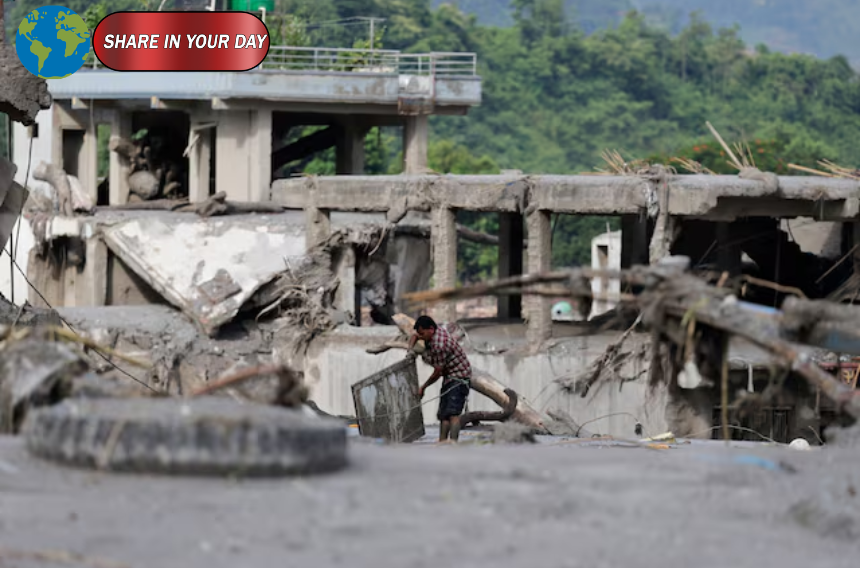
The resulting flood swept through communities in Nepal’s Rasuwa district and crossed into Tibet, destroying homes, roads, bridges and other infrastructure.
According to Reuters reporting, the disaster had killed at least 362 people by Thursday, while nearly 1,000 others remained missing. The final toll could rise as rescuers gain access to isolated areas and continue searching through the destruction.
The disaster was initially associated with seismic activity, but further investigation indicated that the seismic signal was caused by the force of the glacier collapse and resulting debris flow rather than a conventional earthquake.
Satellite imagery and other analysis have helped researchers reconstruct how the event unfolded. A glacier near Langtang Lirung collapsed at high altitude, sending ice and rock into a valley and generating a powerful debris flow that entered the river system.
The resulting torrent moved rapidly through steep Himalayan terrain, giving communities little time to react.
New Lakes Create a Dangerous Second Threat
The immediate flood has now been followed by another concern: water accumulating behind debris that has blocked river channels.
In Nepal, authorities reported that a lake formed after debris blocked a river at the disaster site was continuing to rise. Officials warned residents, travelers and rescuers to stay away from riverbanks and other potentially dangerous locations.
The concern is that the natural barrier holding back the water could fail. Such an event could release a sudden surge downstream, creating another destructive flood even while communities are still recovering from the first one.
This type of event is commonly referred to as a glacial lake outburst flood when a lake associated with glaciers or glacial debris suddenly releases its water.
The danger is especially serious in the Himalayas because steep valleys can concentrate floodwaters and debris into extremely powerful flows.
For people downstream, a breach could provide little warning.
China Warns of Millions of Cubic Metres of Water
Chinese authorities have issued a similar warning on the other side of the border.
China said approximately 3 million cubic metres of water are expected to flow into an already dammed lake during the following three days. Officials said the risk of a breach could increase significantly, with peak flow expected around September 1.
The situation could become even more dangerous if additional rainfall reaches the region.
China’s Ministry of Water Resources has increased monitoring of the affected area, while officials have warned that continuing rainfall could raise water levels and put additional pressure on the natural barrier.
The potential failure of that barrier would threaten communities and infrastructure downstream.
The warning demonstrates how the consequences of Wednesday’s glacier collapse are continuing to spread beyond the original flood zone.
Rescue Operations Continue Amid New Danger
Search and rescue teams are still working through areas heavily damaged by the initial flood.
However, the threat from the newly formed lakes is making rescue operations more difficult.
Teams operating near rivers must now balance the urgency of finding survivors with the possibility of another sudden flood. Some rescuers in Nepal reportedly began moving toward higher ground after authorities issued the latest warnings.
The destruction of roads and bridges has also complicated access to affected communities.
In Tibet, the Gyirong border area suffered extensive damage, while hundreds of people were reported missing. Chinese authorities have evacuated residents from vulnerable locations and deployed additional emergency personnel to support the response.
The scale of the disaster means authorities are simultaneously dealing with rescue operations, infrastructure damage, evacuation planning and the possibility of another flood.
Why Himalayan Floods Can Become So Destructive
The geography of the Himalayas makes the region particularly vulnerable to sudden flooding.
Mountain valleys are often narrow and steep, meaning water released from a high-altitude lake can accelerate rapidly as it moves downhill. When the water carries rocks, mud, ice and other debris, the resulting flow can become far more destructive than an ordinary river flood.
The latest disaster demonstrated that danger.
A glacier collapse sent enormous quantities of ice and rock into a river system, creating a chain reaction that ultimately produced devastating flooding downstream. Reuters reported that the event destroyed communities and critical infrastructure across parts of Nepal and Tibet.
The formation of new lakes following such an event creates another potential trigger.
If debris blocks a river, water can accumulate behind the obstruction. The resulting lake may appear stable at first, but continued rainfall or increasing inflow can place pressure on the barrier.
If the barrier collapses, the stored water can be released within a very short period.
That is why authorities are closely monitoring the new lakes rather than waiting for visible signs of failure.
Climate Change Adds to Long-Term Concerns
Scientists have also raised questions about the role of a warming climate in increasing the vulnerability of Himalayan glaciers and mountain slopes.
Researchers have cautioned that climate change should not automatically be identified as the direct cause of an individual glacier collapse. However, warming temperatures are contributing to glacier loss and changes in high-altitude environments, potentially creating conditions in which ice and mountain terrain become less stable.
Reuters has reported that Nepal has lost a substantial share of its glacial ice over recent decades as temperatures have increased. The changing environment is therefore an important part of the broader discussion about disaster risk in the Himalayas.
The latest disaster highlights why scientists and governments are increasingly focused on monitoring glaciers, lakes and unstable mountain slopes.
Early detection can provide authorities with more time to warn communities and move people out of dangerous areas.
Nepal and China Face a Cross-Border Emergency
The disaster also illustrates how natural hazards in the Himalayas do not stop at national borders.
The glacier collapse occurred in a mountainous region connected by rivers and valleys that cross or approach the Nepal-China frontier. Floodwaters and debris therefore affected communities in both countries.
That makes coordination particularly important.
Nepal and China are now monitoring different parts of the same broader disaster system. Information about water levels, rainfall, lake formation and potential breaches could be critical for communities downstream.
The situation also affects international travelers and pilgrims who use routes through the region.
Earlier reports indicated that hundreds of foreigners were among those missing after the disaster, including travelers and religious pilgrims heading toward destinations in Tibet.
The destruction of roads, bridges and border infrastructure has further complicated efforts to locate missing people and deliver assistance.
What Happens If the Lakes Burst?
If one or both natural barriers fail, the immediate impact would depend on the volume of stored water, the size and stability of the debris barriers, rainfall and the terrain downstream.
A sudden release could produce a powerful surge capable of carrying mud, rocks, trees and other debris.
The danger would be greatest for settlements and rescue operations located close to river channels.
Authorities therefore want residents and emergency workers to maintain distance from potentially affected rivers while monitoring systems remain active.
China’s warning that roughly 3 million cubic metres of water could enter one lake over several days illustrates the scale of the potential threat. Continued rainfall could make the situation more difficult.
For now, officials are relying on monitoring and evacuation measures to reduce the possibility of additional casualties.
The Search for Survivors Continues
Despite the new warnings, rescue teams have not stopped searching for people who may have survived the initial disaster.
The operation remains difficult because entire sections of roads and infrastructure have been destroyed. Some areas are accessible only by helicopter or through damaged mountain routes.
The number of missing people also remains uncertain as authorities compare reports from local communities, tourists, workers and foreign governments.
Reuters reported that at least 362 people had died by Thursday and nearly 1,000 remained missing across the affected areas.
The figures are expected to change as search teams reach isolated areas and authorities receive more information.
Meanwhile, families are waiting for news about missing relatives while governments work to identify victims and coordinate assistance.
A Warning for the Wider Himalayan Region
The latest Nepal China flood risks are a reminder that major Himalayan disasters can develop in multiple stages.
The initial glacier collapse caused the first catastrophic flood. That event then created debris blockages and new lakes, which now represent another possible source of flooding.
This sequence makes monitoring especially important in mountainous areas where a single geological event can trigger several secondary hazards.
Scientists and disaster authorities increasingly emphasize the importance of satellite monitoring, river-level sensors, rainfall forecasts and early-warning systems in vulnerable Himalayan communities.
The challenge is particularly difficult in remote valleys, where communication networks and transportation infrastructure can be limited.
Nevertheless, the current emergency shows why rapid warnings can be critical.
Authorities Remain on High Alert
For Nepal and China, the immediate priority is preventing another wave of casualties while continuing the search for those missing from the first disaster.
Nepal has warned people to stay away from riverbanks and dangerous areas. China is monitoring water levels and rainfall around the threatened lake while emergency teams remain prepared for further developments.
The coming days will be crucial.
If water levels continue rising, authorities may need to expand evacuations and move rescue personnel farther from vulnerable river valleys.
At the same time, weather conditions will play an important role in determining how quickly the lakes grow and how much pressure is placed on their natural barriers.
For communities already devastated by the original flood, the possibility of another disaster is adding urgency to an already desperate rescue operation.
The Himalayan emergency is therefore no longer only a search-and-rescue mission. It has become a race against time to monitor unstable lakes, protect downstream communities and prevent a second catastrophe from following the first.