James Webb Space Telescope May Have Uncovered the Galaxies Behind Mysterious Little Red Dots
Astronomers studying some of the most mysterious objects in the early universe may have taken an important step toward solving one of the James Webb Space Telescope’s biggest puzzles.
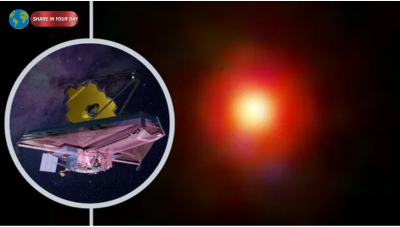
The objects, known as “little red dots” or LRDs, were discovered in large numbers after NASA’s James Webb Space Telescope began observing the distant universe. They are extremely compact, unusually bright and appear predominantly red in infrared observations. Yet despite their apparent simplicity, scientists have struggled to determine exactly what they are and why they were so common during the universe’s earliest stages.
Now, instead of focusing only on the mysterious objects themselves, researchers have examined the galaxies surrounding them. Their findings suggest that the environments hosting little red dots may contain important clues about how these unusual objects formed and evolved.
Webb Finds Hidden Galaxies Around Little Red Dots
A research team examined James Webb Space Telescope observations of 217 little red dots. Rather than concentrating exclusively on the extremely bright central sources, the astronomers searched for much fainter light surrounding them.
That faint emission appears to come from the galaxies hosting the little red dots.
According to the researchers, these host galaxies are remarkably compact. Their typical width is estimated at roughly 1,400 light-years, making them about 2.5 times more compact than comparable star-forming galaxies observed at similar distances in the early universe.
The discovery is significant because previous studies have largely focused on the central engine responsible for the extraordinary brightness of LRDs. The intense central emission can overwhelm the much weaker light from the surrounding galaxy, making the host difficult to study.
By separating the faint galactic light from the powerful central source, astronomers can begin investigating the broader environments in which these objects existed.
What Are the Little Red Dots?
Since their discovery by Webb in 2022, little red dots have become a major subject of astronomical research.
Their unusual combination of brightness, compact size and spectral characteristics has led scientists to propose several explanations. One possibility is that they are associated with rapidly growing supermassive black holes surrounded by enormous amounts of dense gas.
Another possibility involves extreme forms of star formation or even hypothetical supermassive stars.
Recent observations have strengthened the case for black-hole-related explanations. NASA reported in June 2026 that detailed observations of one LRD, known as GLIMPSE-17775, provided multiple lines of evidence supporting a model in which a supermassive black hole is surrounded by a dense cocoon of partially ionized gas.
A separate study published in Nature also found evidence consistent with young supermassive black holes hidden inside dense cocoons of ionized gas. The researchers suggested that the black holes could have masses of roughly 100,000 to 10 million times that of the Sun, while their surrounding gas helps explain why these objects look so different from typical active galactic nuclei observed closer to Earth.
But the mystery is not completely solved.
Why Do Little Red Dots Disappear?
One of the biggest questions surrounding LRDs is their apparent disappearance as the universe becomes older.
The objects are found predominantly at very high redshifts, meaning their light has traveled across the universe for billions of years before reaching Webb. Their numbers then drop dramatically at later cosmic times.
That raises a fundamental question: Did the little red dots disappear entirely, or did they transform into something more familiar?
Researchers have proposed several possibilities.
One recent study suggested that observational effects could partly explain why LRDs appear to vanish. At greater distances, some features of their host galaxies become much harder to detect with current instruments. Another possibility is that the objects represent a temporary stage in the growth of galaxies and black holes.
The new research into their host galaxies adds another piece to that puzzle.
Compact Galaxies Could Hold the Answer
The discovery of unusually compact host galaxies raises new questions about the relationship between little red dots and their surroundings.
Researchers want to know whether the physical properties of these galaxies somehow trigger the LRD phase. They are also investigating whether the objects tend to inhabit particular environments, such as regions where galaxies and dark matter are unusually concentrated.
Another possibility is that the little red dot phase represents a specific stage in the evolution of galaxies or their central black holes.
“We hadn’t seen anything like this in the local universe,” University of Massachusetts Amherst astronomer Jorge Zavala told Space.com. The researchers say it remains unclear whether the phenomenon is connected primarily to galaxy growth, star formation or black-hole growth.
That uncertainty is important. Scientists do not yet know whether every galaxy or black hole passes through a similar stage.
Webb Continues to Change the Picture
The James Webb Space Telescope was designed to observe some of the earliest galaxies and stars in cosmic history. Its observations of little red dots have demonstrated just how much remains unknown about the young universe.
Rather than providing a simple answer, Webb has revealed objects that challenge existing ideas about how galaxies and black holes developed.
The new findings suggest that understanding little red dots may require astronomers to study not only the mysterious red sources but also the galaxies around them.
As Webb continues collecting deeper observations, researchers may eventually determine whether these compact red objects are short-lived stages of black-hole growth, extreme stellar systems, or part of another process altogether.
For now, the galaxies surrounding the little red dots have provided an important new direction. Their compact structure and faint stellar light could offer scientists a rare glimpse into the environments where some of the early universe’s strangest objects were born.