European Allies Back Ukraine as Kyiv Marks Independence Day
European allies back Ukraine as the country marked its 35th Independence Day with a major show of European political and military support in Kyiv, while the absence of senior representatives from the Trump administration drew fresh attention to the changing dynamics around the war.
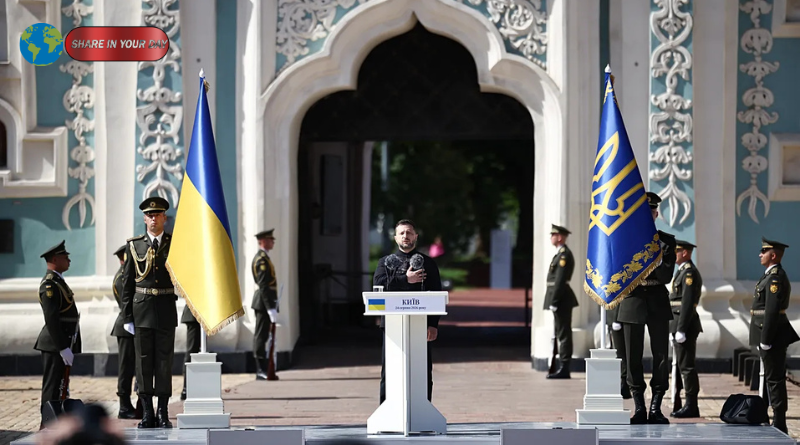
European leaders gathered alongside Ukrainian President Volodymyr Zelenskyy on Monday, August 24, as Ukraine commemorated another independence anniversary under the shadow of Russia’s full-scale invasion. The occasion was particularly significant because it marked Ukraine’s fifth Independence Day since Russian forces launched their invasion in February 2022.
The gathering combined symbolism with practical discussions about Ukraine’s immediate military needs, especially air defence ahead of the winter months. The European Union also announced a fresh package worth €6.1 billion in military assistance, reinforcing the message that European governments intend to maintain substantial support for Kyiv.
At the same time, the absence of US envoys Steve Witkoff and Jared Kushner was closely watched. Their decision not to travel to Kyiv came despite speculation that the Independence Day ceremony could provide an opportunity for senior Trump administration representatives to visit Ukraine.
European Leaders Gather in Kyiv to Support Ukraine
The presence of European leaders gave Ukraine’s Independence Day celebrations a strong diplomatic dimension.
UK Prime Minister Andy Burnham made Kyiv his first overseas destination since taking office. European Council President António Costa also traveled to the Ukrainian capital, joining Zelenskyy and other officials for ceremonies and talks. French President Emmanuel Macron and German Chancellor Friedrich Merz participated remotely in the Coalition of the Willing discussions.
For Kyiv, the gathering was an important demonstration that European backing remains in place despite the uncertainty surrounding the future role of Washington.
Costa delivered one of the clearest messages of the day, pledging that the European Union would continue supporting Ukraine for as long as necessary. He also connected the bloc’s wartime assistance to Ukraine’s longer-term future, including its ambition to join the European Union.
His message reflected a broader European position: Ukraine’s sovereignty and territorial integrity remain central to any future settlement.
The diplomatic symbolism was especially powerful because the event took place in Kyiv rather than a European capital. European officials were therefore showing support while physically standing alongside Ukraine during a continuing war.
EU Announces €6.1 Billion Military Assistance Package
One of the most significant developments was the European Union’s announcement of a new €6.1 billion package for Ukraine’s defence.
The commitment comes as Ukrainian forces continue to face Russian missile and drone attacks and prepare for another winter in which energy infrastructure is expected to remain a major target.
Ukraine has repeatedly asked its partners for more air-defence systems and interceptors. Protecting cities, power facilities and other critical infrastructure has become one of Kyiv’s most urgent military priorities.
The new European assistance therefore carries both strategic and practical significance. It demonstrates that European governments are not limiting their support to political statements but are continuing to commit substantial resources to Ukraine’s defence.
The announcement also comes amid growing European efforts to strengthen defence capabilities across the continent.
The war has pushed European governments to reconsider their own military readiness while simultaneously expanding support for Ukraine. For Kyiv, this creates an increasingly important relationship with European defence industries and governments.
Britain Promises Technology for Ukraine’s Long-Range Missiles
Britain also announced a major new step in defence cooperation with Ukraine.
UK Defence Minister Luke Pollard said London would share technology with Ukraine to support domestic production of the long-range SCALP missile. The announcement is designed to help Ukraine develop greater capacity to manufacture advanced weapons itself rather than depending entirely on deliveries from foreign governments.
The move is significant because Ukraine has spent much of the war expanding its domestic defence industry.
Ukrainian manufacturers have already become major producers of drones and other battlefield technologies. Increasing domestic production of long-range weapons could further reduce the country’s dependence on external stockpiles.
It could also give Ukraine greater flexibility in sustaining its military capabilities during a prolonged conflict.
The British announcement therefore goes beyond a conventional weapons transfer. It represents a deeper form of industrial and technological cooperation between the two countries.
Burnham also used his appearance in Kyiv to underline Britain’s political commitment to Ukraine, comparing the country’s resistance to Russia with Britain’s historical struggle against Nazi Germany.
He told Ukrainians that Britain had once kept alive the “flame of European freedom” and argued that Ukraine was now carrying that responsibility in the 21st century.
Ukraine Needs More Air Defence Before Winter
Air defence was one of the central issues discussed during the Independence Day events.
Ukraine is facing continued Russian missile and drone attacks, while officials are preparing for the possibility of another campaign against energy infrastructure during the colder months.
The threat is particularly serious because Russia has repeatedly targeted Ukraine’s electricity and heating systems during previous winters. Damage to power facilities can affect millions of civilians, making air-defence systems an essential part of Ukraine’s national resilience.
Kyiv is therefore pressing European partners for additional interceptors and other defensive systems.
The urgency has also encouraged closer coordination between Ukraine and its European allies. European governments are increasingly focused not only on supplying weapons but also on ensuring that Ukraine has enough defensive capacity to withstand sustained attacks.
The coming winter could consequently become another major test of both Ukraine’s air-defence network and Europe’s willingness to provide replacement ammunition and systems.
Coalition of the Willing Meets as War Continues
The European leaders were also gathering as part of the Coalition of the Willing, a group of countries working on long-term support and security arrangements for Ukraine.
The coalition has become an important forum as European governments consider what a future security framework for Ukraine could look like.
Its discussions are taking place while diplomatic efforts surrounding the war continue. European governments have repeatedly argued that any settlement must involve Ukraine directly and must not undermine its sovereignty.
The coalition’s role could become even more important if the United States takes a different approach to negotiations with Russia.
For European capitals, the challenge is to maintain pressure on Moscow while preparing Ukraine for any future peace arrangement. That requires military assistance, economic support and political coordination.
The Kyiv meeting therefore served two purposes: it marked Ukraine’s independence while also allowing European governments to discuss the next phase of their collective strategy.
US Envoys Stay Away From Kyiv Ceremony
The most notable absence at the Independence Day event came from Washington.
Trump administration envoys Steve Witkoff and Jared Kushner did not travel to Kyiv for the ceremony, despite speculation that they could attend.
Their absence is significant because the United States remains a central player in diplomatic efforts surrounding the war.
Washington’s position is being watched closely by European governments, particularly as European capitals seek to ensure that Ukraine is not pressured into accepting an agreement that compromises its fundamental interests.
The lack of US representatives at the Kyiv ceremony therefore provided a striking contrast with the strong European presence.
It does not necessarily mean that the United States and Europe have completely diverged over Ukraine. However, the optics were important: European leaders were physically present with Zelenskyy while senior Trump administration envoys were not.
That contrast could reinforce European efforts to develop greater independent capacity to support Ukraine.
Europe Takes a Larger Role in Ukraine’s Future
The Independence Day gathering highlighted how dramatically Europe’s role in the Ukraine war has evolved.
Since Russia’s full-scale invasion, European countries have provided military equipment, financial assistance, humanitarian aid and political backing. The conflict has also encouraged European governments to increase defence spending and expand cooperation between their own military industries.
For Ukraine, Europe is increasingly more than an emergency source of weapons.
The EU is also a long-term political destination for Kyiv. Costa reiterated support for Ukraine’s eventual EU membership, linking the country’s wartime struggle to its broader European integration.
This creates a strategic relationship that could last long after the fighting ends.
Ukraine’s reconstruction, economic recovery and defence modernization will all require significant international assistance. European governments are positioning themselves to play a central role in those efforts.
Ukraine Marks Independence Under the Shadow of War
Ukraine’s Independence Day has become a deeply symbolic occasion since Russia launched its full-scale invasion.
On August 24, 1991, Ukraine declared independence from the Soviet Union. Thirty-five years later, the country’s independence remains at the heart of its conflict with Russia.
The 2026 anniversary was the fifth Independence Day celebrated during the full-scale war.
That history gave this year’s ceremonies particular weight. The event was not simply a national celebration. It was also a statement that Ukraine continues to exist as an independent state despite years of military pressure.
Zelenskyy emphasized the importance of defending that independence and remembering the expectations that surrounded Russia’s invasion in 2022.
When Russian troops advanced toward Kyiv in February 2022, many observers feared the Ukrainian capital could fall quickly. Instead, Ukraine survived the initial assault and has continued resisting more than four years later.
Ukraine’s Defence Industry Becomes Increasingly Important
Another major development during the anniversary period was the growing visibility of Ukraine’s domestic military technology.
Ukraine has rapidly expanded its production of drones and other weapons since the beginning of the full-scale invasion. Domestic manufacturers now play an increasingly important role in supplying Ukrainian forces.
The push for domestic production is strategically important.
Foreign military assistance can fluctuate according to political decisions, production schedules and available stockpiles. A stronger Ukrainian defence industry gives Kyiv greater control over its own supply chain.
European partnerships could accelerate that process.
Technology-sharing agreements such as Britain’s support for SCALP production could allow Ukrainian companies to develop more advanced weapons while creating deeper links with European defence manufacturers.
The result could be a Ukrainian military that is more self-sufficient while remaining closely integrated with European defence systems.
What the Independence Day Meeting Means
The message from Kyiv was clear: European support for Ukraine remains strong.
The EU’s new €6.1 billion military package, Britain’s technology-sharing commitment and the presence of senior European officials all demonstrated that Ukraine continues to have powerful partners on the continent.
At the same time, the absence of Trump administration representatives highlighted uncertainty over the future balance between US and European involvement.
For Ukraine, the immediate priorities remain clear. Kyiv needs more air defence, continued weapons supplies and sufficient financial support to maintain its military effort.
For Europe, the challenge is broader.
European governments must determine how much responsibility they are prepared to assume for Ukraine’s security while also strengthening their own defence capabilities.
As Ukraine entered another year of wartime independence, its European allies sought to make one point unmistakable: the country will not face the next stage of the conflict alone.