Partial Lunar Eclipse Set to Deliver a Stunning 2026 Sky Show
A partial lunar eclipse is about to give millions of skywatchers another spectacular reason to look toward the night sky. The deep lunar eclipse will unfold overnight on Aug. 27-28, 2026, with the Americas in the best position to see the event in its entirety.
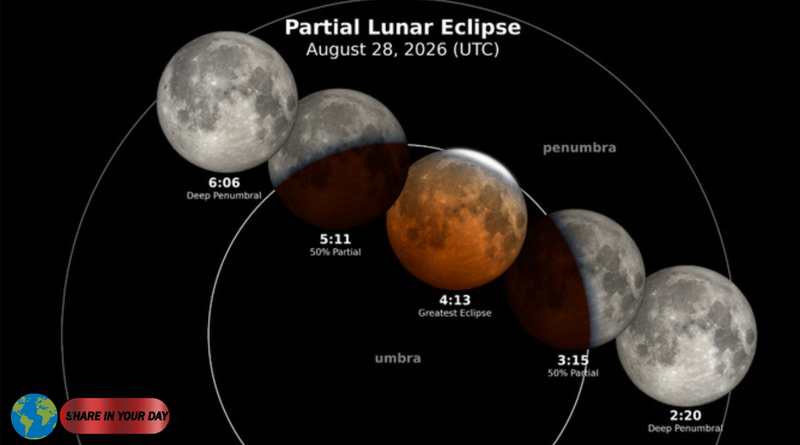
The eclipse is expected to be unusually dramatic because about 96.3% of the Moon’s disk will enter Earth’s darkest shadow, known as the umbra, at maximum eclipse. That leaves only a small portion of the lunar surface directly illuminated by the Sun.
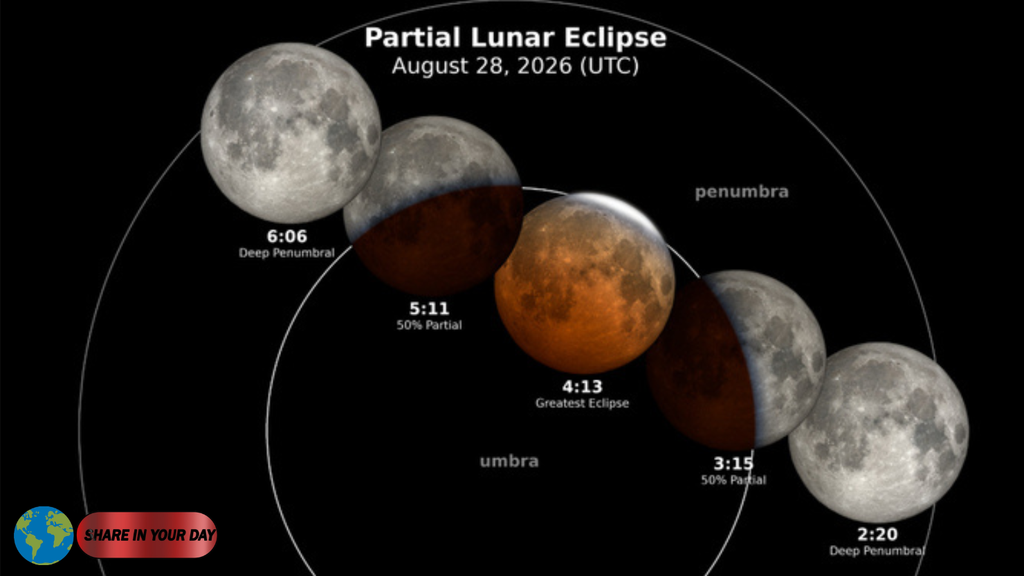
Although it will technically remain a partial eclipse, the Moon could take on a striking reddish or copper-colored appearance as the event reaches its peak.
Astronomers expect the event to be visible to more than 3 billion people across parts of North America, South America, Europe and Africa, weather permitting.
For skywatchers, it is an unusually accessible celestial event. Unlike a solar eclipse, a lunar eclipse can be viewed safely with the naked eye. Binoculars or a telescope can make the changing colors and shadow details even easier to see.
Partial Lunar Eclipse 2026: When Will It Happen?
The partial lunar eclipse 2026 event will take place overnight from Aug. 27 into Aug. 28, depending on the observer’s location.
According to NASA, the moment of greatest eclipse occurs at approximately 4:13 a.m. Universal Time on Aug. 28, when 96.3% of the Moon’s disk will be inside Earth’s umbra.
The timing will vary significantly by location.
In the United States, much of the eclipse will take place during the evening of Aug. 27 and into the early morning hours of Aug. 28. On the West Coast, the peak arrives during the evening, while observers farther east will see the maximum closer to midnight.
For observers in parts of Europe and Africa, the event will occur during the early morning hours of Aug. 28. The Moon will be relatively low in the sky in some locations, making a clear western or southwestern horizon particularly important.
The eclipse lasts for several hours overall, but the most visually impressive period is the deep partial phase, when almost the entire Moon is immersed in Earth’s darkest shadow.
Why This Partial Lunar Eclipse Could Look Like a Blood Moon
One of the biggest attractions of the partial lunar eclipse will be its color.
As the Moon moves into Earth’s umbra, the portion of the lunar surface inside the shadow does not necessarily become completely black. Instead, some sunlight passes through Earth’s atmosphere and is bent toward the Moon.
The atmosphere filters much of the blue light while allowing more red and orange wavelengths to reach the lunar surface.
That process can give the eclipsed portion of the Moon a deep copper, orange or reddish appearance.
This is the same basic phenomenon responsible for the famous red appearance of a total lunar eclipse, commonly called a “Blood Moon.”
However, this August event will not technically be a total lunar eclipse. A tiny portion of the Moon will remain outside the umbra at maximum eclipse, meaning a sliver can stay brighter while the rest of the lunar disk appears much darker and potentially reddish.
That contrast could make the eclipse particularly photogenic.
Partial Lunar Eclipse Will Be Widely Visible
The geographic reach of the partial lunar eclipse is one of its most impressive features.
Unlike a solar eclipse, which is visible only along a relatively narrow path, a lunar eclipse can be seen across a much larger portion of Earth whenever the Moon is above the horizon.
NASA says the Aug. 28 eclipse will be visible across the Americas, western Europe and western Africa.
Space.com estimates that roughly 3.3 billion people could see at least part of the event under suitable conditions.
The Americas are particularly well positioned because the eclipse occurs during their nighttime hours.
Observers in North and South America can potentially follow the eclipse from its earlier stages through maximum eclipse and toward its conclusion, depending on their location.
In Europe and Africa, visibility will be more limited by the Moon’s position and the timing of sunrise.
Some regions will see the Moon setting while the eclipse is still underway.
Why Asia Will Miss the Main Event
Despite the enormous global audience, not everyone will be able to watch the partial lunar eclipse.
The event will occur while the Moon is below the horizon for much of Asia and other parts of the world.
According to astronomical visibility maps, locations including China, India and Japan will not see the eclipse because those areas will be on the daytime side of Earth during the key phases.
This illustrates one of the fundamental differences between lunar and solar eclipses.
A lunar eclipse can cover a huge geographic region, but observers still need to be on the nighttime side of Earth with the Moon above the horizon.
For skywatchers outside the visibility zone, livestreams and astronomical observatories will provide an alternative way to follow the event.
How to Watch the Partial Lunar Eclipse
Watching the partial lunar eclipse does not require expensive equipment.
The most important requirement is simply an unobstructed view of the Moon and reasonably clear weather.
Unlike a solar eclipse, there is no need for special eclipse glasses when viewing a lunar eclipse. It is safe to look directly at the Moon during every stage of the event.
For the best experience, skywatchers should consider the following:
- Find a location away from bright city lights.
- Choose an area with a clear view toward the Moon.
- Check local weather forecasts before the event.
- Arrive early so the Moon’s position can be located before the eclipse becomes dramatic.
- Use binoculars to see the boundary between Earth’s shadow and the illuminated Moon.
- Bring a tripod if photographing the eclipse with a camera or smartphone.
- Avoid tall buildings, trees and mountains that could block a low Moon.
A dark location is not strictly necessary, but it can make the contrast between the Moon and the surrounding sky much more impressive.
Photography Tips for the 2026 Lunar Eclipse
The partial lunar eclipse 2026 could also be an excellent opportunity for amateur astrophotographers.
A smartphone can capture the Moon, although the results will depend heavily on the phone’s camera and zoom capabilities. A dedicated camera with a telephoto lens will generally provide more detail.
A tripod is especially useful because the Moon is bright enough to require relatively short exposures but distant enough that even small movements can cause blur.
Photographers should also experiment with exposure settings.
The full Moon is much brighter than the surrounding sky, but the eclipsed portion becomes significantly darker. Automatic exposure can therefore struggle as the Moon changes throughout the event.
Taking multiple exposures can help capture different stages.
The most dramatic photographs may come close to maximum eclipse, when only a thin illuminated section remains outside Earth’s umbra.
That bright crescent-like region beside the darkened reddish surface could create a striking contrast.
What Makes This Eclipse Different From a Total Lunar Eclipse?
The distinction between a partial and total lunar eclipse is important.
During a total lunar eclipse, the entire lunar disk passes through Earth’s umbra. The Moon can become dramatically red or orange as sunlight is filtered through the atmosphere.
During a partial lunar eclipse, only part of the Moon enters the umbra.
The Aug. 27-28 event comes remarkably close to totality. At maximum eclipse, approximately 96.3% of the Moon’s disk will be inside the umbra.
That means observers could see an eclipse that looks almost total despite technically remaining partial.
The remaining illuminated section is what prevents astronomers from classifying it as a total lunar eclipse.
This near-total appearance is one reason the event is attracting significant attention from astronomers and skywatchers.
The Eclipse Follows a Busy Month for Stargazers
The August partial lunar eclipse arrives only weeks after another major celestial event.
On Aug. 12, 2026, a total solar eclipse crossed parts of Greenland, Iceland and Spain, creating another major viewing opportunity for skywatchers.
The two eclipses occurring within the same month are not a coincidence.
Solar and lunar eclipses occur during eclipse seasons, periods when the geometry of the Moon’s orbit allows the Sun, Earth and Moon to line up closely enough for an eclipse to occur.
A solar eclipse happens around the New Moon, while a lunar eclipse happens around the Full Moon.
The Aug. 27-28 lunar event therefore represents the second major eclipse of the August 2026 eclipse season.
The Science Behind Earth’s Shadow
A partial lunar eclipse occurs when Earth moves directly between the Sun and Moon.
Normally, sunlight travels from the Sun to the Moon and illuminates its surface. During an eclipse, Earth blocks that direct sunlight and casts a shadow into space.
That shadow has two major regions.
The outer region is called the penumbra. The inner and darker region is called the umbra.
When the Moon passes through the penumbra, the change can be subtle.
When it enters the umbra, the difference becomes much more obvious.
During the Aug. 28 eclipse, almost the entire lunar disk will enter the umbra. NASA calculates an umbral magnitude of roughly 0.93, reflecting just how close the event comes to totality.
The Moon’s reddish appearance is then produced by sunlight interacting with Earth’s atmosphere before reaching the eclipsed surface.
In effect, the Earth’s atmosphere acts like a giant filter.
Why the Event Is Safe to Watch
One of the easiest things about watching a partial lunar eclipse is that no specialized eye protection is required.
The Moon does not produce the intense direct sunlight associated with a solar eclipse.
That means viewers can safely watch the eclipse with their eyes, binoculars or telescopes.
Still, normal outdoor precautions are worthwhile.
Skywatchers should choose a safe location, especially if traveling to a remote viewpoint at night. Photographers should also be careful around roads and uneven terrain while concentrating on the sky.
For families, the event can be an especially easy introduction to astronomy because no special equipment is necessary.
When Is the Next Big Lunar Eclipse?
The Aug. 27-28 partial lunar eclipse is notable partly because it comes before a much more dramatic future event.
The next total lunar eclipse is expected on New Year’s Eve in 2028, meaning the 2026 event provides a valuable opportunity for observers who want to experience a near-total lunar eclipse before then.
There will be other lunar eclipses before that date, but their visibility and appearance will vary depending on location.
For many observers, the 2026 eclipse is therefore worth planning around.
A Rare Celestial Show Worth Watching
The partial lunar eclipse of Aug. 27-28, 2026, is shaping up to be one of the year’s most accessible astronomy events.
With approximately 96.3% of the Moon entering Earth’s darkest shadow, the event will come extremely close to totality. Its reddish appearance could make the Moon look dramatically different from its normal full-moon appearance.
Millions of people across the Americas will have an opportunity to watch the eclipse unfold, while parts of Europe and Africa will also see portions of the event.
For viewers with clear skies, the spectacle requires little more than a good view of the Moon.
No special glasses are necessary. No expensive telescope is required. Even a simple pair of binoculars can enhance the experience.
After a month already marked by a major total solar eclipse, the August lunar event offers a spectacular finale.
For anyone fascinated by the night sky, the message is simple: look up.