UN Chief Power Warning Gets Stark Trump Test
The UN chief power warning delivered by António Guterres at the United Nations General Assembly this week placed a broad question at the center of global affairs: who holds power, how it is exercised and whether existing international institutions still reflect the realities of the modern world.
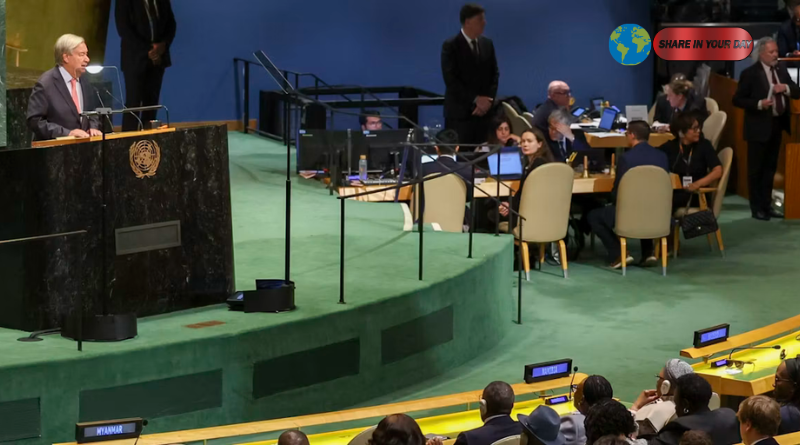
Guterres, the United Nations secretary-general, used his September 22 address to argue that conflicts, inequality, climate change and artificial intelligence should not be viewed as entirely separate crises. Instead, he presented them as different expressions of a deeper transformation in the distribution and use of power.
The argument took on additional significance when U.S. President Donald Trump addressed the same General Assembly roughly an hour later. Trump emphasized American strength, national sovereignty and the use of U.S. power, while rejecting international efforts to establish broad controls over artificial intelligence.
The contrast does not establish that either approach will determine the future of international relations. But the speeches provided a clear illustration of the competing ideas about power that are currently being expressed at the United Nations.
UN Chief Power Warning Focuses on a Changing World
Guterres described the transformation of power as occurring on several levels.
First, he pointed to the emergence of new centers of economic, political and technological influence among states. Second, he highlighted the growing influence of private companies and individuals whose reach can extend across technology, information, finance and political life.
Third, he warned that humans are increasingly transferring important decisions to machines.
The UN secretary-general specifically linked this development to artificial intelligence and autonomous weapons. His concern was not simply that technology is becoming more capable, but that institutions responsible for governing technology may be developing more slowly than the technology itself.
Guterres said the world was facing four major tests of power: war and peace, inequality, climate change and artificial intelligence.
His argument was that each test involves questions about who has influence and who has limited influence over decisions affecting societies.
The UN has described this challenge in particularly stark terms, saying that international institutions continue to reflect power arrangements that were established in an earlier era.
That includes the structure of the UN Security Council, where the permanent membership remains limited to the United States, Russia, China, France and the United Kingdom. Guterres again called for reforms, including stronger representation for Africa.
Trump UN Speech Offered a Different View of Power
Trump’s address to the General Assembly presented a substantially different emphasis.
The White House described the speech as a statement of American strength and sovereignty. Trump argued that his administration had acted rather than simply discussed international problems and said the United States would use its power to protect its interests.
Independent reporting also highlighted the importance Trump placed on American military and political power.
Reuters reported that his 37-minute speech addressed Iran, Russia and Ukraine, the International Criminal Court, Venezuela, Cuba and artificial intelligence. Trump also presented the United States as a country prepared to use its influence directly rather than rely primarily on multilateral institutions.
This emphasis is important in the context of Guterres’ speech because the UN chief’s argument was specifically about how power is changing and how international systems respond to that change.
Trump’s remarks demonstrated one version of that changing political environment: a major power emphasizing national authority and its ability to act independently.
Artificial Intelligence Becomes a Major Point of Difference
Artificial intelligence was one of the clearest areas of contrast.
Guterres called for international safeguards around AI and warned against allowing machines to make life-and-death decisions. He also called for stronger international cooperation on AI risk management and independent oversight.
Trump took a different position on international AI governance.
According to the White House and independent reporting, he rejected attempts to establish what he described as a globalist system for controlling artificial intelligence. Trump also announced that he wanted the U.S. government to use the term “super intelligence” rather than “artificial intelligence” in official documents.
The issue is larger than terminology.
Governments are currently debating how AI should be regulated, how safety standards should be established and whether advanced systems should be subject to international rules.
The United Nations has argued that AI governance requires cooperation because the technology crosses national borders. Meanwhile, governments and technology companies have competing interests concerning innovation, national security and economic growth.
Trump’s speech showed that there is no universal agreement on how much international oversight should be applied.
Inequality Is Also a Question of Power
Guterres connected economic inequality to political power rather than treating it solely as an economic problem.
His argument was that developing countries can be constrained by debt, limited access to financing and a lack of influence over institutions that shape the global financial system.
The secretary-general called for measures including debt relief, stronger multilateral development banks and improved access to international financial resources.
This issue has been part of a broader debate over whether international financial institutions adequately represent today’s global economy.
The distribution of economic influence has changed significantly since many of the major post-World War II institutions were created.
Countries that have become economically and politically more significant are seeking greater influence, while developing countries continue to argue that the existing system leaves them with limited representation.
Guterres presented this as another example of the mismatch between contemporary power and older international structures.
Climate Change Adds Another Layer to the Power Debate
Climate change was the third major area in Guterres’ argument.
He described the climate crisis as an intergenerational imbalance because its consequences can fall heavily on populations that have contributed relatively little to historical emissions.
The UN chief also emphasized renewable energy as a potential shift in the distribution of energy power. Solar and wind resources are geographically widespread, unlike fossil-fuel reserves that are concentrated in particular regions.
The argument does not mean that renewable energy eliminates geopolitical competition.
Countries still compete over critical minerals, manufacturing capacity, energy infrastructure and technology. However, the transition toward renewable energy could alter the strategic importance of traditional energy systems.
This is why Guterres included climate change alongside war, inequality and AI in his broader discussion of power.
The Debate Over International Institutions
One of the most significant themes in the speeches was the future of multilateral institutions.
The United Nations was created after World War II around principles including collective security, international cooperation and respect for international law.
More than eight decades later, the global distribution of economic and political power has changed.
New geopolitical centers have emerged. Private technology companies have gained enormous influence over information and computing infrastructure. Artificial intelligence is creating new forms of technological power that did not exist when the UN system was established.
Guterres argues that international institutions therefore need to adapt.
His warning is not simply about adding new rules. It concerns whether international institutions have enough authority and legitimacy to manage problems that increasingly cross national borders.
Trump, Iran and the Use of American Power
Trump’s speech also provided a concrete example of how national power can be presented.
Iran was a major part of his address. Trump said he faced a decision between reaching an agreement with Iran and taking further action against the country.
ABC News reported that Trump described the choice in unusually stark terms while also saying he believed a deal could eventually be reached.
His comments reflected the broader approach outlined throughout his speech: American military and economic strength as tools for pursuing U.S. objectives.
The remarks also came amid continuing tensions involving Iran, the United States and countries in the wider Middle East.
That makes the discussion about power highly practical rather than theoretical.
Questions about who has power, how it is used and what limits exist can directly affect diplomacy, military policy, trade and international security.
Cuba Shows the Same Tension
Cuba was another example.
Trump described Cuba as a failed state and said his administration was seeking fundamental political change there. The Cuban delegation subsequently walked out of the General Assembly during his remarks.
U.S. Secretary of State Marco Rubio later said Washington was open to discussions with Cuban officials concerning political change.
The episode illustrates another feature of contemporary international politics: powerful countries can attempt to influence political outcomes outside their own borders, while affected governments and other UN members may challenge those actions.
Again, the significance lies less in a single speech than in the underlying question of how national power interacts with international rules.
What the UN Chief Power Warning Means for AI
Artificial intelligence may ultimately become one of the most difficult tests identified by Guterres.
Unlike conventional military or economic power, AI can be distributed through software, computing infrastructure and access to data.
A small number of companies currently possess enormous computing resources and technical capabilities. Governments, meanwhile, are attempting to determine how those systems should be regulated without unnecessarily restricting technological development.
The UN’s position is that international cooperation is required.
Guterres warned that decisions involving life and death should not be surrendered to autonomous machines and called for safeguards around advanced AI systems.
Trump’s rejection of broad international controls demonstrates why reaching global agreement may be difficult.
Different governments have different priorities. Some emphasize safety and regulation. Others prioritize innovation, economic competition or national security.
The result is likely to be an extended international debate over where authority should sit.
A Wider Debate About Who Controls the Future
The central idea behind the UN chief power warning is therefore broader than the speeches of Guterres and Trump.
It concerns a world in which political influence is becoming more distributed in some areas while becoming more concentrated in others.
Countries such as China, India and other emerging powers have increased their economic and political influence. Technology companies control infrastructure that can affect billions of people. Artificial intelligence is beginning to influence decisions once made exclusively by humans.
At the same time, established institutions remain largely structured around arrangements developed decades ago.
That creates a difficult question for international governance: should existing institutions adapt to the new distribution of power, or should countries place greater emphasis on national decision-making?
The speeches at the UN General Assembly did not provide a common answer.
Instead, they exposed the disagreement.
Guterres called for stronger international cooperation, institutional reform and safeguards around emerging technologies. Trump emphasized American sovereignty, national strength and freedom from what he characterized as excessive international control.
Why the Debate Matters Beyond the UN
The implications extend well beyond diplomatic speeches.
Decisions about international power can affect wars and peace negotiations. They can influence the rules governing artificial intelligence, global trade, climate finance and international development.
They can also determine how much influence governments have over multinational corporations and emerging technologies.
For the United Nations, the challenge is particularly significant.
The organization must operate in a world where the distribution of power is changing while maintaining cooperation among countries with very different interests.
Guterres’ speech presented that challenge as a defining issue for the international system.
Trump’s response demonstrated one of the competing approaches: placing greater emphasis on national power and sovereignty.
Neither speech resolves the underlying debate.
What they make clear is that questions about power are increasingly connected to nearly every major global issue, from military conflicts and economic inequality to climate change and artificial intelligence.
As the world enters a period of rapid technological and geopolitical change, the question of who exercises power—and under what rules—will remain central to international affairs.