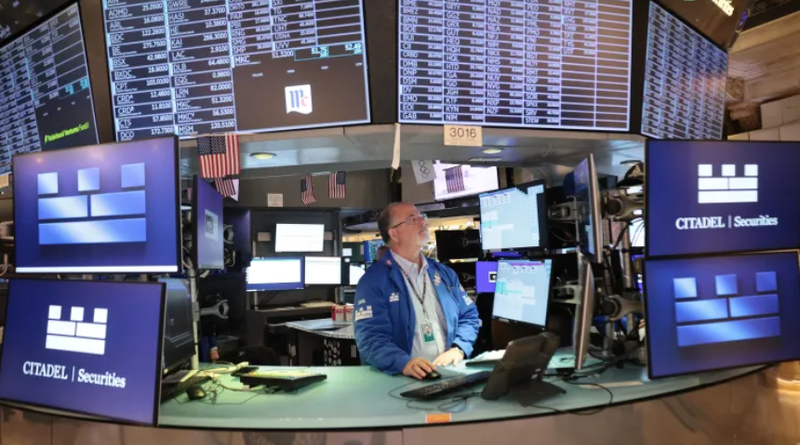
Stock Market Today: Dow and S&P 500 Fall on AI Fears
Wall Street ended lower on Monday as investors weighed growing concerns about the future of artificial intelligence, rising oil prices and the possibility of higher interest rates. The Dow Jones and S&P 500 both declined, while technology stocks faced heavier selling pressure.
The Dow Jones Industrial Average fell 152.09 points, or 0.3%, to finish at 52,421.20. The S&P 500 dropped 37 points, or 0.5%, to 7,619.98. The Nasdaq Composite, which is more heavily exposed to technology companies, fell 0.6% to 26,186.41.
The declines came after a strong run for U.S. stocks this year. Despite Monday’s losses, the S&P 500 remained up 11.3% in 2026, while the Dow had gained 9.1% and the Nasdaq was up 12.7%.
Dow Jones and S&P 500 Retreat as AI Stocks Slide
The biggest pressure on the market came from the technology sector, particularly companies tied closely to the artificial intelligence boom.
Investors reacted to warnings from prominent AI executives about the speed of AI development and the potential risks associated with increasingly powerful systems. Those comments raised fresh questions about whether the enormous spending on AI infrastructure can continue at its current pace.
Nvidia was among the companies hit hardest, with shares falling 3.4%. Other major semiconductor names also declined. Micron Technology lost more than 5%, while Advanced Micro Devices and Broadcom each dropped more than 4%.
The semiconductor sector was particularly weak, highlighting how dependent the recent stock-market rally has become on expectations surrounding artificial intelligence.
The selloff did not affect every technology company equally, however. Some software stocks recovered after recent declines, suggesting investors were moving money between different areas of the technology market rather than abandoning the sector completely.
Rising Oil Prices Add Pressure
Energy markets provided another major concern for investors.
Brent crude oil climbed to $105.68 a barrel after approaching $110 earlier in the session. The increase reflected continuing concerns about disruptions to energy supplies in the Middle East.
Higher oil prices can create problems for the economy because they raise transportation and production costs. If those increases remain elevated for long enough, businesses may pass higher expenses on to consumers.
That could make inflation more difficult to control.
For investors, the timing was particularly important because markets were already focused on the Federal Reserve and its next decision on interest rates.
Treasury Yields Reach a Key Level
The bond market added another layer of uncertainty.
The yield on the 10-year U.S. Treasury briefly moved above 5% during Monday’s trading session. It was the first time the benchmark yield had reached that level since 2023.
Treasury yields are closely watched because they influence borrowing costs throughout the economy. Higher yields can make mortgages, corporate financing and other forms of borrowing more expensive.
They can also make bonds more attractive compared with stocks.
The 10-year yield later pulled back from its session high, helping stocks recover somewhat from their worst levels of the day. Still, the move above 5% served as a reminder that inflation and monetary policy remain major risks for financial markets.
Investors Await the Federal Reserve
The Federal Reserve was another central focus on Wall Street.
Investors entered the week expecting the central bank to remain concerned about persistent inflation. The prospect of higher interest rates has become increasingly important as oil prices rise and Treasury yields move higher.
For much of 2026, expectations for corporate earnings have helped support elevated stock valuations. However, higher interest rates can make future corporate profits less valuable when calculated in today’s dollars.
That creates a difficult environment for high-growth companies, particularly technology businesses whose valuations depend heavily on expectations for future earnings.
The combination of AI concerns, higher oil prices and interest-rate uncertainty therefore gave investors several reasons to reduce risk.
Some Stocks Buck the Market Trend
Although the major indexes finished lower, Monday’s session was not a broad collapse across Wall Street.
Several companies outside the AI trade performed better, helping limit the losses in the major indexes. Some software companies also rebounded following recent weakness.
Cybersecurity stocks were among the stronger areas of the market as investors considered the growing importance of digital security in an increasingly AI-driven economy.
This divergence shows that investors are becoming more selective. Instead of selling every technology stock, traders are increasingly examining individual companies, their earnings prospects and their exposure to the AI investment cycle.
What the Dow Jones and S&P 500 Losses Mean
The decline in the Dow Jones and S&P 500 does not necessarily signal the end of the broader stock-market rally.
Both indexes remain substantially higher for the year. Monday’s losses were relatively modest compared with the gains recorded over the preceding months.
However, the session demonstrated how quickly sentiment can change when several risks appear at the same time.
AI has been one of the most powerful themes driving the market, particularly through demand for chips, data centers and related infrastructure. Any indication that companies may slow their spending could therefore have consequences far beyond the technology sector.
At the same time, higher oil prices and Treasury yields could put additional pressure on consumers and businesses.
Wall Street Faces a Critical Week
Investors now have several major issues to monitor as the week continues.
The Federal Reserve’s interest-rate decision will be closely watched for clues about the direction of monetary policy. Investors will also continue tracking crude oil prices, Treasury yields and developments involving the AI industry.
For now, the market remains caught between strong corporate earnings and a growing list of economic and geopolitical concerns.
Monday’s decline in the Dow Jones and S&P 500 reflects that tension. The indexes remain well above their levels at the beginning of the year, but investors are becoming more cautious as expensive valuations, rising energy costs, higher bond yields and uncertainty surrounding AI spending collide.
The next several trading sessions could provide a clearer indication of whether Monday’s weakness is simply a temporary pause or the beginning of a broader shift in market sentiment.