Ratko Mladic Funeral Exposes Serbia’s EU Rift
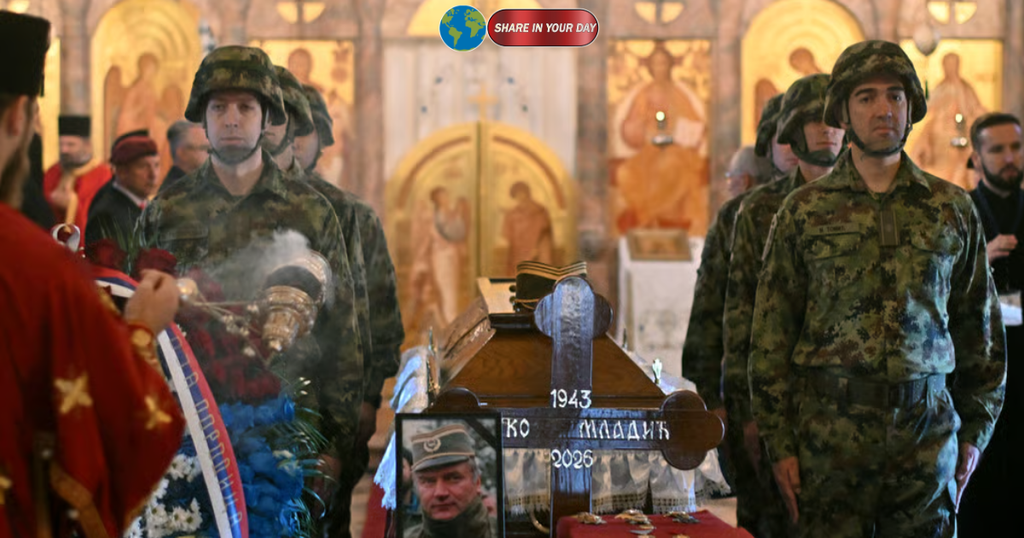
The Ratko Mladic funeral has exposed a growing contradiction at the center of Serbia’s European ambitions. Thousands gathered in Belgrade to pay tribute to the former Bosnian Serb military commander, whose convictions for genocide, war crimes and crimes against humanity remain a defining part of the region’s painful history. The ceremony has triggered strong criticism from European Union officials and renewed questions about whether Serbia is genuinely prepared to embrace the political values required for EU membership. RReuters+1
The funeral comes at a sensitive moment for Serbia. Belgrade has continued to present EU membership as a strategic objective, while maintaining political positions and relationships that frequently put it at odds with Brussels.
The public honoring of Mladic has therefore become more than a dispute over a funeral. It has turned into a powerful symbol of the gap between Serbia’s stated European direction and the nationalist sentiment that remains influential at home.
Ratko Mladic Funeral Draws Thousands in Belgrade
The Ratko Mladic funeral took place in Belgrade after the former Bosnian Serb commander died while serving a life sentence in prison. Large crowds attended the ceremony, including veterans, nationalist supporters and others who continue to view Mladic as a Serbian hero rather than as a convicted war criminal. RReuters+1
Mladic was convicted by the International Criminal Tribunal for the former Yugoslavia and later had his life sentence upheld. His convictions included responsibility for crimes committed during the Bosnian War, including the Srebrenica genocide and the siege of Sarajevo.
The Srebrenica massacre remains one of the darkest episodes of the 1990s Balkan conflicts. About 8,000 Bosniak Muslim men and boys were killed in July 1995.
For survivors and families of victims, the public celebration of Mladic represents something very different from a private funeral.
It is seen as an attempt to rehabilitate a figure who was found responsible for some of the worst atrocities committed in Europe since World War II.
Why the Ratko Mladic Funeral Matters to the EU
The European Union has repeatedly made clear that membership is not simply an economic arrangement.
Candidate countries are expected to demonstrate respect for democracy, human rights, the rule of law and European values. Confronting the legacy of war crimes is therefore closely connected to Serbia’s broader relationship with the bloc.
EU officials had already warned that the handling of the Ratko Mladic funeral would be an important test for Serbia’s European path. EU Enlargement Commissioner Marta Kos canceled a planned visit to Serbia after the events surrounding the funeral, while European officials criticized what they regarded as the glorification of a convicted war criminal. Eeuronews+1
European Commission President Ursula von der Leyen subsequently criticized the large turnout and said the images from the event were shocking. European Council President António Costa also stressed the importance of European values, justice and human rights. RReuters
The message from Brussels is therefore broader than criticism of one ceremony.
The EU is questioning whether Serbia’s political culture is moving in the same direction as the values required for membership.
Serbia’s European Ambitions Face a Difficult Reality
Serbia has long sought closer integration with the European Union.
But the country’s relationship with Brussels has never been straightforward. Its political leadership has attempted to balance its EU aspirations with strong ties to Russia, nationalist sentiment and domestic political pressures.
That balancing act has become increasingly difficult.
The EU expects candidate countries to align themselves progressively with its foreign policy. Serbia, however, has maintained relationships with Moscow that distinguish it from many other European countries.
At the same time, the unresolved Kosovo issue remains a major obstacle to deeper European integration.
These disputes are now joined by concerns over democratic standards and the political treatment of war crimes.
The Ratko Mladic funeral has consequently become another issue in a much larger debate over Serbia’s strategic direction.
Ratko Mladic Remains a Divisive Figure
The continuing admiration for Mladic highlights the unresolved nature of the Balkan Wars’ legacy.
For many victims and their families, Mladic is inseparable from the destruction and suffering of the Bosnian War.
For some Serbian nationalists, however, he continues to symbolize resistance, military strength and the defense of Serb interests.
That competing interpretation of history is one reason reconciliation in the Western Balkans remains so difficult.
The problem is not simply disagreement about a historical figure. It concerns the fundamental question of how societies remember conflict and whether political leaders are prepared to acknowledge responsibility for atrocities committed in their name.
The Ratko Mladic funeral brought that unresolved question into the center of European politics.
EU Officials See More Than a Symbolic Dispute
The response from Brussels suggests that European officials are treating the funeral as a political signal.
The EU’s concern is that public glorification of Mladic could indicate a broader unwillingness to confront nationalist narratives that conflict with European integration.
The issue is particularly sensitive because Serbia is not an ordinary third country from the EU’s perspective.
It is a candidate for membership.
That means every major political development in Serbia can be assessed against the criteria expected of a future member state.
European officials have therefore linked the funeral controversy to Serbia’s wider accession process rather than treating it as an isolated cultural or historical dispute. Eeuronews+1
Serbia’s Domestic Politics Add Another Layer
The controversy comes as Serbia faces significant domestic political pressure.
The government has proposed dissolving parliament and moving toward an early parliamentary election, amid prolonged political tensions and mass protests that began after the 2024 Novi Sad railway station disaster. AAP News
President Aleksandar Vucic remains the country’s dominant political figure, but the political environment has become more challenging.
Against this backdrop, questions of nationalism and Serbian identity have particular political importance.
The public reaction to Mladic’s funeral cannot therefore be separated completely from Serbia’s internal political competition.
Nationalist themes can resonate strongly with sections of the electorate, while the government simultaneously needs to maintain working relations with Brussels.
That creates a difficult political calculation.
Moving too far toward European demands can generate resistance among nationalist voters. Moving too far toward nationalist symbolism can damage Serbia’s European ambitions.
The Vucic Government Faces a Delicate Balance
President Vucic has frequently attempted to position Serbia between competing geopolitical interests.
His government has pursued EU integration while also maintaining close relations with Russia and preserving strong nationalist themes within domestic politics.
This approach has allowed Belgrade considerable room to maneuver.
But the room for ambiguity becomes smaller as the EU places greater emphasis on democratic standards, foreign-policy alignment and historical accountability.
The Ratko Mladic funeral illustrates that problem particularly clearly.
European officials can interpret the public celebration of Mladic as evidence that Serbia’s political environment remains incompatible with aspects of the European project.
Meanwhile, nationalist supporters can portray criticism from Brussels as external interference in Serbian affairs.
That creates a political feedback loop in which criticism from the EU can itself become fuel for nationalist rhetoric.
The Srebrenica Legacy Remains Central
Any discussion of Mladic inevitably returns to Srebrenica.
The 1995 massacre, in which approximately 8,000 Bosniak Muslim men and boys were killed, remains one of the central historical issues dividing communities across the former Yugoslavia.
International courts have established the legal characterization of the massacre and Mladic’s responsibility.
Yet political acceptance of those judgments varies considerably across the region.
This difference between legal history and public memory is one of the greatest challenges facing reconciliation efforts.
The Ratko Mladic funeral demonstrated that decades after the Bosnian War, the legacy of the conflict can still mobilize large crowds and generate intense political reactions.
Bosnia and Herzegovina Reacts With Anger
The reaction has not been limited to Brussels.
Officials and victims’ groups in Bosnia and Herzegovina have strongly condemned the public honoring of Mladic. For communities that suffered during the war, the funeral was viewed as a deeply painful reminder that the past remains politically contested. UUOL Notícias+1
The emotional response is especially strong in Sarajevo and among survivors of the siege.
Mladic’s forces conducted a prolonged siege of Sarajevo that became one of the defining symbols of the Bosnian War.
For those affected by the conflict, his funeral is therefore not an abstract debate about historical interpretation.
It is connected directly to personal loss.
Serbia’s EU Path Could Become More Complicated
The EU does not necessarily have to end Serbia’s accession process because of one controversial event.
However, the controversy can reinforce existing concerns.
Serbia’s membership bid already faces challenges involving democratic reforms, rule of law, relations with Kosovo and foreign-policy alignment.
The funeral adds another highly visible issue to that list.
If Brussels concludes that Serbian authorities are tolerating or encouraging the glorification of convicted war criminals, it could further weaken political confidence in Serbia’s commitment to the European integration process.
The bigger question is therefore not whether one funeral automatically changes Serbia’s membership prospects.
It is whether the funeral becomes part of a broader pattern that convinces EU governments that political convergence with Serbia is moving too slowly.
The Gap Between Policy and Political Reality
This is ultimately the central contradiction highlighted by the Ratko Mladic funeral.
Serbia’s government can continue to describe EU membership as a strategic priority.
But membership requires more than statements from government officials.
It requires political reforms, institutional changes and a demonstrated willingness to accept the principles underlying the European project.
Those principles can become difficult to defend domestically when nationalist narratives remain powerful.
The funeral showed how far apart those two realities can be.
On one side is Serbia’s strategic ambition to become part of the European Union.
On the other is a domestic political environment in which thousands can gather to honor a commander convicted of some of the most serious international crimes committed during the Balkan conflicts.
That contradiction is unlikely to disappear quickly.
What Comes Next for Serbia and the EU?
The immediate diplomatic fallout may eventually fade.
But the underlying political questions will remain.
Serbia will have to decide how firmly it wants to pursue European integration and how much political capital its leadership is willing to spend defending that objective.
The EU, meanwhile, will have to determine how much pressure it can apply without pushing Serbia further away.
The challenge is particularly complicated because Serbia occupies an important geopolitical position in the Western Balkans.
Brussels wants stability in the region and does not want Serbia to drift permanently away from Europe.
At the same time, accepting symbolic gestures that appear to glorify convicted war criminals could undermine the credibility of the EU’s own standards.
That is why the response to the Ratko Mladic funeral matters beyond Serbia.
It is also a test of how Europe handles unresolved conflicts, nationalist politics and enlargement in a strategically important part of the continent.
Ratko Mladic Funeral Becomes a Test of Serbia’s Direction
The Ratko Mladic funeral has exposed a political contradiction that Serbia has struggled to resolve for years.
The country wants closer ties with the European Union, yet nationalist forces remain influential and the legacy of the Yugoslav wars continues to shape domestic politics.
The funeral turned that contradiction into a highly visible international event.
EU leaders have condemned the glorification of Mladic. Serbian nationalists have celebrated his legacy. Victims’ groups have condemned the ceremony. And Serbia’s government now faces renewed scrutiny over the direction of its European policy. RReuters+1
Whether the controversy produces a lasting change in Serbia’s EU accession process remains uncertain.
But one thing is clear: the funeral has made it harder for Belgrade to maintain the idea that its European ambitions can be separated from the country’s unresolved political and historical debates.
For the EU, the question is increasingly about more than Serbia’s eventual membership.
It is about whether Serbia is willing to make the political and moral choices that membership requires.
Image ALT Text
Ratko Mladic funeral in Belgrade as Serbia faces EU membership tensions
Suggested Internal Links
- Serbia and EU membership explained
- Latest Serbia political news
- Balkan politics and European Union relations
- Srebrenica genocide history
- Serbia and Kosovo relations
Suggested External Links
- POLITICO Europe — Ratko Mladic funeral and Serbia’s EU ambitions
- Reuters — Funeral of convicted war criminal Mladic draws thousands
- Reuters — EU reaction to Mladic funeral
SEO note: The article uses “Ratko Mladic funeral” as the primary keyword in the title, meta description, slug, introduction, subheadings and body. Yoast/RankMath can still adjust its score after the article is entered into WordPress, particularly for internal links and image placement.