T. Rex Trackway Reveals How the Giant Dinosaur Walked
A newly documented T. rex trackway in North Dakota is giving scientists an unusually direct look at how an adult Tyrannosaurus rex moved across the landscape more than 66 million years ago.
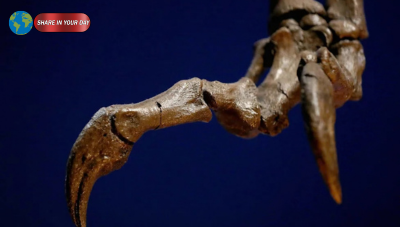
The discovery consists of four enormous three-toed footprints preserved in the Upper Cretaceous Hell Creek Formation. Together, the prints form a trackway about 23 feet, or 7 meters, long. Researchers estimate that the tracks were made roughly 66.5 million years ago, near the end of the age of non-avian dinosaurs.
The findings are significant because dinosaur bones tell scientists about anatomy, but footprints can preserve something different: behavior in motion.
In this case, the spacing between the prints provides evidence about the animal’s stride and walking speed. Researchers estimate that the dinosaur was moving at approximately 1.5 to 2 meters per second, or around 3.4 to 4.5 miles per hour.
The research was published in the Journal of Vertebrate Paleontology in September 2026.
T. Rex Trackway Contains Four Giant Footprints
The newly described T. rex trackway contains four large, three-toed impressions.
Each footprint is approximately 1 meter long, making the individual tracks considerably larger than many previously documented tyrannosaur footprints. The trackway itself extends for about 7 meters and was discovered in southwestern North Dakota.
The tracks are preserved in unusual geological structures known as sandstone concretions. According to the researchers, calcium carbonate cemented sand around the original footprint depressions. The resulting casts became harder than the surrounding rock.
That unusual preservation helped the footprints survive even though the surfaces are now heavily fractured and eroded.
Unfortunately, the erosion means that the tracks do not preserve every detail of the dinosaur’s foot. Scientists therefore cannot reconstruct the foot anatomy from the prints alone with complete confidence.
However, their enormous size, three-toed shape, proportions and location provide several important clues.
Most importantly, numerous T. rex skeletal remains have been discovered in the same general area.
Why Scientists Think a T. Rex Made the Tracks
Identifying the animal that created a fossil footprint is not always straightforward.
A three-toed footprint does not automatically mean that a Tyrannosaurus rex made it. Several dinosaur groups had three toes, and the appearance of a footprint can change depending on the softness of the sediment, the way the animal placed its foot and how the track was preserved.
The researchers therefore considered alternative explanations.
The Hell Creek Formation contained several large dinosaurs, including hadrosaurs. Some hadrosaurs could also produce large three-toed footprints. However, their track shapes tend to have broader digital impressions and different proportions.
The new footprints are unusually large and relatively narrow.
Their size also helps narrow the possibilities. The researchers concluded that the combination of location, geological age, footprint dimensions, toe shape and nearby T. rex fossils makes an adult Tyrannosaurus rex the most likely trackmaker.
The scientific paper is careful about this conclusion. Rather than presenting the identification as an absolutely preserved “signature,” the researchers describe the tracks as likely attributable to an adult T. rex.
That distinction matters in paleontology.
A fossil footprint is evidence of movement, not a preserved foot. Scientists must account for the way sediment deforms under an animal’s weight and how geological processes alter the resulting impression over millions of years.
The T. Rex Trackway Captures Movement
One of the most valuable aspects of the discovery is that the researchers found a sequence rather than a single isolated footprint.
A lone dinosaur footprint can provide information about foot size and shape. A sequence can reveal much more.
By examining the distance between consecutive prints, scientists can estimate stride length and walking speed. The four footprints in this discovery therefore provide a small snapshot of the dinosaur’s movement across the ancient environment.
The study estimates a walking speed of about 1.5 to 2 meters per second. That translates to roughly 5 to 6.5 feet per second.
The stride was approximately 4 meters.
That does not mean the animal was running.
Instead, the measurements are consistent with a large theropod moving at a walking pace.
This is an important distinction because T. rex is often portrayed as an extremely fast predator in popular culture. Fossil evidence, however, allows scientists to examine particular movements without relying on assumptions based on its appearance.
The newly described T. rex trackway provides direct evidence of one adult animal walking through soft sediment near the end of the Cretaceous.
A Rare Record From the Final Days of Dinosaurs
The geological age of the footprints makes the discovery even more interesting.
Researchers estimate that the tracks were made about 66.5 million years ago. The rocks containing them are part of the Upper Cretaceous Hell Creek Formation and sit approximately 33 meters below the Hell Creek-Fort Union Formation boundary.
That places the animal extremely close, in geological terms, to the end-Cretaceous mass extinction.
The Chicxulub asteroid impact occurred approximately 66 million years ago and contributed to the extinction of non-avian dinosaurs and many other organisms.
The footprints therefore come from a period when T. rex was still living in North America.
They are not evidence of what happened immediately before the extinction event. Instead, they offer a snapshot of the environment and animal behavior during the final portion of the Cretaceous.
At that time, the Hell Creek landscape supported a variety of dinosaurs and other animals. Rivers, floodplains and changing sedimentary environments created conditions in which occasional footprints could become buried and preserved.
Most footprints disappeared.
This one survived.
Why Dinosaur Footprints Matter
Fossilized bones remain among the most important sources of information about extinct animals, but trace fossils can answer questions that skeletons cannot.
A skeleton can show scientists the approximate structure of an animal’s legs and feet. A trackway can show how those limbs were actually used while the animal was alive.
Researchers can investigate:
- Walking speed
- Stride length
- Foot placement
- Direction of travel
- Gait
- Interaction with sediment
- Possible movement patterns
The T. rex trackway therefore adds another piece to the scientific understanding of the famous predator.
Trackways are also valuable because they preserve an animal’s actions rather than simply its body.
In other words, a skeleton can tell scientists what a dinosaur was built like. A trackway can sometimes show what that dinosaur was doing.
The Tracks Were Difficult to Interpret
The discovery also demonstrates why paleontological identification can be complicated.
The surfaces of the four footprints are heavily fractured. According to the researchers, relatively little detailed anatomical information remains beyond the large size and three-digit configuration.
That means the scientists could not simply compare every visible feature with a T. rex foot and declare a perfect match.
Instead, they evaluated multiple lines of evidence.
The tracks are unusually large. Their proportions are compatible with a giant theropod. Their narrow toe impressions differ from typical hadrosaur track shapes. The rocks are the correct age, and abundant T. rex skeletal material has been found locally.
Taken together, these observations strengthen the interpretation that an adult T. rex created the trackway.
The researchers also used digital scanning to document the footprints and reconstruct their dimensions. This approach is particularly useful when a fossil surface is fragile or difficult to remove from the field.
Digital Scanning Adds a New Layer of Evidence
Modern paleontology increasingly combines traditional excavation with digital technology.
The researchers created detailed digital records of the footprints, allowing measurements and three-dimensional analysis without relying entirely on physical specimens.
Digital models can also help scientists examine the shape of damaged tracks and compare them with other fossil footprints.
In this case, scanning helped researchers evaluate the length, width and spacing of the footprints and investigate the animal’s movement.
The technology does not eliminate uncertainty. A digital reconstruction cannot restore anatomical details that were never preserved.
But it can make the available evidence easier to measure, preserve and study.
The discovery therefore combines an ancient biological record with modern analytical methods.
The First Adult T. Rex Trackway
Individual footprints attributed to tyrannosaurs have been reported previously.
However, the new study is notable because it describes a sequence of footprints that researchers interpret as having been produced by an adult T. rex.
The authors describe it as the first reported trackway likely attributable to an adult Tyrannosaurus rex.
Earlier tracks have presented identification challenges.
For example, some large three-toed tracks from the Late Cretaceous have been attributed to other tyrannosaurids or remain controversial. The authors emphasize that assigning a particular dinosaur species to a track is difficult because different animals can produce superficially similar footprints.
That makes a well-preserved sequence associated with the right age, location and dimensions particularly valuable.
A Discovery That Started in the Field
The trackway was discovered during fieldwork in North Dakota, with research involving the Denver Museum of Nature & Science and Liverpool John Moores University.
The research team included paleontologists and other specialists who investigated the footprints, performed measurements and analyzed their geological context.
The discovery also highlights an important part of paleontology: major scientific finds do not always begin with a complete skeleton.
Sometimes the evidence is a subtle feature in a rock surface.
A depression that initially looks like an ordinary geological formation can become important once researchers recognize its shape, size and relationship to surrounding rocks.
In this case, four impressions together created a rare behavioral record.
What the T. Rex Trackway Still Cannot Tell Us
Despite the excitement surrounding the discovery, the footprints do not answer every question about T. rex.
They do not reveal the dinosaur’s exact body mass, sex or age.
They also do not prove that the animal was hunting, traveling toward prey or interacting with another dinosaur.
There is no evidence from these four footprints alone that the animal was part of a group.
The trackway primarily provides information about movement.
The researchers also note that future excavations could potentially expose additional portions of the trackway. More tracks might provide additional information about the animal’s gait and movement.
However, the amount of material covering the site could make further excavation difficult.
That means the four existing footprints may remain the central evidence for this particular trackway.
A New Window Into Tyrannosaurus Rex
The discovery adds an unusual type of evidence to the long scientific history of Tyrannosaurus rex.
Scientists have studied T. rex teeth, skulls, bones, muscle attachments and complete or partial skeletons for generations. Those fossils have helped reconstruct the animal’s anatomy and evolutionary history.
The T. rex trackway adds something different.
It records a moment when the animal was alive and moving.
About 66.5 million years ago, an enormous three-toed predator crossed soft sediment in what is now North Dakota. The animal left four impressions behind. Sediment later filled those impressions, minerals cemented the material, and geological processes preserved the evidence until scientists could study it.
The dinosaur disappeared millions of years ago.
Its footsteps remained.
The study, published in the Journal of Vertebrate Paleontology, shows how even a small number of fossilized tracks can provide valuable information about extinct animals.
For paleontologists, the discovery is more than another dinosaur fossil. It is a rare behavioral record from one of the most famous predators in Earth’s history.
And for the public, those four footprints offer an extraordinary connection to a world that existed long before humans: a brief trail left by an adult Tyrannosaurus rex as it walked across the ancient landscape.