Four Astronauts Return to Earth After 237 Days in Space as NASA Completes Major ISS Crew Handover
Four astronauts have safely returned to Earth after spending 237 days aboard the International Space Station (ISS), concluding an extended mission that involved scientific research, station maintenance and an unusual medical emergency that reshaped NASA’s crew schedule.
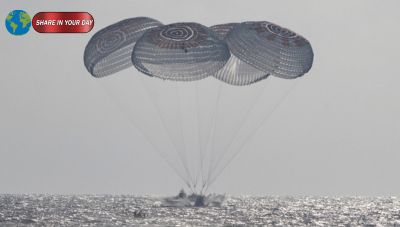
The crew included NASA astronauts Jessica Meir and Jack Hathaway, European Space Agency astronaut Sophie Adenot of France, and Russian cosmonaut Andrey Fedyaev. Their return marked the end of a demanding period in orbit and highlighted the international cooperation required to maintain a continuous human presence in space.
The astronauts splashed down in the Pacific Ocean on October 8, 2026, after spending nearly eight months away from Earth. Their mission lasted longer than initially anticipated, giving the crew additional time to complete work aboard the orbiting laboratory before returning home.
Their departure also followed the arrival of a replacement crew transported to the station by SpaceX, allowing NASA and its international partners to continue their research operations without interrupting the station’s activities.
A Mission Extended by an Unusual Medical Emergency
The astronauts’ extended stay was connected to a medical emergency involving NASA astronaut Mike Fincke. The incident prompted changes to the agency’s crew schedule and led to an early return arrangement that NASA described as its first medical evacuation in 65 years of human spaceflight.
The situation demonstrated the challenges of managing human health in an environment where medical facilities are limited and returning to Earth requires careful coordination.
Although the International Space Station has supported astronauts from multiple countries for decades, an unexpected medical situation can affect mission planning, staffing levels and the timing of spacecraft movements.
NASA must consider the health of its astronauts alongside the operational requirements of the station. That includes maintaining enough trained personnel to conduct experiments, operate critical equipment and respond to emergencies.
The crew’s extended stay also underscored the importance of having dependable spacecraft available for transportation between Earth and orbit.
SpaceX’s Crew Dragon spacecraft has become a central part of NASA’s approach to transporting astronauts, providing the agency with regular access to the space station through its commercial crew partnership.
Scientific Research and Maintenance in Orbit
During their time aboard the ISS, the astronauts participated in scientific investigations and maintenance activities designed to support future space exploration.
The space station serves as a research laboratory where scientists can examine how microgravity affects the human body, biological processes, materials and technology.
These investigations are important because astronauts traveling on future missions to the Moon and Mars will face longer periods away from Earth, increasing the need to understand how the human body responds to spaceflight.
The crew also conducted spacewalks and completed technical work needed to keep the station operating safely. Such activities can involve inspecting equipment, installing hardware and maintaining systems exposed to the demanding conditions of orbit.
Spacewalks require extensive preparation because astronauts must operate in pressurized spacesuits while working outside the station. Every movement must be carefully coordinated to reduce risks and protect essential equipment.
For Adenot, the mission also established a significant milestone. She spent 237 days in space, setting a new endurance record for the European Space Agency at the time of her return.
Her achievement highlights the growing contribution of European astronauts to long-duration missions and international research conducted aboard the ISS.
SpaceX Continues Supporting NASA’s Space Station Operations
SpaceX has become a major partner in NASA’s efforts to maintain routine transportation to and from low Earth orbit.
The company’s Crew Dragon spacecraft carries astronauts between Earth and the ISS, while its Falcon 9 rocket provides the launch capability needed to deliver crews into orbit.
In early October, SpaceX launched Crew-13, carrying NASA astronauts Jessica Watkins and Luke Delaney, Canadian astronaut Joshua Kutryk and Russian cosmonaut Sergey Teteryatnikov.
The spacecraft reached the ISS after approximately eight hours, marking the fastest launch-to-docking flight by a U.S. spacecraft to the station, according to NASA.
The arrival of the new crew allowed the station’s personnel to complete a handover before the departing astronauts began their return journey.
Crew handovers are essential to long-term operations because incoming astronauts must learn about ongoing experiments, equipment conditions and any technical issues that developed during the previous team’s stay.
The process also ensures that research continues while experienced crew members prepare for departure.
With the departing astronauts safely back on Earth, the station remains staffed by an international team responsible for its daily operations and scientific program.
Returning to Earth Brings New Physical Challenges
Although landing marks the end of an astronaut’s mission, the return to normal life does not happen immediately.
Living in microgravity for months changes how the body responds to gravity. Astronauts can experience muscle loss, reduced bone density, changes in balance and other physiological effects after prolonged periods in orbit.
Following splashdown, returning crew members undergo medical evaluations and rehabilitation to help them readjust to life on Earth.
Walking, standing and performing familiar physical activities can initially feel different after months without the constant effects of gravity. Recovery programs are designed to rebuild strength, improve balance and monitor overall health.
The rehabilitation period also allows medical teams to evaluate the effects of long-duration spaceflight and gather information that can support future missions.
Such research is particularly important as NASA and its international partners prepare for increasingly ambitious exploration programs.
Longer missions beyond low Earth orbit will expose astronauts to challenges that cannot be fully replicated during shorter flights, making the experience gained aboard the ISS valuable for future planning.
Why the Mission Matters for Future Space Exploration
The successful return of the four astronauts represents more than the completion of an individual expedition. It also demonstrates the resilience of an international space program that must adapt when unexpected circumstances arise.
NASA relies on cooperation with commercial companies and international agencies to maintain the station, conduct research and prepare for future exploration.
SpaceX provides transportation services, while international partners contribute astronauts, equipment, scientific expertise and operational support.
The International Space Station remains an important testing ground for technologies and procedures that could eventually support missions to the Moon and Mars.
Research conducted there helps scientists understand the risks associated with prolonged spaceflight and develop better ways to protect astronauts during extended missions.
The experience gained from medical emergencies, crew rotations and long-duration stays also helps space agencies improve contingency planning.
As the returning astronauts begin their recovery on Earth, the work aboard the ISS continues. The next crew will build on the research already completed while preparing for new experiments and operational responsibilities.
Their mission illustrates both the difficulties of living in space and the progress made in making human spaceflight a more sustainable and routine activity.