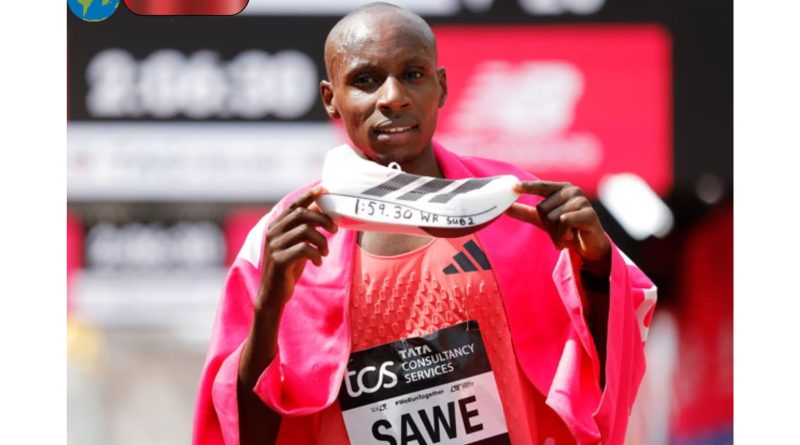
Sabastian Sawe Marathon Record: History Made in London
The Sabastian Sawe marathon record has officially rewritten the limits of human endurance. At the 2026 London Marathon, the Kenyan long-distance runner achieved what had long been considered nearly impossible—completing a full marathon in under two hours under official race conditions.

Clocking a staggering time of 1 hour, 59 minutes, and 30 seconds, Sawe not only won the race but shattered the previous world record by a massive margin. The achievement marks the first time in history that the two-hour barrier has been broken in a competitive marathon, cementing Sawe’s place among the greatest athletes of all time.
Breaking the Ultimate Barrier in Marathon History
For decades, the two-hour marathon barrier stood as one of sport’s most elusive milestones. While Kenyan legend Eliud Kipchoge famously ran a sub-two-hour time in a controlled exhibition in 2019, it did not count as an official record due to special conditions.
That changed in London.
The Sabastian Sawe marathon record is the first sub-two-hour performance achieved in a standard, regulated race environment. This distinction is critical, as it places Sawe’s accomplishment in the official record books and elevates it to a historic benchmark in athletics.
Experts have already begun comparing this moment to iconic sporting achievements such as the first sub-four-minute mile and Usain Bolt’s world-record sprint performances.
A Race for the Ages
The 2026 London Marathon will be remembered not just for Sawe’s record-breaking performance, but for the extraordinary level of competition across the field.
Ethiopia’s Yomif Kejelcha finished second with a remarkable time of 1:59:41, also breaking the two-hour barrier in his marathon debut. Meanwhile, Uganda’s Jacob Kiplimo placed third with 2:00:28, a time that still surpassed the previous world record.
This means that:
- Two athletes ran under two hours
- Three athletes beat the previous world record
- The marathon standard was dramatically redefined in a single race
Such depth of performance is virtually unprecedented in distance running.
How Sawe Achieved the Impossible
The Sabastian Sawe marathon record was not the result of a single factor, but rather a combination of elite training, race strategy, and cutting-edge technology.
1. Relentless Training Regimen
Sawe reportedly trained up to 150 miles (241 km) per week, building the endurance necessary to sustain a blistering pace over 42.2 kilometers.
2. Precision Pacing
Maintaining a sub-two-hour pace requires near-perfect consistency. Sawe averaged less than 17 seconds per 100 meters, a level of precision that leaves virtually no margin for error.
3. Advanced Footwear Technology
Sawe wore next-generation racing shoes, part of a growing trend in elite running that has contributed to faster times globally. These “super shoes” are designed to maximize energy return and reduce fatigue over long distances.
4. Strategic Race Execution
The race featured ideal pacing conditions and tactical execution, allowing Sawe to conserve energy early and push aggressively in the final stages.
Why This Record Changes Everything
The Sabastian Sawe marathon record is more than just a number—it represents a paradigm shift in long-distance running.
For years, experts debated when—or if—the two-hour barrier would be broken under official conditions. Some predicted it might take decades. Instead, Sawe has accelerated that timeline dramatically.
This achievement will likely have several long-term impacts:
- Raising performance standards for elite runners
- Increasing competition intensity in major marathons
- Driving innovation in training and equipment
- Inspiring a new generation of athletes
The psychological barrier has now been shattered, opening the door for even faster times in the future.
A Historic Day for the London Marathon
The 2026 edition of the London Marathon has already been described as one of the greatest days in the event’s history.
More than 60,000 runners participated, while hundreds of thousands of spectators lined the streets of London to witness the spectacle.
In addition to Sawe’s historic run:
- Tigst Assefa set a women-only world record
- Multiple course and personal records were broken
- The event showcased the global appeal of marathon running
The race’s iconic route—passing landmarks such as Tower Bridge and Buckingham Palace—provided a dramatic backdrop for a truly historic performance.
The Rise of Sabastian Sawe
Before his record-breaking run, Sawe was already a rising star in distance running. However, his latest achievement has elevated him into a new echelon of global sports icons.
Interestingly, Sawe’s journey to elite running began relatively late. He only started competing seriously in his mid-20s, yet quickly rose through the ranks to dominate the marathon scene.
His rapid progression highlights not only his natural talent but also his discipline and commitment to the sport.
Comparing Past and Present Marathon Records
To fully appreciate the magnitude of the Sabastian Sawe marathon record, it is important to consider how marathon times have evolved over the years.
- Early 2000s: Records hovered around 2:05–2:06
- 2010s: Gradual improvements brought times close to 2:01
- 2023: Kelvin Kiptum set a record of 2:00:35
- 2026: Sawe breaks the barrier with 1:59:30
The leap from just over two hours to under two hours is not just incremental—it is transformative.
Global Reactions to the Record
The athletics world has responded with awe and admiration. Coaches, athletes, and analysts have praised Sawe’s performance as a defining moment in sports history.
Some have even described it as:
- “A once-in-a-generation achievement”
- “The greatest marathon performance ever”
- “A turning point for endurance sports”
Comparisons to legendary milestones underline the significance of the achievement and its lasting impact.
What Comes Next?
With the Sabastian Sawe marathon record now set at 1:59:30, the question shifts from “if” to “how much faster.”
Experts believe that:
- Sub-1:59 performances may soon become possible
- Competition among elite runners will intensify
- Technology and training methods will continue evolving
Sawe himself may not be done yet. His coach has suggested that he could potentially run even faster under optimal conditions.
Conclusion
The Sabastian Sawe marathon record is a defining moment in the history of sport. By breaking the two-hour barrier in an official race, Sawe has achieved what many once thought impossible.
His performance at the 2026 London Marathon will be remembered for generations—not just as a record, but as a symbol of human potential pushed to its limits.
As the world reflects on this historic achievement, one thing is clear: the future of marathon running has arrived, and it is faster than ever.