Blood Moon 2026: 5 Facts About August’s Eclipse
Blood Moon 2026 is arriving at the end of August, giving skywatchers another major celestial event just weeks after the dramatic total solar eclipse that crossed parts of the Northern Hemisphere.
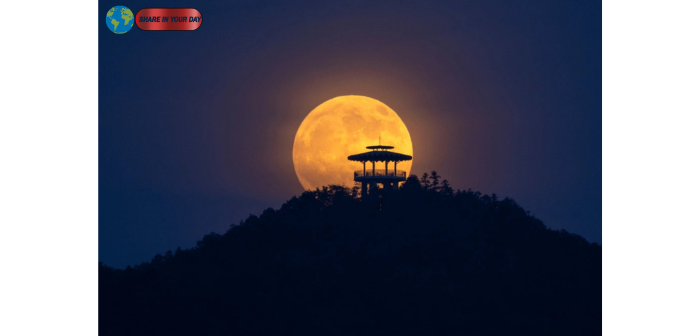
The August 27–28 lunar eclipse will be a deep partial lunar eclipse. At its peak, approximately 96.3% of the Moon’s disk will pass into Earth’s darkest central shadow, known as the umbra. The event can make much of the full Moon appear dramatically darkened, with the portion inside Earth’s shadow taking on a coppery or reddish color.
Unlike a solar eclipse, the lunar event is completely safe to watch with the naked eye. No special eclipse glasses are required.
However, where you live will determine whether you can see it.
Blood Moon 2026: When Is the August Lunar Eclipse?
The eclipse occurs on August 27–28, 2026, depending on the observer’s time zone.
NASA lists the astronomical event as an August 28 eclipse in Universal Time. The deepest point occurs at approximately 4:13 a.m. UTC on August 28. In the United States, that corresponds to the evening of August 27 in many locations.
NASA’s skywatching guidance says the eclipse will be visible from large portions of the Americas, Europe and Africa. Some areas of the Pacific will also have visibility, depending on the stage of the eclipse and local horizon conditions.
That means the best viewing opportunities will not be evenly distributed around the world.
For observers in parts of Asia, including Southeast Asia, the event may not be visible because the Moon will not be above the horizon during the key stages.
Skywatchers should therefore check local eclipse circumstances before planning a viewing trip.
Is Blood Moon 2026 a Total Lunar Eclipse?
No.
That is one of the most important details to understand about the August event.
Blood Moon 2026 is a deep partial lunar eclipse, rather than a total lunar eclipse. NASA reports that about 96.3% of the Moon’s disk will enter the umbra at maximum eclipse. A small portion of the Moon will remain outside the darkest part of Earth’s shadow.
During a total lunar eclipse, the entire Moon passes through Earth’s umbra. During a partial lunar eclipse, only part of the lunar surface enters that central shadow.
The difference can be subtle to casual observers.
Because the August eclipse is unusually deep, however, the Moon should still undergo a dramatic transformation.
As Earth’s shadow moves across the lunar disk, most of the bright full Moon will disappear into darkness. The remaining illuminated section can provide a striking contrast against the shadowed surface.
Why Can the Moon Turn Red?
The term “Blood Moon” is commonly used when the Moon takes on a reddish, orange or copper-colored appearance during a lunar eclipse.
The color comes from Earth’s atmosphere.
During an eclipse, Earth sits between the Sun and Moon. Direct sunlight is blocked from reaching the Moon, but some sunlight passes through Earth’s atmosphere before reaching the lunar surface.
The atmosphere scatters shorter wavelengths of light, particularly blue light, more efficiently than longer wavelengths such as red and orange. The remaining light that reaches the Moon can therefore give the eclipsed portion a reddish appearance.
The exact color can vary.
Depending on atmospheric conditions, the Moon may appear orange, copper, dark red or brownish. Dust and particles in Earth’s atmosphere can influence the appearance as well.
That means every lunar eclipse can look slightly different.
For the August 2026 event, observers should not expect the entire Moon to become a classic deep-red sphere because this is not a total lunar eclipse. Instead, the section inside the umbra may develop a coppery or reddish tint while a small portion remains in direct sunlight.
Where Can You See Blood Moon 2026?
Visibility is one of the biggest factors for anyone hoping to watch the August lunar eclipse.
NASA says the eclipse will be visible from the Americas, Europe and Africa, with portions of the Pacific also included in the viewing region.
Observers in parts of North and South America have particularly favorable opportunities because the eclipse occurs during nighttime there.
Parts of Europe and Africa can also see portions of the event, depending on local Moonrise and Moonset times.
The exact experience varies by location.
Some locations will see the Moon already undergoing the eclipse as it rises. Others will see the beginning of the event before the Moon sets.
Therefore, simply knowing that your country is inside the broad visibility zone is not enough. Local timing matters.
For accurate local circumstances, skywatchers can use NASA’s eclipse resources and astronomical planning tools.
What Time Does the Eclipse Peak?
The maximum eclipse occurs at approximately 4:13 a.m. UTC on August 28. NASA’s eclipse data show that this is the point at which the greatest portion of the Moon is immersed in Earth’s umbra.
For viewers in North America, this translates to the evening of August 27.
For some European and African locations, the deepest part of the eclipse occurs during the early morning hours of August 28.
The easiest way to avoid confusion is to think in terms of your local clock rather than relying solely on the calendar date.
An eclipse that NASA identifies as August 28 in UTC can still occur on August 27 for viewers several time zones west of Greenwich.
Weather is another consideration.
A perfectly timed eclipse is of little use if clouds cover the Moon. Skywatchers should check the forecast on the evening of the event and, if necessary, move to an area with clearer skies.
How to Watch Blood Moon 2026 Safely
Watching a lunar eclipse is remarkably easy.
There is no need for special protective glasses.
A lunar eclipse occurs because the Moon is moving through Earth’s shadow. The Moon is not producing dangerous levels of light, and viewing it directly is safe.
NASA specifically notes that lunar eclipses can be watched with the naked eye. Binoculars or a small telescope can also provide a closer look at Earth’s curved shadow moving across the lunar surface.
For the best experience, choose a location with:
- A clear view of the Moon.
- Minimal cloud cover.
- Low levels of artificial light.
- An unobstructed horizon.
- A comfortable place to watch for several hours.
You do not need a professional telescope.
In fact, one of the advantages of a lunar eclipse is that it can be enjoyed by almost anyone.
A smartphone can also capture the Moon, although photographing an eclipse requires different camera settings than taking an ordinary nighttime photograph.
A tripod can help prevent blurred images. Manual exposure controls can also make it easier to capture detail on the darkened lunar surface.
Blood Moon 2026 Follows a Busy Eclipse Season
The August lunar eclipse comes shortly after another major astronomical event.
On August 12, 2026, a total solar eclipse crossed parts of Greenland, Iceland, northern Russia, the Atlantic Ocean and Spain, with a small portion of Portugal also inside the path of totality. Much larger areas of Europe, Africa and North America experienced a partial solar eclipse.
The two events are connected by the geometry of the Sun-Earth-Moon system.
Eclipses happen during periods when the orbital alignment of the Sun, Earth and Moon allows the three bodies to line up closely enough for one object’s shadow to fall on another.
NASA describes these periods as eclipse seasons. Each season lasts roughly 35 days and occurs about twice a year.
That helps explain why major eclipses can occur relatively close together.
The August 2026 sequence therefore offers skywatchers an unusual opportunity to experience both types of eclipse within the same month.
What Happens During a Partial Lunar Eclipse?
A lunar eclipse develops gradually.
At first, the Moon enters Earth’s faint outer shadow, called the penumbra. The change can be difficult to notice.
Eventually, the Moon reaches Earth’s darker umbra.
This is when the eclipse becomes visually dramatic.
A curved shadow begins to move across the bright lunar surface. As more of the Moon enters the umbra, the illuminated portion becomes smaller.
During the August 2026 event, the eclipse reaches an unusually deep partial phase. Nearly the entire lunar disk enters the umbra, although a small section remains outside it.
The process then reverses.
The Moon gradually moves out of Earth’s shadow, and the bright portion grows again.
The entire eclipse lasts much longer than the brief totality of a solar eclipse, giving observers plenty of time to watch the changing appearance.
Will the Moon Turn Completely Red?
Probably not.
Because this is a partial lunar eclipse, not a total one, a small part of the Moon remains outside Earth’s umbra.
That means viewers should not expect the classic image of a completely red-orange Moon associated with a total lunar eclipse.
Nevertheless, the eclipse is deep enough to produce an impressive visual effect.
NASA says that at maximum eclipse about 93% of the Moon’s diameter is inside the umbra in its general skywatching description, while NASA’s detailed visualization gives a more precise figure of 96.3% of the lunar disk within the umbra.
The difference reflects the distinction between how the eclipse depth is described geometrically and how much of the lunar disk is immersed in the umbra.
Either way, the result is the same for observers: almost the entire Moon will pass through Earth’s darkest shadow.
Why the August 2026 Eclipse Is Worth Watching
Not every partial lunar eclipse is equally dramatic.
Some are shallow, with only a small portion of the Moon entering Earth’s umbra. Those events can be easy to overlook.
August’s eclipse is different.
With nearly the entire lunar disk entering the umbra, the Moon will undergo a substantial visual change.
The event is also easy to observe because it requires no specialized equipment.
That combination makes the August eclipse especially accessible.
Families can watch it from a backyard. Amateur astronomers can photograph it. Experienced skywatchers can use binoculars or telescopes to study the progression of Earth’s shadow.
And unlike a solar eclipse, there is no concern about damaging your eyesight by looking directly at the Moon.
The Next Lunar Eclipses After August 2026
The August event is not the end of the eclipse calendar.
NASA lists the next lunar eclipse as a penumbral lunar eclipse on February 20, 2027. That event will be visible from the Americas, Europe, Africa, Asia, Australia and Antarctica.
A penumbral eclipse is considerably more subtle than the August 2026 event.
During a penumbral eclipse, the Moon passes through the outer portion of Earth’s shadow. The resulting dimming can be difficult to notice without careful observation.
The August 2026 event therefore offers a much stronger visual spectacle for many observers.
Blood Moon 2026: The Bottom Line
Blood Moon 2026 is set to close August with a striking celestial display.
The August 27–28 event is technically a deep partial lunar eclipse, not a total lunar eclipse. At maximum eclipse, about 96.3% of the Moon’s disk will be inside Earth’s umbra, creating a dramatic darkened appearance and potentially producing coppery or reddish colors across the shadowed portion.
The eclipse will be visible across broad areas of the Americas, Europe and Africa, although the exact timing and visibility will depend on location.
The deepest point occurs at about 4:13 a.m. UTC on August 28, which means many observers in North America will experience the peak during the evening of August 27.
Most importantly, the event is completely safe to watch without special eye protection.
After August’s total solar eclipse, the lunar eclipse provides a second opportunity to watch the geometry of our solar system unfold in real time.
For anyone with clear skies and a good view of the Moon, it could be one of the most memorable nights in the August 2026 sky.