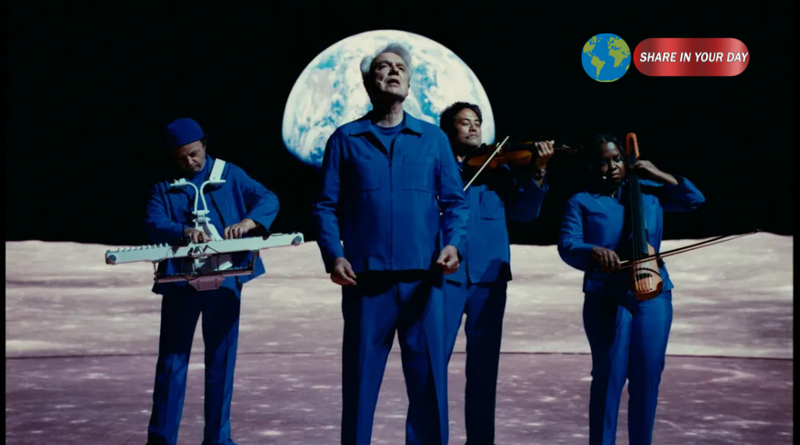
David Byrne 70mm Film Brings His Latest Tour to the Big Screen
The David Byrne 70mm film project is turning one of the most visually ambitious concert tours of recent years into a cinematic experience. The film is being directed by Brady Corbet, the filmmaker behind The Brutalist, and was shot on 70mm film during David Byrne’s performances in his hometown of Baltimore.
The project captures Byrne’s Who Is the Sky? tour, a production built around music, movement, visual storytelling and a large ensemble of performers. Rather than simply documenting a concert from the audience’s perspective, the filmmakers are using the wide visual possibilities of 70mm to preserve the scale and choreography of Byrne’s stage production.
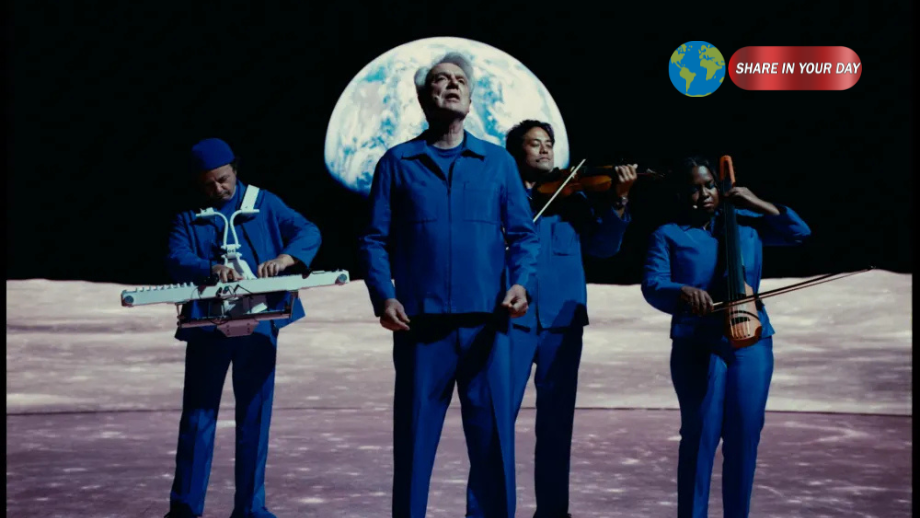
The announcement also adds another significant chapter to Byrne’s long relationship with concert cinema. The former Talking Heads frontman was at the center of Stop Making Sense, Jonathan Demme’s influential 1984 concert film, and later saw his American Utopia stage production adapted for the screen by Spike Lee.
Now, decades after Stop Making Sense changed the perception of what a concert film could be, Byrne is attempting something different again.
Who Is the Sky? Becomes a Cinematic Experience
The new film is based on Byrne’s Who Is the Sky? tour, which takes its name from his 2025 studio album.
The tour has traveled across four continents and more than 150 performances, according to reporting surrounding the film. Its production is deliberately theatrical, combining Byrne with musicians, singers and dancers who remain in constant motion throughout the performance.
That visual component appears to be one of the primary reasons Corbet chose to shoot the production on 70mm.
Traditional concert films can sometimes struggle to reproduce the atmosphere and physical scale of a live show. Wide shots may lose detail, while close-ups can remove the relationship between performers, stage design and audience.
The David Byrne 70mm film is designed to preserve that larger picture.
Byrne himself said he initially did not understand how much of a difference the format would make. After seeing frames captured by Corbet, however, he became convinced that the format was particularly well suited to the production’s visual scope.
That choice could make the film stand out in an increasingly crowded concert-film market.
Brady Corbet Takes on David Byrne’s Concert World
The appointment of Brady Corbet as director is another major reason the project has attracted attention.
Corbet is best known for The Brutalist, his ambitious 2024 drama that earned major critical recognition and multiple Academy Award nominations. His approach to filmmaking emphasizes scale, composition and visual atmosphere, making him an intriguing choice for a concert production as visually elaborate as Byrne’s current show.
The collaboration also brings together two artists who have built careers around challenging conventional formats.
Byrne has repeatedly reimagined what a musical performance can look like.
Corbet, meanwhile, demonstrated with The Brutalist that he is comfortable working on an expansive cinematic canvas.
Their partnership therefore makes the new project more than a straightforward recording of a live performance.
It is a meeting of music and cinema.
Baltimore Gives the Film a Personal Connection
The film was captured during performances at the Hippodrome in Baltimore, Byrne’s hometown.
That detail gives the project an additional emotional dimension.
According to Corbet, the performances represented an inclusive celebration of community and Baltimore itself, a city he described as one of America’s underappreciated historic cities.
For Byrne, filming the show in his hometown creates an opportunity to preserve a particularly meaningful chapter of the tour.
Rather than filming at a generic arena or major international venue, the production was captured in a place directly connected to Byrne’s personal history.
The decision also allows the film to incorporate a sense of location that can be difficult to reproduce in conventional concert movies.
Baltimore is not simply the backdrop.
It becomes part of the story.
Why 70mm Matters for the David Byrne Film
The decision to use 70mm film is perhaps the most distinctive technical element of the project.
70mm is known for producing exceptionally detailed images and a large-format cinematic presentation. The format can capture wide compositions while retaining significant visual detail, making it particularly attractive for large-scale productions.
For Byrne’s show, that could be especially important.
The Who Is the Sky? production features numerous performers moving around the stage rather than remaining in fixed positions. A wide frame can capture those movements while preserving the relationship between dancers, musicians and Byrne himself.
Corbet has revealed that the Baltimore performances were captured using both 8-perf and 15-perf 70mm formats.
That is an unusually ambitious approach for a concert film.
It also suggests that the filmmakers are treating the project as a cinematic work rather than simply archival footage.
David Byrne Has a Long History With Concert Films
For Byrne, appearing in another concert film is hardly unfamiliar territory.
His most famous collaboration with cinema remains Stop Making Sense, the 1984 Talking Heads film directed by Jonathan Demme.
The movie became one of the most celebrated concert films ever produced, largely because Demme and Byrne understood that a live performance could be presented as a cinematic narrative rather than a simple collection of songs.
The film’s reputation continued to grow decades after its original release, and it returned to theaters in a restored 4K version in 2023.
Byrne later returned to the format with American Utopia, the Broadway and touring production that was filmed by Spike Lee.
That project demonstrated that Byrne remained interested in translating his live performances into another medium.
The new film continues that tradition while taking a distinctly different visual direction.
From American Utopia to Who Is the Sky?
The new production follows American Utopia, which was released as a concert film directed by Spike Lee.
That project focused heavily on the minimalist but kinetic stage design of Byrne’s Broadway production.
The new film appears to have a different identity.
The Who Is the Sky? tour is built around an expansive ensemble and constant movement, giving Corbet more opportunities to use the width and depth of the 70mm frame.
The result could therefore be less like a conventional music documentary and more like a large-format cinematic performance.
That distinction is important.
A concert film has to accomplish two things simultaneously: preserve the energy of being in the room and create something that works as cinema.
Byrne has spent much of his career experimenting with that balance.
The Tour Has Become One of Byrne’s Most Ambitious Productions
The scale of the Who Is the Sky? tour helps explain why the film project has generated so much interest.
The production involves 13 musicians, singers and dancers, with performers constantly moving across the stage.
That structure creates a visual language that differs from a conventional rock concert.
Instead of placing the singer at the center while musicians remain behind them, Byrne’s production turns the entire stage into a moving composition.
The performers become part of the choreography.
Music and movement operate together.
That makes the show particularly well suited to film.
A camera can move between individual performers, capture large ensemble formations and then return to Byrne without losing the wider context.
70mm adds another dimension by allowing the filmmakers to preserve those broad compositions at a much larger visual scale.
A Film About More Than Music
The new project could also continue Byrne’s longstanding interest in community.
His stage work has often emphasized the relationship between performers and audiences.
The Who Is the Sky? show does not simply present Byrne as a distant star. Instead, it creates an environment in which musicians and dancers share the stage and interact as a collective.
Corbet’s comments about the Baltimore performances reinforce that interpretation.
He described the band’s performance as an inclusive celebration of community, with particular emphasis on Baltimore.
That could become an important theme in the final film.
The project is not merely about preserving songs.
It is about preserving the experience of people creating something together.
What We Know About the Film’s Release
Despite the announcement, several important details remain unknown.
A final release date has not yet been announced, and distribution plans are still being developed.
The film is currently in post-production. The project is being produced by The Deep End Films and Pre-Code, Corbet’s company, with Mona Fastvold also involved. River Road Entertainment is presenting the film.
Global distribution rights are being handled by Byrne’s representatives at The Gersh Agency alongside The Deep End.
That leaves considerable room for speculation about how the movie will eventually reach audiences.
A theatrical release would make sense given the use of 70mm, particularly if the filmmakers want audiences to experience the production on a large screen.
However, no official rollout strategy has been announced yet.
Why a Theatrical Release Could Be Important
The choice of 70mm naturally raises expectations for a theatrical presentation.
Large-format film is particularly suited to theaters capable of projecting it at the scale for which it was designed.
For a production that emphasizes wide stage compositions, a large screen could allow audiences to appreciate details that might otherwise disappear on a television or laptop.
This is particularly relevant to Byrne’s choreography.
The performers are not simply background figures. They form a central part of the production.
A theatrical presentation could therefore make it easier for audiences to experience the complete visual architecture of the show.
At the same time, the film could eventually find a second life through home viewing and streaming.
For now, however, the filmmakers have not announced the complete release plan.
The Legacy of Stop Making Sense Looms Large
Any new David Byrne concert film will inevitably be compared with Stop Making Sense.
That comparison is both unavoidable and potentially unfair.
Demme’s film became a landmark because it captured Talking Heads at a particular moment while presenting the performance with extraordinary clarity and energy.
The new project does not appear to be attempting to recreate that formula.
Instead, Corbet is approaching Byrne’s work through a contemporary cinematic perspective.
The use of 70mm immediately establishes a different visual identity.
Rather than copying the aesthetic of Stop Making Sense, the new film can stand as another document of Byrne’s continuing evolution as a performer.
That may ultimately be its greatest strength.
David Byrne Continues to Push the Format Forward
Byrne’s career has repeatedly demonstrated a willingness to challenge expectations.
From Talking Heads to his solo work, theater productions and concert films, he has consistently blurred the boundaries between music, performance art and visual storytelling.
The David Byrne 70mm film fits naturally within that history.
It captures a tour that itself attempts to rethink the conventional concert experience and places it in the hands of a filmmaker known for ambitious visual storytelling.
That combination could produce something unusual.
The film is not simply an archive of what happened onstage.
It is an attempt to translate the architecture, movement and atmosphere of the performance into cinema.
What Fans Can Expect Next
For now, fans will have to wait for more information about the film’s release.
The Who Is the Sky? tour itself continues through September, with its final scheduled performance taking place Sept. 19 at Forest Hills Stadium in Queens, New York.
Meanwhile, the Baltimore footage is moving through post-production.
That means the next major announcement is likely to focus on the film’s title, premiere plans, distribution strategy or release date.
Whatever form the final rollout takes, the combination of David Byrne, Brady Corbet and 70mm film has already made the project one of the more intriguing music-cinema collaborations of 2026.
A New Chapter in David Byrne’s Concert-Film Legacy
The David Byrne 70mm film represents an unusual meeting of musical history and contemporary cinema.
Byrne has already helped redefine the concert film once. With Stop Making Sense, he and Jonathan Demme demonstrated that a live music performance could become a powerful cinematic work.
Years later, American Utopia extended that tradition through Spike Lee’s lens.
Now Brady Corbet is taking on the challenge.
His task is to capture a visually ambitious production while preserving the energy and communal spirit of Byrne’s live show.
The decision to shoot in 70mm suggests that the filmmakers are taking that challenge seriously.
The Baltimore performances provide the emotional foundation. The 70mm format provides the visual scale. And Byrne’s decades-long relationship with performance cinema provides the history behind the project.
The final film is still in post-production, and its release plans remain to be announced.
But the ingredients are already remarkable.
A legendary musician.
An acclaimed modern filmmaker.
A hometown performance.
A 13-person ensemble.
And one of cinema’s most visually expansive formats.
If the finished project succeeds in translating the energy of Who Is the Sky? to the big screen, it could become another important entry in David Byrne’s extraordinary concert-film legacy.
Source: Variety, Aug. 27, 2026.
Additional Sources: Pollstar, Pitchfork and Rock Cellar Magazine.