Netanyahu Targets Mamdani During Fiery UN Speech as Delegates Walk Out
Israeli Prime Minister Benjamin Netanyahu used his address to the United Nations General Assembly on Thursday to sharply criticize New York City Mayor Zohran Mamdani, defend Israel’s conduct in Gaza and confront growing international criticism of his government.
Netanyahu’s speech unfolded amid visible tension inside and outside the United Nations headquarters in New York. Dozens of delegates left the chamber as he prepared to speak, while demonstrators gathered nearby to protest Israel’s military campaign and Netanyahu’s appearance.
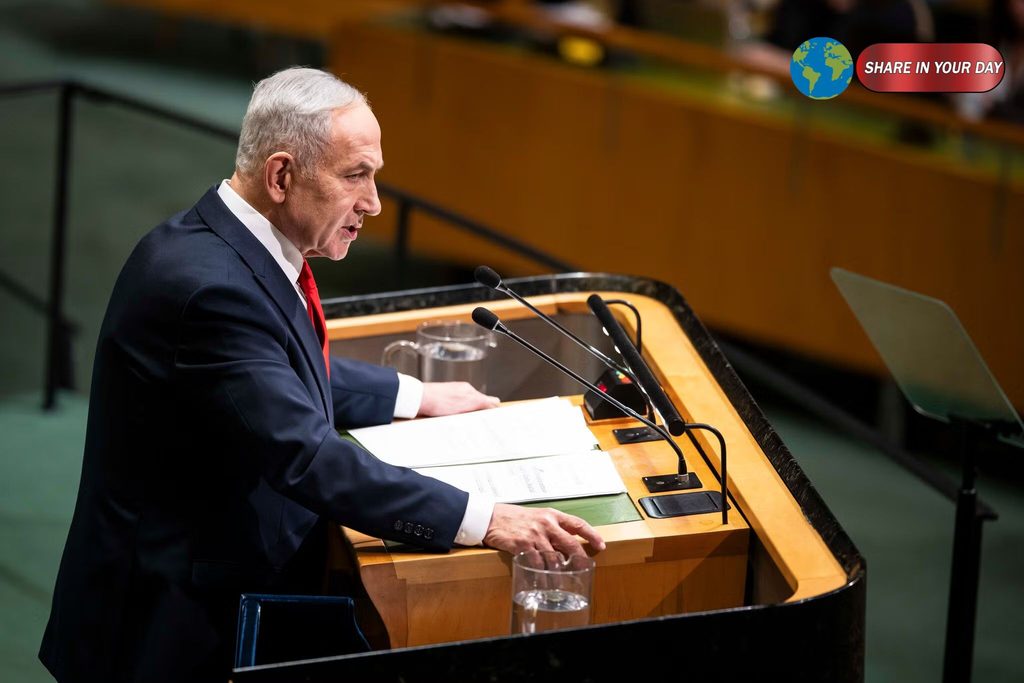
The Israeli prime minister responded to the walkout by accusing those who left of abandoning Israel’s perspective and urged remaining critics to hear his arguments. His address combined attacks on Israel’s opponents with a broad defense of the country’s military actions and its approach to regional security.
Netanyahu Directly Challenges Mamdani
One of the most prominent targets of Netanyahu’s speech was Mamdani, who has repeatedly criticized the Israeli government’s conduct in Gaza and previously described Netanyahu in highly critical terms.
Netanyahu accused the New York mayor of contributing to an atmosphere in which Jewish New Yorkers feel unsafe. He also challenged Mamdani over his past statements and political associations, arguing that the mayor’s criticism of Israel crosses into hostility toward Jews.
Mamdani responded after the speech, rejecting Netanyahu’s characterization and accusing the Israeli leader of using the United Nations platform to repeat what he described as false claims about Israel’s conduct in Gaza.
The dispute reflects a confrontation that has developed beyond national politics. Mamdani, as New York City’s mayor, has been particularly outspoken about Netanyahu’s presence in the city, while Netanyahu has increasingly responded directly to the mayor’s criticism.
Mamdani has previously acknowledged that New York City does not independently have the legal authority to execute an International Criminal Court arrest warrant against Netanyahu. He has instead called on federal authorities to address the warrant.
Delegates Walk Out as Netanyahu Begins
The atmosphere inside the General Assembly was unusually confrontational.
As Netanyahu approached the podium, numerous representatives left the chamber. The walkout reflected the diplomatic divisions surrounding Israel as criticism of its actions in Gaza has intensified.
Netanyahu did not ignore the departure. Instead, he addressed those who remained and presented the walkout as evidence of what he described as an unwillingness to confront Israel’s arguments.
The scene underscored the increasingly polarized international response to the Gaza conflict. Supporters of Israel have emphasized the country’s right to defend itself and the threat posed by Hamas and other armed groups. Critics have focused on Palestinian civilian deaths, humanitarian conditions and allegations concerning Israel’s conduct during the war.
The International Criminal Court issued arrest warrants for Netanyahu and former Israeli Defense Minister Yoav Gallant in November 2024 over alleged war crimes and crimes against humanity. Israel rejects the allegations. Separately, a genocide case brought against Israel at the International Court of Justice remains unresolved.
Defense of Israel’s Military Campaign
Netanyahu devoted significant portions of his address to defending Israel’s military record and rejecting accusations that the country had committed genocide in Gaza.
He argued that Israel’s military campaign was aimed at preventing attacks against its population and portrayed Israeli forces as operating in defense of the country.
The prime minister also highlighted Israel’s confrontation with Iran and other regional armed groups. He credited cooperation with the United States and praised President Donald Trump as an important partner in Israel’s regional strategy.
Netanyahu pointed to military operations against Iran, Hamas and Hezbollah as evidence that Israel had successfully confronted threats that he said endangered its citizens.
His remarks came as the broader Middle East remains deeply affected by conflict and diplomatic tensions. The speech therefore served not only as a defense of Israel’s actions in Gaza but also as an argument for continuing Israel’s military approach toward regional adversaries.
Criticism of Western Allies
Netanyahu also criticized several countries that have traditionally maintained close relationships with Israel.
He accused governments including Britain and France of yielding to political pressure over Israel’s policies. Those governments have increasingly expressed criticism of Israeli actions and have taken steps concerning Israeli settlements in the occupied West Bank.
Netanyahu rejected those positions and argued that Israel should not be pressured into compromising its security.
He also criticized Qatar and Turkey, accusing both countries of supporting or providing platforms to Hamas. Qatar has played a significant role in regional diplomacy and negotiations involving Gaza, while Turkey has maintained close ties with Palestinian representatives and strongly criticized Israel’s military campaign.
Netanyahu’s comments illustrated how disagreements over Gaza have increasingly affected Israel’s relationships with countries that have previously played important diplomatic roles in the region.
Protests Outside the United Nations
The tensions surrounding Netanyahu’s appearance were not limited to the General Assembly chamber.
Hundreds of protesters gathered near the United Nations before and during the speech. Demonstrators called for an end to the war in Gaza and criticized U.S. support for Israel.
The demonstrations included Jewish, Palestinian, Iranian and Lebanese New Yorkers, along with elected officials, political candidates and activists. Police made more than 100 arrests, according to organizers cited by The Guardian, although authorities had not immediately confirmed the exact number.
The protests added another layer to the political dispute involving Netanyahu and Mamdani. The mayor had previously said New Yorkers had a constitutional right to demonstrate, while emphasizing that his administration would not prevent peaceful protests.
A Wider Political Battle
Netanyahu’s appearance at the United Nations came as he faces political pressure at home ahead of Israel’s October 27 election.
That domestic political context has added significance to the tone of his international speeches. His address presented a strong defense of his government’s decisions while portraying Israel as confronting hostile forces and international pressure.
For Mamdani, the confrontation also carries significance because his position on Israel and Gaza has been an important part of his public political profile.
The exchange between the two leaders demonstrates how the Gaza conflict has become intertwined with politics in New York, Washington and other Western cities. Their dispute is likely to remain part of broader debates over Israel, Palestinian statehood, antisemitism, international law and the role of the United States in the Middle East.
Netanyahu left the United Nations after delivering a speech that highlighted the deep divisions surrounding Israel’s war in Gaza. The walkout inside the chamber and protests outside showed that those divisions remain pronounced, while his direct confrontation with Mamdani brought an international conflict into sharp focus in New York City.