Nepal-China Floods: 750 Dead, 3,000 Missing
The Nepal-China floods have left at least 750 people dead and more than 3,000 missing after a catastrophic glacier collapse triggered flash floods and landslides along the Himalayan border. Rescue teams are continuing to search for survivors while authorities warn that further flooding remains possible in some affected areas.
The disaster struck on Wednesday after a large mass of ice, rock and debris collapsed in the Himalayas near the border between Nepal and China’s Tibet region. The resulting surge of water and mud swept through river valleys, villages, roads and hydropower facilities, causing widespread destruction.
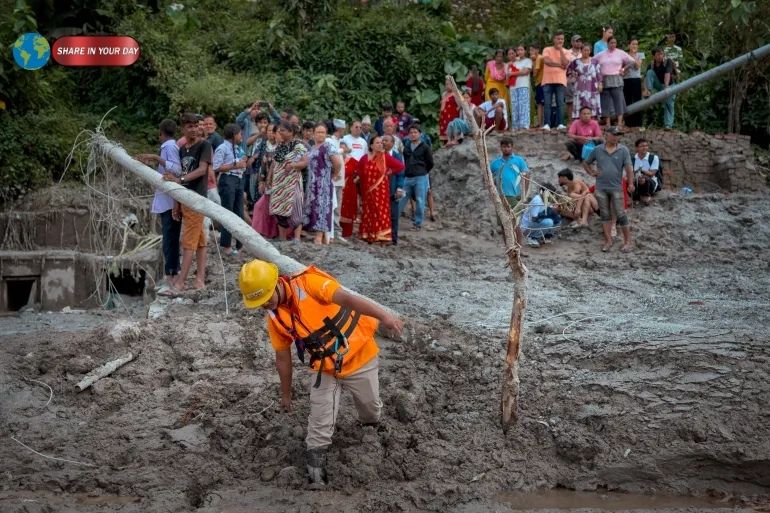
Authorities in Nepal and Tibet are now facing a complex humanitarian emergency. Thousands of people remain unaccounted for, infrastructure has been severely damaged and rescue teams are struggling to reach some of the hardest-hit locations.
Nepal-China Floods Death Toll Continues to Rise
The combined death toll reported by Nepal and Chinese authorities had reached about 750 by Sunday, with 734 deaths recorded in Nepal and 16 in Tibet’s Gyirong County. More than 3,000 people were reported missing across the two sides of the border.
However, casualty figures remain fluid because rescue workers are still reaching isolated communities and recovering bodies from rivers and debris. Authorities have warned that the final death toll could increase significantly as search operations continue.
In Nepal, officials reported 2,498 people missing as of Sunday morning. The missing include Nepali citizens, foreign nationals, members of the security forces and people who were travelling in the affected region.
Bodies have also been carried downstream by powerful floodwaters. Authorities have faced difficulties identifying victims and storing remains because of the scale of the disaster.
The situation has placed considerable pressure on hospitals and temporary morgues. Nepal has begun collecting DNA samples to assist with identification, while unidentified victims are being transferred to facilities capable of preserving remains.
The humanitarian impact is enormous. The International Federation of Red Cross and Red Crescent Societies estimated that about 93,000 people in Nepal had been affected by the disaster.
More Than 900 Hydropower Workers Are Missing
One of the most urgent parts of the rescue operation is the search for hundreds of workers believed to be missing at hydropower projects.
Nepal’s Independent Power Producers’ Association reported that around 933 people were missing or unaccounted for at 11 hydropower projects and tunnel sites in the Rasuwa and Nuwakot districts.
The workers include citizens of Nepal, India, South Korea and China.
Some workers are believed to have been inside tunnels when floodwaters and debris struck. Rescue teams have been working to remove huge quantities of mud and rubble blocking tunnel entrances.
At the Upper Trishuli-1 hydropower project, Nepali soldiers have already rescued hundreds of workers. Authorities said 254 workers had been rescued from the facility.
Other sites remain much more difficult to access.
At the 22-megawatt Chilime Hydropower project in Rasuwa, rescuers have reportedly been unable to enter a tunnel because it is filled with mud. Officials have considered deploying specialist rock-climbing and tunnel-rescue teams.
The situation illustrates the extraordinary difficulties facing rescuers. Heavy machinery is difficult to transport into remote mountain valleys, while unstable slopes, damaged roads and changing weather conditions continue to slow operations.
India has also sent specialists to help. An 11-member team consisting of medical personnel and tunnel-rescue experts reached Nepal to support assessments in the Chilime and Langtang areas.
[Internal link: Latest Nepal disaster and emergency news]
What Caused the Nepal-China Floods?
The disaster began with a glacier collapse high in the Himalayas.
According to reports, a large mass of ice, rock and other material collapsed from a high-altitude area before plunging downward and entering a river system. The debris rapidly accumulated water, mud and rock, creating an extremely powerful flood surge.
The resulting flow moved through the Lende River system and into major waterways in Nepal.
The Trishuli River was among the most severely affected. Earlier reporting indicated that the river rose dramatically within a short period, demonstrating the extraordinary force of the flood.
The disaster also caused landslides and destroyed sections of roads and bridges. Several communities were effectively cut off from outside assistance.
Scientists and disaster experts have increasingly warned about the vulnerability of Himalayan communities to glacier-related hazards. Rising temperatures can destabilize glaciers and increase risks associated with glacial lakes, landslides and sudden floods.
That does not mean every individual flood can be attributed solely to climate change. However, the broader warming trend is a major concern for countries such as Nepal, where settlements, roads, hydropower facilities and tourism routes are often located in narrow mountain valleys.
New Lake Creates Additional Flood Risk
Rescue operations were temporarily interrupted after a new lake formed from debris at the disaster site.
The lake raised concerns that additional water could build up behind unstable material and suddenly escape downstream. Such an event could produce another dangerous flood and put rescuers and nearby communities at risk.
Authorities subsequently determined that the immediate threat was manageable and allowed rescue operations to resume. Nevertheless, officials have continued monitoring water levels and river conditions.
Fresh rainfall has added another layer of uncertainty.
On Sunday, authorities warned residents after water levels in the Bhotekoshi River increased. Flood alerts were sent to mobile phones, while people in vulnerable locations were urged to remain cautious and move away from dangerous riverbanks.
The possibility of additional flooding is particularly concerning because many roads and bridges have already been destroyed.
Rescue Teams Face Difficult Mountain Conditions
The Nepal-China floods have created a rescue operation unlike a conventional flood response.
Mountain terrain is making access difficult. In several areas, roads have been washed away or covered by landslides. Bridges have also collapsed, leaving some communities isolated.
Nepal has deployed thousands of soldiers and police personnel to search for survivors, evacuate residents and deliver emergency assistance.
The country’s military and police have been involved in helicopter evacuations, debris clearance and searches around damaged infrastructure.
But rescuers are working against time.
People trapped in tunnels may have limited access to air, water and food. Meanwhile, unstable slopes and continuing rainfall can create additional dangers for rescue workers.
The government has therefore sought specialist assistance from neighboring countries, including India and China.
China has mobilized about 2,100 rescue personnel and allocated more than 220 million yuan, or roughly $32.7 million, for relief operations. Heavy-lift drones and helicopters have also been used to transport equipment and supplies in difficult terrain.
International organizations and governments, including the United Nations, Red Cross, Australia, India, South Korea and the United States, have also offered assistance.
Foreign Nationals Among the Missing
The disaster has affected people from numerous countries.
Chinese authorities said 261 foreign nationals from 23 countries were missing on the Tibetan side of the disaster zone. Those reported missing include citizens of Nepal, India, the United States, the United Kingdom, Canada, Australia and several European countries.
Nepal has also reported hundreds of foreign nationals among its missing.
The large international presence reflects the importance of the Himalayan border region for trade, tourism, pilgrimage, construction and hydropower development.
Families in Nepal and abroad are now waiting for information about relatives who were in the affected areas when the disaster struck.
The identification of victims is another major challenge. Many bodies have been badly damaged by floodwaters and debris, making visual identification difficult.
Authorities have begun collecting DNA samples in an effort to help families establish what happened to missing relatives. Reuters reported that Nepal had also begun mass burials of unidentified victims as authorities struggled with the number of bodies requiring preservation and identification.
Damage to Roads, Bridges and Hydropower
The human cost of the disaster has been accompanied by enormous damage to infrastructure.
Roads connecting Kathmandu with northern districts have been disrupted. Bridges have been swept away or damaged, while hydropower facilities have been inundated by mud and debris.
The destruction has complicated not only rescue operations but also the delivery of food, medicine, fuel and other essential supplies.
Nepal’s finance minister has estimated that the economic losses could exceed $4 billion, according to Al Jazeera’s reporting.
For a country heavily dependent on tourism, hydropower, transport infrastructure and remittances, the disaster could have consequences well beyond the immediate emergency.
Rebuilding damaged roads and bridges could take months or even years in some remote mountain areas.
International Aid Begins to Arrive
As Nepal struggles to manage the disaster, international support is increasing.
The United States and Canada have each announced about $3.6 million in humanitarian assistance, while the United Kingdom has pledged about $6.8 million.
The United Nations has released $2.5 million in emergency funding. The European Union has also announced humanitarian support, while the International Federation of Red Cross and Red Crescent Societies has allocated emergency funds and launched a larger appeal.
The immediate priorities include rescuing survivors, providing shelter, supplying food and clean water, treating injured people and supporting families searching for missing relatives.
Specialized equipment is also urgently needed.
Nepal has sought items including heavy-lift drones, DNA testing equipment and body-freezer units. These resources could help authorities manage both the rescue and identification phases of the emergency.
Climate Risks Raise Broader Questions
The scale of the Nepal-China floods has renewed attention on the risks facing communities across the Himalayan region.
The Himalayas contain extensive glaciers and high-altitude lakes. As temperatures rise, scientists have warned that changes in the cryosphere can increase hazards from unstable ice, rockfalls, landslides and glacial lakes.
Nepal is particularly exposed because many communities and major infrastructure projects are concentrated in narrow valleys below steep mountain slopes.
Hydropower is a crucial part of Nepal’s development strategy, but projects located in mountainous river systems can face serious risks from extreme floods and landslides.
The latest disaster is therefore likely to prompt renewed discussion about early-warning systems, glacier monitoring, disaster preparedness and the location of critical infrastructure.
Better monitoring cannot prevent every natural disaster. It can, however, give communities more time to evacuate when dangerous conditions develop.
What Happens Next?
The immediate priority remains the search for survivors.
Rescue teams are expected to continue clearing debris, examining damaged tunnels and searching river valleys for missing people. Authorities must also maintain flood warnings because further rainfall could destabilize slopes or increase river levels.
At the same time, Nepal faces the difficult transition from emergency rescue to humanitarian relief and reconstruction.
Thousands of people need shelter, food, medical care and access to basic services. Roads must eventually be repaired, damaged bridges reconstructed and power infrastructure restored.
Families of missing people will also need reliable information as authorities work through the enormous task of identifying recovered bodies.
The coming days will be critical.
The death toll is still expected to change as rescuers reach areas that remain inaccessible. The number of missing people could also change as survivors are located and authorities reconcile lists from villages, workplaces and government agencies.
For now, the disaster remains one of the most serious emergencies to hit the Himalayan border region in recent years.
The Nepal-China floods have demonstrated how quickly a glacier collapse, landslide and flash flood can turn into a cross-border humanitarian catastrophe. With thousands still missing and rescue teams facing difficult terrain and unstable weather, the focus remains firmly on finding survivors and preventing further loss of life.
Sources
- Al Jazeera — Nepal-China flood disaster: latest toll and missing people
- Reuters — Rescuers race to find thousands missing after Nepal-China glacier collapse
- Associated Press — Nepal warns of possible fresh flooding
Internal Link Suggestions
- [Internal link] Nepal flood latest updates
- [Internal link] Nepal disaster and emergency news
- [Internal link] Climate change and Himalayan glaciers
- [Internal link] Latest international news