Xi Jinping Trump Summit: 5 Big Moves Ahead
The Xi Jinping Trump summit is emerging as one of the most closely watched diplomatic events on the international calendar, but Chinese President Xi Jinping is not approaching the expected meeting with U.S. President Donald Trump from a standing start.
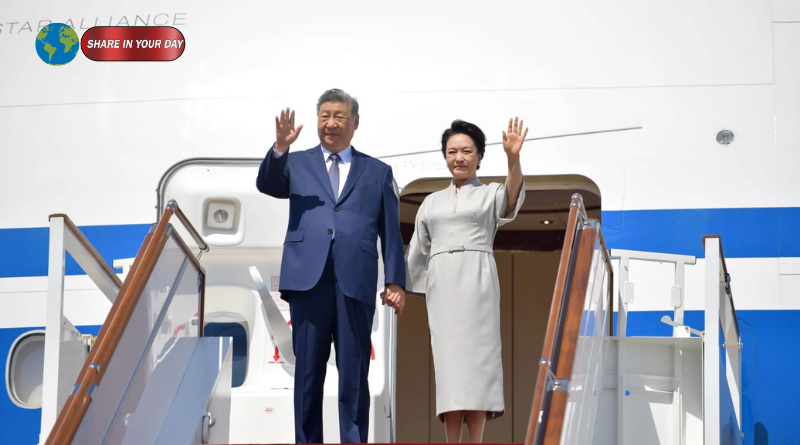
Instead, Beijing is using a busy diplomatic schedule to strengthen relationships across Asia and the wider Global South before Xi potentially sits down with Trump in Washington later this year.
Xi arrived in Bishkek, Kyrgyzstan, for the Shanghai Cooperation Organisation summit as part of a broader international tour. He is also scheduled to visit Egypt and is widely expected to attend the 2026 BRICS summit in New Delhi before a possible meeting with Trump in the United States.
The sequence is significant.
China is seeking to demonstrate that its international influence extends well beyond its relationship with Washington. At the same time, Xi’s diplomatic activity comes as relations between China and India show signs of improvement after years of tension and as the SCO and BRICS seek to strengthen their roles in an increasingly fragmented global system.
Xi Jinping Trump Summit Comes After Major Diplomatic Push
For Xi, the timing of his foreign travel is particularly notable.
Reuters reported that Xi’s visit to Kyrgyzstan and Egypt represents an unusually active period of overseas diplomacy for the Chinese leader. He is expected to participate in the SCO summit in Bishkek and then travel to Egypt for talks with President Abdel Fattah al-Sisi.
The expected trip to India would add another important stop.
Xi is expected to attend the BRICS summit in New Delhi on September 12-13, according to multiple reports. If confirmed, it would mark his first visit to India in seven years. Reuters has reported that China is expected to send a large delegation, highlighting the importance Beijing attaches to the meeting.
That means Xi could arrive at a future meeting with Trump after engaging with several major powers and emerging economies.
The message is straightforward: China has options.
1. China Wants Stronger Ties With India
One of the most important elements of Xi’s diplomatic schedule is his potential engagement with Indian Prime Minister Narendra Modi.
Relations between China and India deteriorated sharply after deadly border clashes in 2020. The two countries subsequently spent years attempting to stabilize their relationship and reduce military tensions along their disputed Himalayan border.
However, diplomatic contacts have increased.
Carnegie Endowment analysis published in July said high-level political engagement between Beijing and New Delhi had resumed after the relationship reached one of its lowest points in decades. Officials from both countries have held discussions covering the border dispute and other bilateral issues.
Xi’s expected participation in the BRICS summit could therefore provide an important opportunity for further engagement.
A direct meeting between Xi and Modi would attract enormous attention, although reports differ over whether a formal bilateral meeting is scheduled during the current SCO gathering in Bishkek.
For China, improved relations with India could reduce strategic pressure on its western border while expanding economic and diplomatic cooperation.
For India, closer engagement with China does not necessarily mean abandoning its relationship with the United States.
Instead, New Delhi has increasingly emphasized strategic autonomy.
That makes India an especially important player in the emerging competition between Washington and Beijing.
2. BRICS Could Give Xi More Diplomatic Leverage
The upcoming BRICS summit in New Delhi could be another major stage for China’s diplomatic strategy.
BRICS has expanded considerably from its original group of Brazil, Russia, India, China and South Africa. Its expanded membership gives the organization greater economic and demographic weight, while its discussions increasingly focus on trade, finance, development and global governance.
India’s hosting of the 2026 summit gives Modi a central role.
Xi’s expected attendance would place the Chinese leader alongside Modi and Russian President Vladimir Putin at a highly symbolic gathering.
Reports indicate Putin is also expected to attend the New Delhi summit.
That creates an unusual diplomatic sequence.
Xi, Putin and Modi are appearing together at the SCO summit in Bishkek and are expected to meet again at BRICS in New Delhi.
The symbolism matters even if the three countries do not share identical interests.
India maintains close relations with Russia but also has deep economic and strategic ties with the United States. China remains a competitor to India in Asia. Russia, meanwhile, has become increasingly dependent on China as its relationship with Western countries has deteriorated.
BRICS therefore provides a platform where countries can cooperate without necessarily forming a formal alliance.
That distinction is important.
3. The SCO Is Becoming More Important
The Shanghai Cooperation Organisation is another major part of Xi’s diplomatic strategy.
Founded in 2001, the SCO has expanded beyond its original China-Russia-Central Asia framework. India and Pakistan joined as full members in 2017, Iran joined in 2023 and Belarus became a member in 2024. The organization now includes 10 member states.
The current summit in Bishkek also comes at a particularly sensitive geopolitical moment.
Xi, Putin, Iranian President Masoud Pezeshkian and Modi are among the leaders attending.
The gathering is taking place against the backdrop of major international conflicts and growing pressure on countries aligned with Iran and Russia.
For Beijing and Moscow, the SCO offers a way to demonstrate that the international system is not exclusively controlled by Western institutions.
The organization represents more than 40% of the world’s population and roughly one-quarter of global GDP, according to World Bank-based figures cited in recent reporting.
Yet the SCO has significant limitations.
It does not operate like NATO, and its members have very different foreign-policy priorities.
India and China remain strategic competitors. India and Pakistan have their own long-running disputes. Central Asian countries seek to maintain relationships with Russia, China, Europe and the United States simultaneously.
Consequently, the SCO’s growing size does not automatically translate into unified geopolitical action.
4. Xi Is Building Position Before Meeting Trump
This may ultimately be the most important part of Xi’s schedule.
A future Xi Jinping Trump summit would inevitably focus on the U.S.-China relationship.
Trade, tariffs, technology, investment, supply chains and strategic competition are all likely to remain major issues.
But Xi’s diplomatic tour suggests Beijing does not want its relationship with Washington to define China’s entire foreign policy.
Instead, China is strengthening ties with multiple countries before entering another high-level dialogue with Trump.
That can give Beijing additional diplomatic leverage.
A Chinese leader who arrives in Washington after attending the SCO summit, visiting Egypt and participating in BRICS is presenting a different image from a leader whose international agenda revolves primarily around U.S. relations.
It reinforces China’s argument that the global system is becoming more multipolar.
Recent analysis has described Xi’s increased diplomatic activity as a significant gauge of Beijing’s priorities after a period in which the Chinese leader sharply reduced overseas travel.
That makes the coming weeks particularly important.
5. Trump Still Has Significant Leverage
Despite China’s diplomatic momentum, Washington remains extremely important to Beijing.
The United States is one of China’s most important economic relationships, and any improvement or deterioration in bilateral ties can have consequences for global markets.
A Trump-Xi meeting could therefore become a crucial moment for both countries.
Trump has demonstrated a willingness to use tariffs and economic pressure as negotiating tools. China, meanwhile, has its own economic leverage and has increasingly emphasized trade relationships outside the United States.
That creates a complicated negotiating environment.
Neither side can easily ignore the other.
At the same time, both governments have incentives to prevent competition from escalating into an uncontrolled economic confrontation.
This is why Xi’s diplomatic activity before a potential meeting with Trump matters.
Beijing can pursue engagement with Washington while simultaneously deepening relationships elsewhere.
China and India Are Central to the Equation
India may ultimately be one of the most important countries in this diplomatic equation.
New Delhi is increasingly positioned between competing global power centers.
India works with the United States through strategic partnerships, including cooperation in technology, defense and the Indo-Pacific. Yet it maintains longstanding relationships with Russia and has major economic ties with China.
Modi’s participation in the SCO and expected BRICS summit therefore reflects India’s broader strategy of maintaining room to maneuver.
Recent reporting says Modi is expected to hold bilateral meetings with Putin and Iranian President Pezeshkian during the SCO summit.
India’s approach is not simply about choosing Washington or Beijing.
Instead, New Delhi appears focused on maximizing its strategic options.
That could make Modi an especially important figure during Xi’s diplomatic push.
What the SCO and BRICS Can — and Cannot — Do
It would be easy to interpret the SCO and BRICS gatherings as evidence of a new anti-U.S. alliance.
The reality is more complicated.
The organizations include countries with conflicting interests and different economic systems.
India, for example, has no interest in becoming subordinate to China. Central Asian states similarly seek to preserve their independence. Even Russia and China do not have identical strategic objectives.
As a result, the emerging international system is better described as increasingly multipolar than as a simple division between two opposing blocs.
Recent analysis of the SCO summit has highlighted the organization’s ambition to challenge Western dominance while also noting its internal divisions and limited ability to produce unified action.
That distinction could become crucial during future negotiations between Xi and Trump.
A New Diplomatic Chessboard
The coming weeks could therefore reveal much about the direction of global politics.
Xi’s travel schedule connects several important diplomatic arenas: the SCO, BRICS, China-India relations, China-Russia cooperation and the eventual U.S.-China dialogue.
Each has a different purpose.
The SCO emphasizes security and regional cooperation.
BRICS focuses heavily on economic and political cooperation among emerging powers.
China’s relationship with India affects Asian stability and trade.
And the United States remains China’s most consequential strategic competitor.
Taken together, these relationships form a complex diplomatic network.
For Xi, the objective is not necessarily to create a single alliance against Washington. Rather, it is to ensure that China has strong relationships across multiple regions and institutions.
What to Watch Before the Xi Jinping Trump Summit
Several developments could shape the eventual meeting between Xi and Trump.
First, watch Xi’s engagement with Modi. A productive China-India dialogue could signal that Beijing and New Delhi are continuing to stabilize their relationship.
Second, watch BRICS. Decisions involving trade, finance and economic cooperation could demonstrate how much influence the expanded group can exercise.
Third, watch the SCO. The organization’s response to regional conflicts will provide a useful test of whether its growing membership translates into meaningful collective action.
Fourth, watch Washington and Beijing. Any new tariff, trade or technology restrictions could make the eventual Trump-Xi meeting more difficult.
Finally, watch the language from both leaders. Diplomatic statements can reveal whether the two sides are moving toward confrontation, managed competition or a limited reset.
Conclusion
The Xi Jinping Trump summit may eventually become the headline event, but Xi’s diplomatic strategy is already unfolding.
His appearance at the SCO summit, expected participation in BRICS in India and planned engagement with other major governments indicate that Beijing is seeking to strengthen its international position before another high-stakes encounter with Washington.
The strategy also highlights the growing importance of India.
Modi is balancing relationships with China, Russia, the United States and other major powers while positioning India as an increasingly influential voice in the Global South.
For Xi, meanwhile, the message is that China can pursue multiple diplomatic partnerships at the same time.
The coming weeks will show whether that strategy produces greater leverage for Beijing or exposes the limits of cooperation among countries with very different interests.
Either way, the diplomatic calendar leading toward a potential Trump-Xi meeting could prove just as important as the summit itself.