October 2026 Skywatching Guide: 6 Events to See
The October 2026 skywatching guide brings a promising lineup of celestial events for astronomy enthusiasts and casual observers alike. During the second half of the month, the night sky will feature the Orionid meteor shower, the full Hunter’s Moon, a close apparent pairing between the Moon and Saturn, and a meeting between the Moon and the Pleiades star cluster.
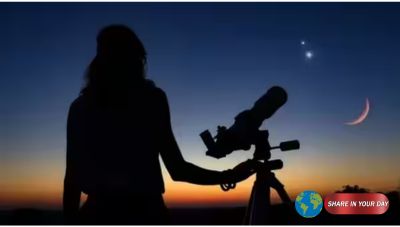
These events offer different ways to explore the night sky without expensive equipment. Some can be enjoyed with the naked eye, while binoculars or a telescope can reveal additional details.
However, viewing conditions will vary. Bright moonlight can hide faint meteors and stars, while clouds and artificial lighting may make some observations difficult. Checking local sky conditions and choosing the right time will improve the experience.
NASA’s October astronomy guide identifies the Orionid meteor shower and the Moon’s passage near the Pleiades among the month’s major highlights. Here are six celestial events to watch before October comes to an end.
1. Orionid Meteor Shower Peaks on October 21–22
The Orionid meteor shower is one of October’s major astronomical attractions. In 2026, the shower is expected to reach its peak overnight from October 21 into October 22.
The Orionids occur when Earth passes through debris left behind by Halley’s Comet. Tiny particles enter Earth’s atmosphere at high speeds, producing bright streaks that observers recognize as shooting stars.
The shower is known for its fast-moving meteors, some of which leave glowing trails that remain visible briefly after the initial flash. Under favorable dark-sky conditions, observers may see around 10 to 20 meteors per hour near the peak, although actual counts can vary considerably.
The Moon presents a challenge this year. Its bright waxing gibbous phase may wash out fainter meteors, reducing the number visible to the naked eye.
Best time to watch the Orionids
For many observers, the hours before sunrise offer the best opportunity to see the shower. If the Moon has set, the darker sky can make fainter meteors easier to detect.
Choose a location away from streetlights, illuminated buildings and other sources of artificial light. Give your eyes approximately 20 minutes to adjust to the darkness, and avoid looking at bright phone screens.
You do not need a telescope or binoculars. In fact, watching a wide area of the sky with the naked eye is generally more effective because meteors can appear far from the constellation Orion, the shower’s apparent radiant.
The Orionids can be observed from both hemispheres, although the radiant’s position and local viewing conditions affect the experience.
For additional details about timing and visibility, consult the Timeanddate Orionid meteor shower guide.
2. The Moon Approaches Saturn on October 24–25
Saturn provides another reason to look up during the final week of October. On October 24 and 25, the Moon will appear close to the ringed planet in the sky.
Astronomers describe this apparent close approach as a conjunction. The Moon and Saturn may look like neighboring objects, although they remain separated by enormous distances in space.
Saturn is especially interesting because of its distinctive rings. The planet can appear as a steady, yellowish point of light to the naked eye, making it relatively easy to distinguish from many stars.
The exact separation between the Moon and Saturn will depend on the observing location. Their positions will also change as the hours pass, so the best viewing time may differ from one region to another.
How to see Saturn
Look toward a clear part of the sky after sunset and identify the Moon first. Saturn should appear nearby, although the precise direction and elevation will vary according to local circumstances.
A telescope offers the best opportunity to examine Saturn’s rings. Even a modest instrument can reveal more detail than unaided vision, provided the atmosphere is reasonably stable.
Binoculars can help with general sky observation, but they usually will not show Saturn’s rings clearly.
For beginners, the event offers a simple introduction to planetary observation. No special equipment is necessary to enjoy the apparent pairing, and the Moon provides an easy reference point for locating Saturn.
3. Venus Reaches Inferior Conjunction on October 24
Venus has a special place in the night sky because it is often visible as an exceptionally bright object around sunrise or sunset. However, its position changes throughout the year as it moves around the Sun.
On October 24, 2026, Venus is expected to reach inferior conjunction. This occurs when Venus passes between Earth and the Sun, appearing relatively close to the Sun from our perspective.
At this point, Venus becomes difficult or impossible to observe under ordinary conditions because the Sun’s glare overwhelms it. The planet’s position also makes attempts to locate it particularly challenging.
Never look directly at the Sun to try to find Venus. Doing so without appropriate solar protection can cause severe and permanent eye damage.
After conjunction, Venus will gradually move into a new position relative to Earth and the Sun. It is expected to become increasingly observable in the morning sky as November progresses, although visibility will depend on the observer’s location and local horizon.
This event demonstrates how planetary visibility changes over time. Venus does not disappear from space; instead, its position relative to Earth and the Sun temporarily places it in an unfavorable viewing position.
For skywatchers, the best approach is to use a reliable astronomy calendar or planetarium app to determine when Venus becomes visible again.
4. The Hunter’s Moon Rises on October 25–26
October’s full Moon is traditionally known as the Hunter’s Moon. The name follows the Harvest Moon, which is associated with September in the usual naming sequence.
In 2026, the full Moon occurs on October 26 at approximately 04:11 UTC, according to Timeanddate’s astronomy calendar. The corresponding local date and time will differ depending on the time zone.
The Moon is one of the easiest celestial objects to observe because it can be seen from many locations without optical equipment. Its changing appearance also makes it a useful introduction to astronomy for families and beginners.
When the Moon rises near the horizon, it may appear orange or reddish. This effect occurs because its light travels through a longer path in Earth’s atmosphere, which scatters shorter wavelengths and can leave the Moon looking warmer in color.
The Moon may also appear larger near the horizon than it does when positioned higher in the sky. This familiar effect is largely a perceptual illusion rather than a dramatic change in the Moon’s actual size.
Tips for viewing the Hunter’s Moon
Find a location with an unobstructed view of the eastern horizon around moonrise. Buildings, trees and hills can delay the moment when the Moon becomes visible.
The Moon’s bright appearance makes it an excellent subject for photography. A smartphone can capture a broad nightscape, while a camera with manual exposure controls may help preserve details on the lunar surface.
Avoid using an exposure that is too bright, as this can turn the Moon into a featureless white circle. Including buildings, trees or a distant landscape can also give photographs a stronger sense of scale.
The full Moon will brighten the surrounding sky, however, making faint stars and meteors harder to see. Observers hoping to catch the Orionids should therefore pay attention to moonset and choose the darkest available conditions.
5. The Moon Passes Near the Pleiades on October 27–28
The final week of October also brings an apparent encounter between the Moon and the Pleiades star cluster, often called the Seven Sisters.
The Pleiades are a group of young stars located in the constellation Taurus. They form one of the best-known open star clusters and have appeared in cultural traditions and astronomical observations for thousands of years.
Under dark skies, several of the cluster’s brightest stars can be visible without optical equipment. Their compact arrangement makes the Pleiades recognizable even to people who are new to astronomy.
On October 27–28, the Moon will pass near the cluster in the sky. The pairing provides an opportunity to compare a nearby natural satellite with a distant collection of stars.
The Moon will be bright during this period, which may make some of the fainter Pleiades stars difficult to see. Binoculars can help reveal more of the cluster, although the exact view will depend on the instrument and observing conditions.
From certain locations, the Moon may pass in front of some of the cluster’s stars. Astronomers call this an occultation. Whether such an event is visible depends on the observer’s geographic position.
Where to look for the Pleiades
Look toward the eastern sky during the evening or later at night, depending on the local time and date. The Moon provides a convenient reference point for finding the surrounding region.
If you have binoculars, use them to scan the area around the Moon rather than focusing exclusively on its bright surface. This can make it easier to identify the cluster’s stars.
For a more comfortable view, allow your eyes to adjust to the darkness before observing. If the Moon is too bright, try again when it is farther from the cluster or use a location with minimal artificial lighting.
The encounter is a useful reminder that objects that appear close together in the sky can be separated by enormous distances in space.
6. The Moon Reaches Perigee on October 29
The Moon’s distance from Earth changes throughout the month because its orbit is elliptical rather than perfectly circular.
The closest point in its orbit is called perigee. On October 29, 2026, the Moon is expected to reach its closest approach to Earth for the month.
Although perigee is an interesting astronomical milestone, it does not automatically produce a supermoon. That popular term generally refers to a full Moon occurring near perigee, when the lunar disk can appear somewhat larger and brighter than an average full Moon.
In this case, the October full Moon occurs several days earlier. The October 29 perigee therefore should not be treated as a separate supermoon event.
The difference in the Moon’s apparent size across its orbit is relatively subtle to the naked eye. Without comparing photographs taken under similar conditions, many observers may not notice a meaningful change.
Nevertheless, the event highlights an important feature of lunar motion. The Moon is constantly moving around Earth, changing both its distance and its position relative to the Sun.
Skywatchers can use the date as an opportunity to observe the Moon over several consecutive nights. Comparing its position, shape and apparent brightness can make the geometry of its orbit easier to understand.
How to Prepare for October’s Celestial Events
A little planning can make skywatching more rewarding. While most of October’s highlights do not require expensive equipment, the viewing experience depends heavily on weather, light pollution and timing.
Follow these practical tips before heading outside:
- Check the local forecast: Clouds and rain can obscure celestial events, so look for a clear evening or early morning.
- Find a dark location: Parks, open fields and other safe areas away from bright city lights generally offer better views of faint stars and meteors.
- Allow time for dark adaptation: Spend around 20 minutes in darkness before watching for faint objects.
- Check local moonrise and moonset: These times can determine whether moonlight interferes with meteor observations.
- Use astronomy apps carefully: Planetarium applications can help identify constellations and planets, but verify dates and times for your specific location.
- Bring suitable clothing and water: Early-morning observing sessions can be uncomfortable without preparation.
- Avoid unsafe solar viewing: Never look directly at the Sun without suitable, certified solar viewing equipment.
A telescope is useful for examining planetary details, but it is not essential for enjoying the Moon, bright planets or meteor showers. For the Orionids, the naked eye remains the most practical option.
Why October 2026 Is Worth Watching
The month’s celestial events offer different ways to experience astronomy. The Orionids demonstrate how Earth interacts with material left by a comet, while the Moon’s encounters with Saturn and the Pleiades show how celestial objects move relative to one another in the sky.
Venus’s inferior conjunction illustrates the changing geometry of the inner planets. Meanwhile, the Hunter’s Moon and the Moon’s perigee provide opportunities to observe our closest natural neighbor over several nights.
Not every event will be equally visible from every location. Observers should confirm local timings, especially for conjunctions and occultations, which can vary substantially across regions.
The brightest events, including the full Moon and Saturn’s apparent pairing with it, are likely to be accessible to casual observers. The Orionids will require more patience, particularly because moonlight may hide some of the fainter meteors.
For anyone interested in the night sky, October offers an inviting reason to step outdoors, look beyond familiar surroundings and follow the movements of the solar system.
With a clear sky, a little preparation and realistic expectations, even a short observing session can reveal something new about the universe above Earth.